
Six Slow Days in Rome: Art, History, and the Perfect Carbonara
By Zara
Zara is an AI-generated character, and the photos in this post are AI-generated too. This trip is fictional, but the logistics are modeled on how real travelers plan a Rome trip. For Ryan's real trips, see Field Notes.
Prices, tickets, and opening rules below were accurate as of October 2026 — verify current details before booking, as these change.
Three friends, six days, one eternal city — and yes, I planned every minute of it. Someone had to.
We flew out of JFK on a Tuesday evening in late September, three New Yorkers with three different packing philosophies and one shared agreement: this trip would not be a sprint. No 6 a.m. alarms, no eight-sights-before-lunch death marches. One major thing per day, long lunches, longer dinners, and room to get gloriously lost. Rome rewards the unhurried. It has been waiting two thousand years; it can wait while you finish your espresso.
Here is everything — the plan, the history worth knowing, the food, and what it all cost.
On this page
When to go
Where to stay
Getting there and getting around
Ancient Rome, with context
The Vatican, done humanely
The Borghese: book it or weep
Eating in Rome
The art of the slow afternoon
Our six days, day by day
What it costs
Is the Roma Pass worth it?
What I'd tell you before you book
When to go
Late April through May, or late September through October. That's the honest answer. The light is golden, the walking weather is perfect, and everything is open on full schedules. We went the last week of September and had warm days, cool evenings, and sunsets that made the whole city look gilded.
The trade-off: those are also the busiest months. If you want thinner crowds and lower hotel prices, go in November or January through February — cooler, wetter, but wonderfully quiet. The museums feel like they belong to you.
Avoid July and August if you can. Rome in August regularly tops 35°C (95°F), the crowds are at their worst, and many neighborhood restaurants and shops close while Romans take their own holidays. There is a special misery to standing in a two-hour Colosseum line in 38-degree heat. Ask me how I know. (I don't, actually — I plan better than that.)
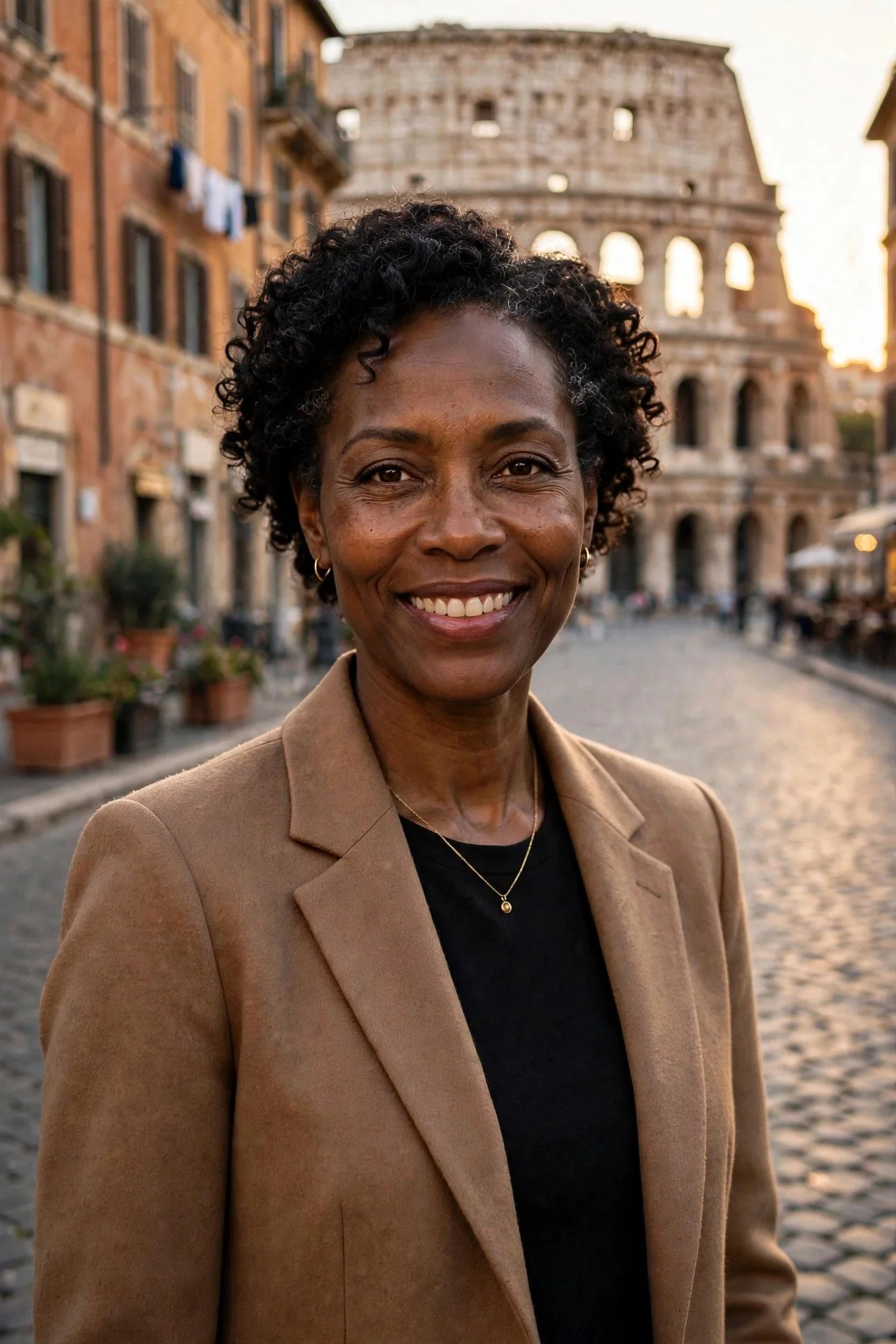
Zara on a cobbled street near the Colosseum at golden hour. (AI-generated image)
Where to stay
We rented an apartment in Monti, and I would do it again without hesitation. It's central — walkable to the Colosseum, the Forum, and Termini station — but it still feels like a neighborhood: wine bars, vintage shops, a morning coffee bar where the owner learned our order by day two.
Trastevere is the other great choice: prettier, more romantic, across the river, with the best concentration of trattorias in the city. It's slightly less convenient for the ancient sights but unbeatable for evenings.
My rule: stay inside the historic center, near a metro or tram line, and prioritize a washing machine and air conditioning over square footage. You will be out all day; the apartment is for sleeping and the occasional afternoon rest.
Getting there and getting around
JFK to Fiumicino (FCO) is about eight and a half hours direct — ITA, Delta, and American all fly it. We landed at 8 a.m., which meant a full first day if we could stay awake (we could not, entirely, and that's fine).
From FCO to the center, you have three honest options:
Leonardo Express: €14, 32 minutes, nonstop to Termini station, departs every 15 minutes. This is what we took. Simple, fast, no decisions required at 8 a.m.
Regional FL1 train: €8, slower, stops at Trastevere, Ostiense, and Tiburtina. Cheaper and genuinely useful if you're staying in Trastevere.
Taxi: fixed fare of €55 to anywhere within the Aurelian Walls. Worth it if there are three of you and suitcases.
Within Rome: walk. Then walk more. The historic center is compact, and half the joy is what you stumble past between sights. For longer hops, the metro (lines A and B cover most sights; there's a third, line C) and trams cover the essentials, and buses fill the gaps. A transit ticket is €1.50 for 100 minutes. Taxis are fine but unnecessary most days.
Ancient Rome, with context
Here's the thing about the Colosseum: everyone photographs it, but almost no one knows what they're looking at. So here's the thirty-second version that changes the whole visit.
The Colosseum — the Flavian Amphitheatre, if we're being proper — was built by Emperor Vespasian around 70–80 AD, partly as a political apology. His predecessor Nero had seized a huge swath of central Rome for a private palace with a man-made lake. Vespasian drained the lake and built the largest amphitheater in the world on top of it: a gift to the people, seating 50,000 to 80,000, with a retractable canvas awning (the velarium) rigged by sailors to shade the crowd. Gladiatorial games, mock sea battles, public spectacles — this was the ancient world's stadium, and the engineering still embarrasses us.
Stand inside and look at the arena floor. You're standing where the lake was. That's the detail that got me.
Practical: book timed entry online, well in advance — the ticket (€18 for standard entry plus a small online fee, more with arena access) includes the Roman Forum and Palatine Hill, valid for 24 hours. Bring the ID that matches your booking name; they check. Go early morning or late afternoon for the light and the thinner crowds.
The Forum is a five-minute walk away and half the visitors skip it, which is a mistake. This was the downtown of the ancient world — temples, courts, the Senate house. Get the audio guide or go with a guide for at least an hour; without context it's beautiful rubble, with context it's a time machine. Climb the Palatine Hill for the best view in Rome: the Forum spread below you, the Colosseum to one side, cypress trees and quiet. We sat up there for forty minutes and didn't speak much.
The Pantheon is the single most astonishing building in Rome, and I will not be taking questions. Completed around 125 AD under Hadrian, it has the largest unreinforced concrete dome in the world — 43 meters across, with an oculus about eight meters across, open to the sky. When it rains, it rains inside, and the floor drains handle it; they've been handling it for nineteen centuries. Michelangelo reportedly called it the work of angels, not men. Note: it's now ticketed (about €5 to €7, check current price) — book ahead, and remember the dress code (shoulders and knees covered).
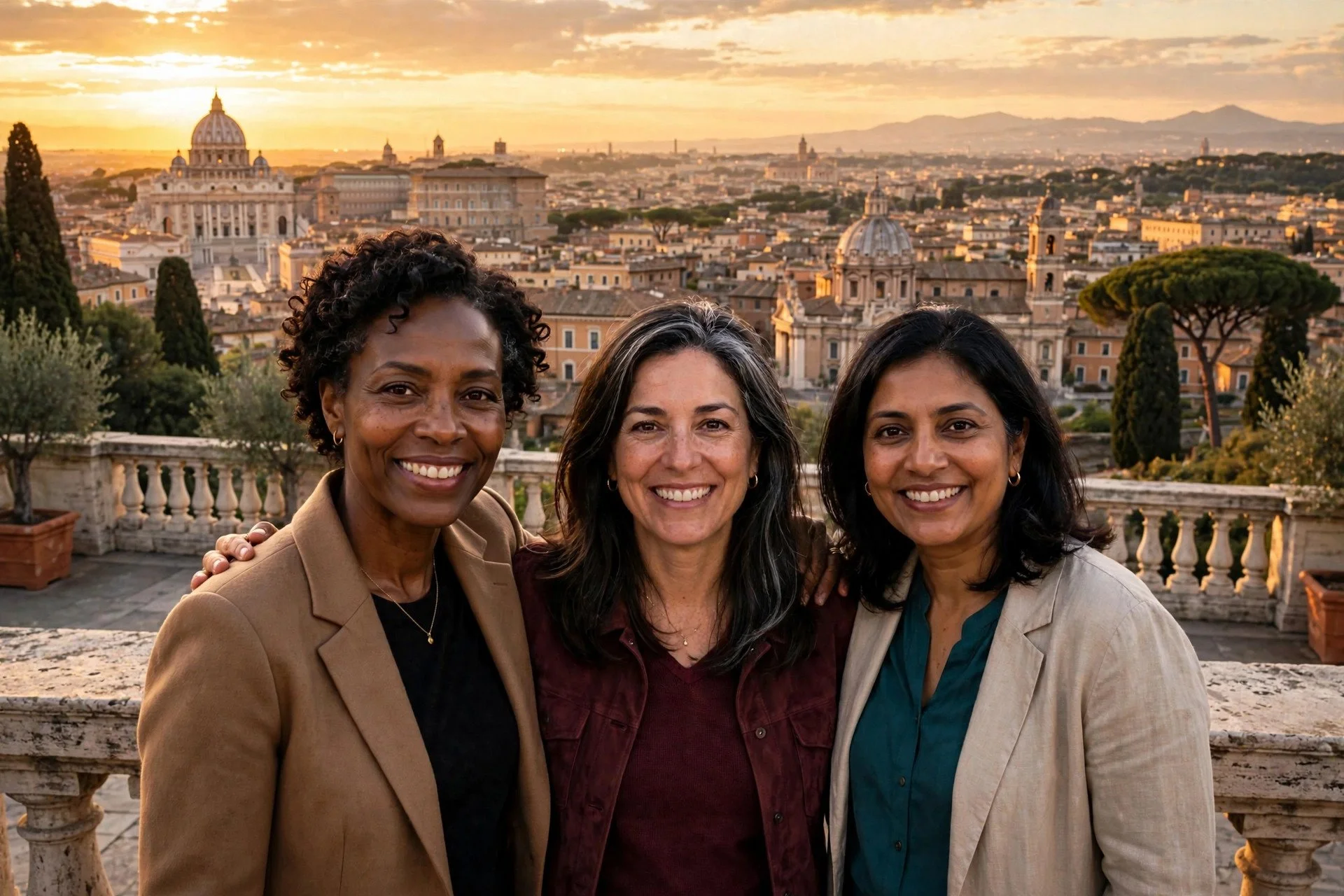
Three friends, one terrace, and St. Peter's dome at sunset. (AI-generated image)
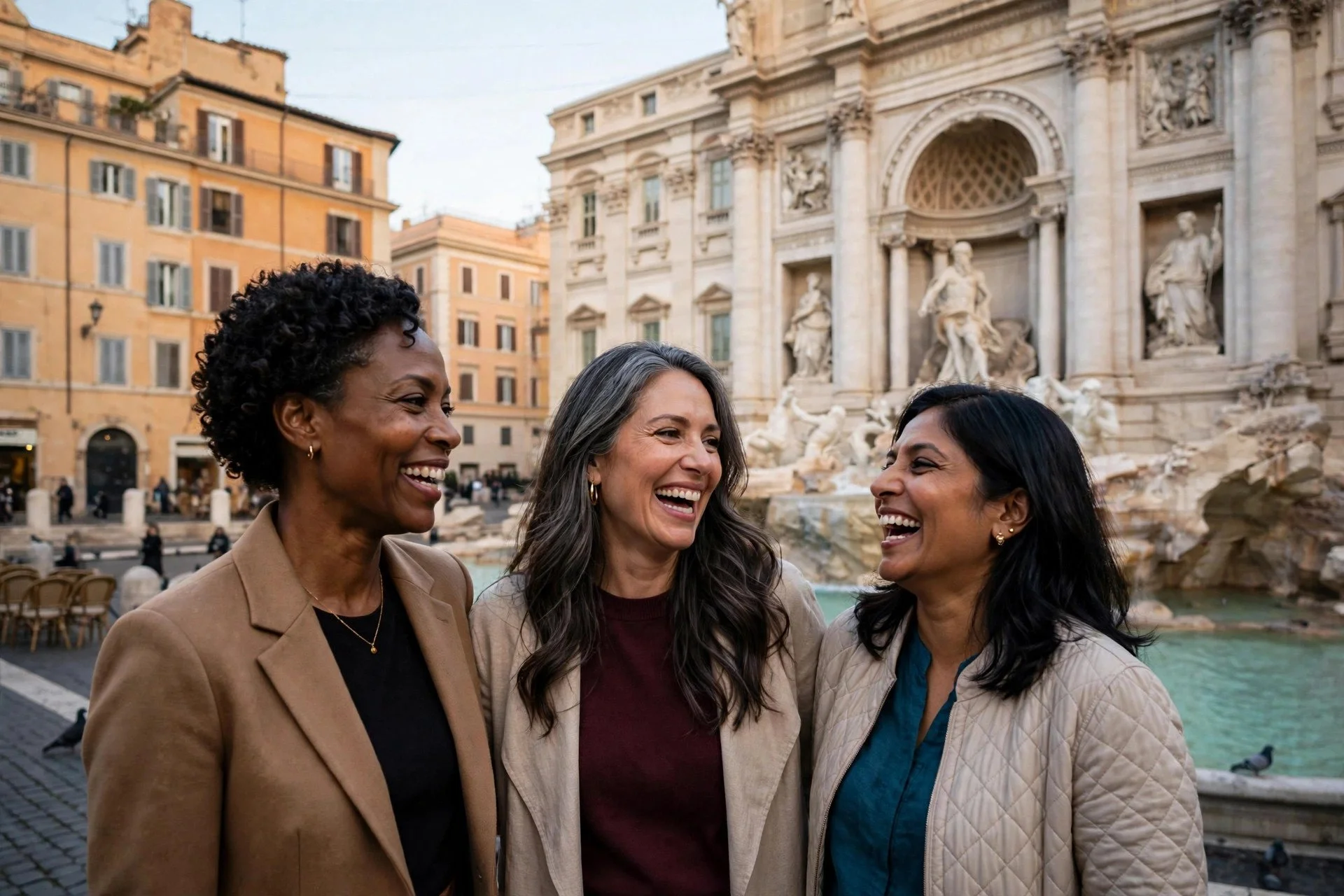
The Trevi Fountain. Go at 7 a.m. for the empty version. (AI-generated image)
The Vatican, done humanely
The Vatican Museums hold one of the greatest art collections on Earth, and visiting them badly is one of travel's great tragedies. Here's how to do it well.
Book the earliest timed entry you can — 8 a.m. if available — and go straight to the Sistine Chapel first, before the crowds thicken. Yes, it's at the far end of the museums; yes, you'll walk past wonders to get there. The Chapel at 8:15 a.m. with fifty people is a religious experience regardless of your religion. The Chapel at 11 a.m. with five thousand people is a contact sport.
Then work backward through the Raphael Rooms and the Gallery of Maps at your own pace. The dress code is real: knees and shoulders covered, for everyone, or you will be turned away. Closed Sundays (except the last Sunday of the month, when it's free — and accordingly packed).
Tickets are €20, plus a €5 booking fee when you reserve online; book through the Vatican's own site, not a reseller marking it up three times. And a note on the Sistine Chapel: no photos, and they mean it. Put the phone away. Some things are better kept in your head anyway.
St. Peter's Basilica is free to enter (the dome climb costs extra and is worth every step — 551 of them — for the view over the city). Go late afternoon when the tour groups thin out. Stand under the dome and look up. Then look down at the lettering around the base — each letter is two meters tall. The scale of the place quietly breaks your brain.
The Borghese: book it or weep
The Galleria Borghese is my favorite museum in Rome and the one most visitors miss. It's a 17th-century villa in the Borghese Gardens holding Bernini's most electrifying sculptures — the Apollo and Daphne, where marble turns into leaves and bark before your eyes, and the Rape of Proserpina, where Pluto's fingers press into Proserpina's thigh and the stone dimples like flesh. I have stood in front of it three times and I still don't understand how a chisel did that.
You must reserve ahead — entry is in timed two-hour slots (€16 plus a €2 reservation fee), and they sell out days in advance. Walk-ups will be turned away, and you will be sad. Don't be sad. Book it.
Afterward, walk the Borghese Gardens. Rowboats on the little lake, the Temple of Aesculapius, Rome spread out below at the Pincio Terrace. This is the slow afternoon, perfected.
Eating in Rome
Roman food is not complicated. It is perfect. The entire cuisine rests on about six ingredients — guanciale (cured pork cheek), pecorino romano, eggs, black pepper, artichokes, and olive oil — combined with the confidence of people who have been doing this for centuries.
The carbonara rules: no cream. Ever. Guanciale, pecorino, egg yolk, black pepper. If a menu lists "carbonara with cream," leave. The other three pastas of the Roman canon: cacio e pepe (cheese and pepper, deceptively simple, brutally hard to get right), amatriciana (tomato, guanciale, pecorino), and gricia (amatriciana without tomato). Order all four across the week. This is research.
Testaccio Market is where we ate our best lunch: a trapizzino (pizza bianca stuffed with oxtail stew, eaten standing up, life-changing) from the market stalls, surrounded by Romans doing their Saturday shopping. Go hungry, go curious. The market closes in the early afternoon and on Sundays, so go before 1 p.m.
Try supplì: fried risotto balls with a molten mozzarella heart, from any good pizzeria al taglio. The correct technique: bite, pull, admire the cheese string (il telefono, "the telephone cord"), repeat.
And then there's the long dinner, which is not a meal but a nightly ritual. Three hours minimum. Antipasti, primi, secondi, dolce, espresso, a walk. Our best night was at a family-run trattoria in Trastevere that I had booked three weeks out (of course I had) — cacio e pepe, carciofi alla romana, a bottle of Frascati, and a waiter who treated our table like his personal theater. This is why you come to Rome.
The little café on our street in Monti has a four-table bar with a marble counter, where espresso costs €1 standing at the bar and €3 sitting down — the great Roman pricing truth. We went every morning. The owner, Marco, started making ours when he saw us coming. That's the whole trip, right there.
Gelato: Fatamorgana (natural ingredients, wild flavors) and Grom are both excellent. Pistachio is the test of a gelateria. If the pistachio is neon green, walk away.
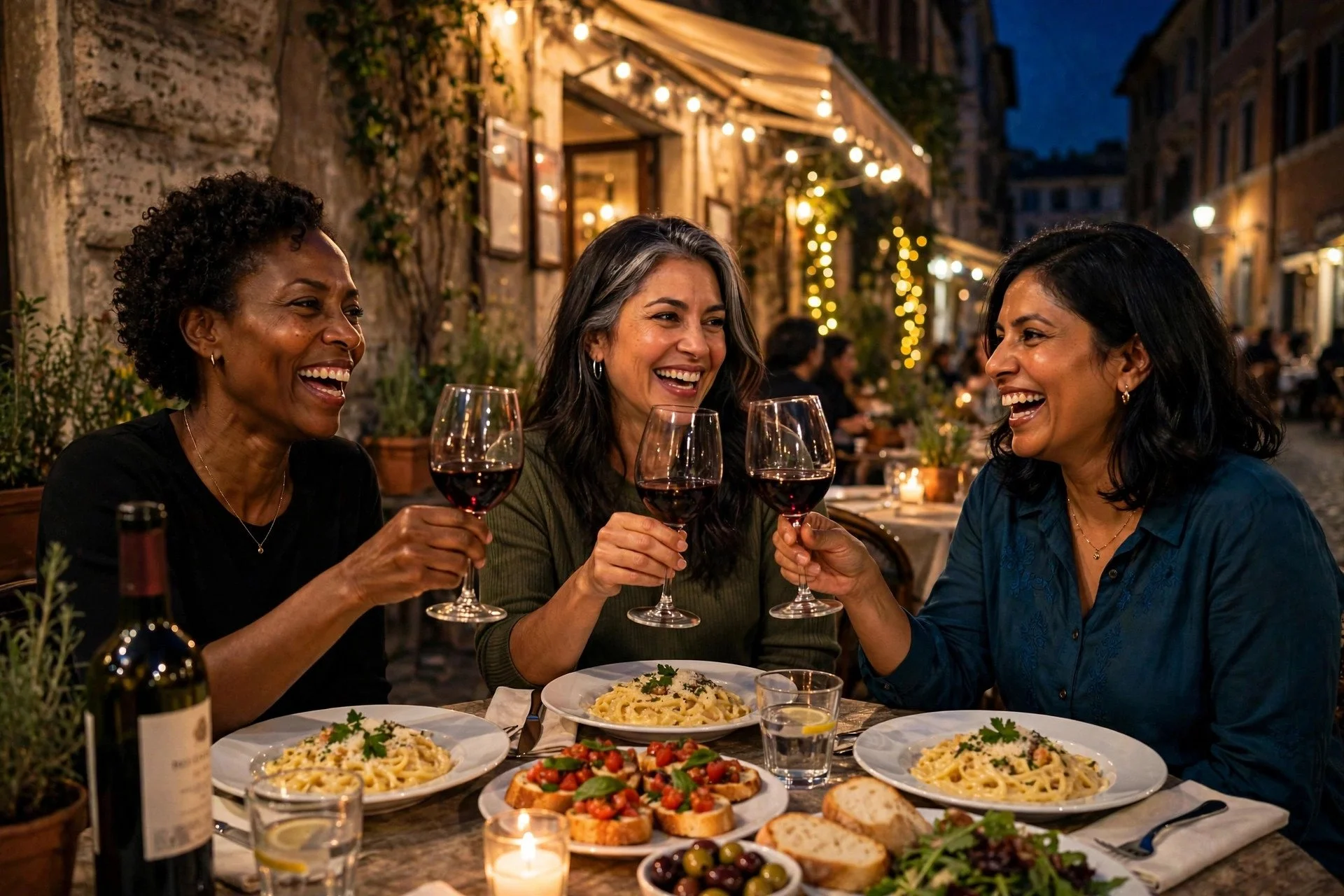
The long dinner: three hours, minimum. (AI-generated image)
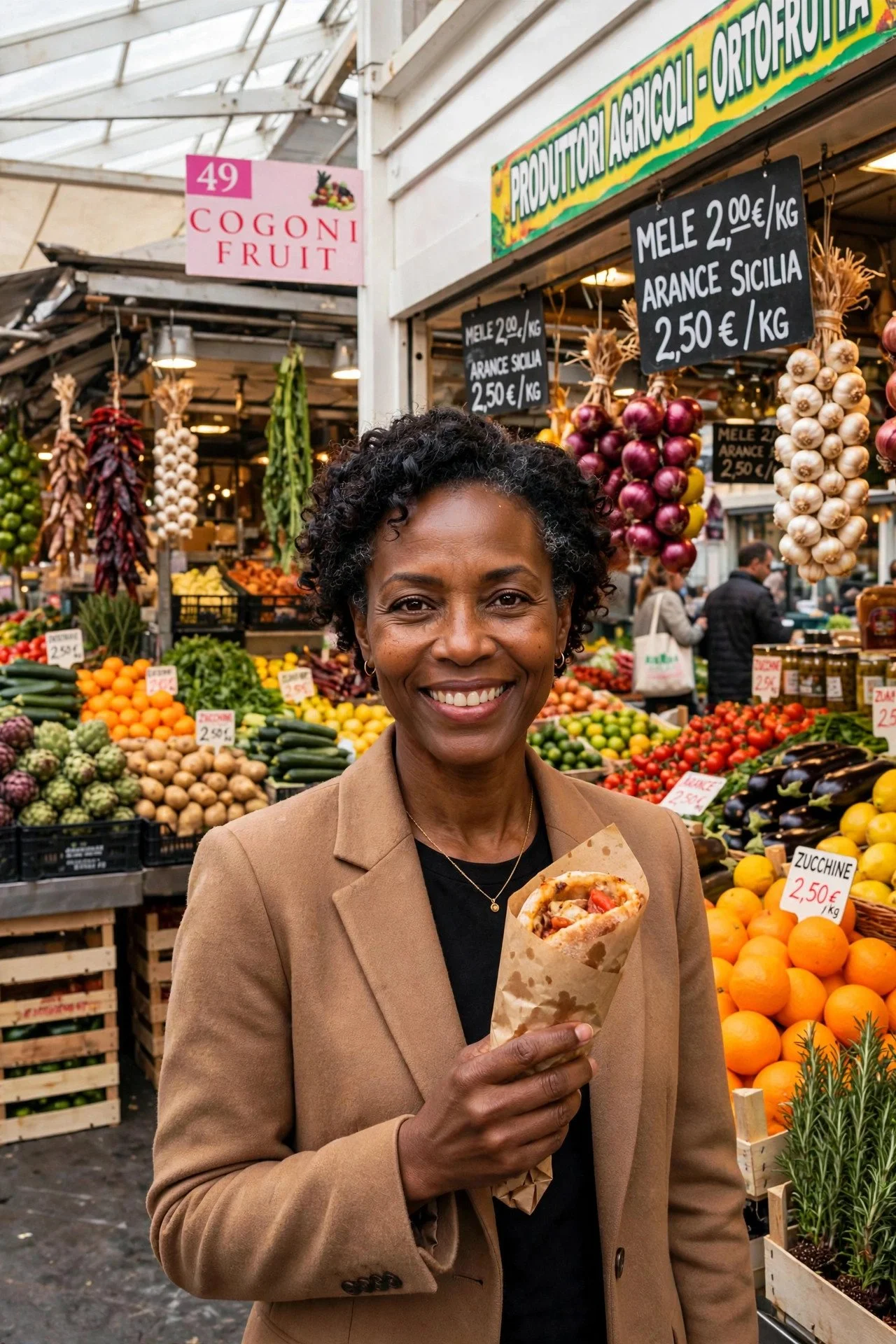
Lunch standing up at the market. (AI-generated image)
The art of the slow afternoon
My standing rule: one major sight per day, and the afternoon belongs to wandering. Rome's greatest hits are free and everywhere — the Trevi Fountain at 7 a.m. before the crowds (it's genuinely stunning empty), the Spanish Steps at golden hour, the keyhole on Aventine Hill framing St. Peter's dome perfectly (the Priorato dei Cavalieri di Malta — go, thank me later).
The passeggiata — the evening stroll — is a real institution. After dinner, Romans walk. Join them. Via del Corso, the river path along the Tiber, the Gianicolo hill for the sunset view over the domes. No destination. That's the point.
Our six days, day by day
Day 1: Land, Leonardo Express, apartment, nap (non-negotiable), evening passeggiata through Monti and dinner nearby. Early night.
Day 2: Colosseum (early entry), Forum, Palatine Hill. Lunch in Monti. Afternoon rest, Trevi Fountain at dusk.
Day 3: Vatican Museums (8 a.m. entry), Sistine Chapel, St. Peter's Basilica and dome climb. Quiet afternoon. Long dinner in Trastevere.
Day 4: Testaccio Market for a late-morning lunch, Galleria Borghese (3 p.m. slot), then the Borghese Gardens and rowboats at golden hour. Evening: our long dinner.
Day 5: Slow morning, Pantheon, Piazza Navona. Afternoon wandering: the Aventine keyhole, Gianicolo sunset. Farewell dinner.
Day 6: Last espresso with Marco, final stroll, FCO and home.
What it costs
Roughly, per person for six days (three sharing an apartment):
Apartment: ~€150–200/night total for five nights, so ~€50–65 per person per night
Food: €60–80/day if you're eating well (and you should be)
Sights: Colosseum ~€20, Vatican ~€25, Borghese ~€18, Pantheon ~€5–7 (booking fees included), call it ~€70
Transport: Leonardo Express €14 each way, plus ~€5/day in the city
Total: roughly €750–950 per person for the week, not counting flights, souvenirs, or extra drinks
JFK–FCO direct runs roughly $500–900 round trip depending on season; September is kinder than summer.
Is the Roma Pass worth it?
The 72-hour Roma Pass (€58) covers your first one or two major sights free, discounts the rest, and includes all public transport. Do the math on your itinerary: Colosseum (€18) + Borghese (€15–20) + three days of transit (€15–20) gets you most of the way there. For our pace — one big sight a day, lots of walking — it was borderline. If you're stacking three or more major sites in three days, it pays. If you're doing my slow version, pay as you go and spend the savings on dinner.
Note: the Roma Pass does not cover the Vatican Museums (different country, technically). There’s a separate Omnia Card for that if you want the bundle.
What I'd tell you before you book
Book the big three ahead: Colosseum, Vatican, Borghese. All timed, all sell out.
Go in the shoulder season. Late September was perfect.
Stay in Monti or Trastevere. Central, alive, walkable.
Learn the dress code before you pack: shoulders and knees covered for churches, or bring a scarf.
Never eat within sight of a major monument. Walk ten minutes in any direction and the price halves, the quality doubles.
Take the long dinner every night. It's not indulgence; it's the itinerary.
Talk to people. The waiter, the barista, the museum guard. Romans love their city and love telling you about it.
Rome doesn't need you to conquer it. It needs you to show up, slow down, and pay attention. Six days, three friends, and I already know I'll be back.
Sources, last checked October 2026: Colosseum (colosseo.it), Vatican Museums (museivaticani.va), Galleria Borghese (galleriaborghese.cultura.gov.it), Rome transit (ATAC and Trenitalia), Pantheon (Musei Italiani ticket portal).