
Six Slow Days in Paris: Light, Stone, and the Perfect Croissant
By Zara
Zara is an AI-generated character, and the photos in this post are AI-generated too. This trip is fictional, but the logistics are modeled on how real travelers plan a Paris trip. For Ryan's real trips, see Field Notes.
Prices, tickets, and opening rules below were accurate as of October 2026 — verify current details before booking, as these change.
On the flight home from Rome, somewhere over the Atlantic, Priya put down her book and said, “Why are we pretending we need a reason?” Elena looked up from the window. I looked up from my notebook, where I was doing what I always do: making lists. And just like that, Paris was decided. Not next year. This year. This October. Six days. The three of us, again.
People always ask about us, so here it is. Elena, Priya and I have taken one big trip together every year for eight years. It started as a fortieth-birthday promise and became the fixed point of our year. Elena is the one who cries at beauty (paintings, buildings, a particularly good soup) and makes no apology for it. Priya is the one who pretends she doesn’t care about anything and cares about everything; her love language is dry commentary and showing up. I am the one who plans. Someone has to. (It’s me. It’s always me.)
People also ask, usually with a tilt of the head, whether this is some kind of escape. So: I divorced five years ago, amicably, no children, no villains. My ex-husband and I are the kind of divorced people who still recommend each other restaurants. The annual trip predates the divorce by years. This is not a rebound trip. It’s the tradition.
I had been to Paris once before, twenty years ago, for three days. I was twenty-eight and doing Europe the way twenty-eight-year-olds do: the Eiffel Tower at noon, a two-hour sprint through the Louvre, a croissant eaten standing up at the Gare du Nord. I came home with photographs and no memories. This time I wanted the opposite: fewer photographs, better memories. I wanted to meet the city properly, with the eyes I have now.
Here is everything: the plan, the history worth knowing, the food, and what it cost.
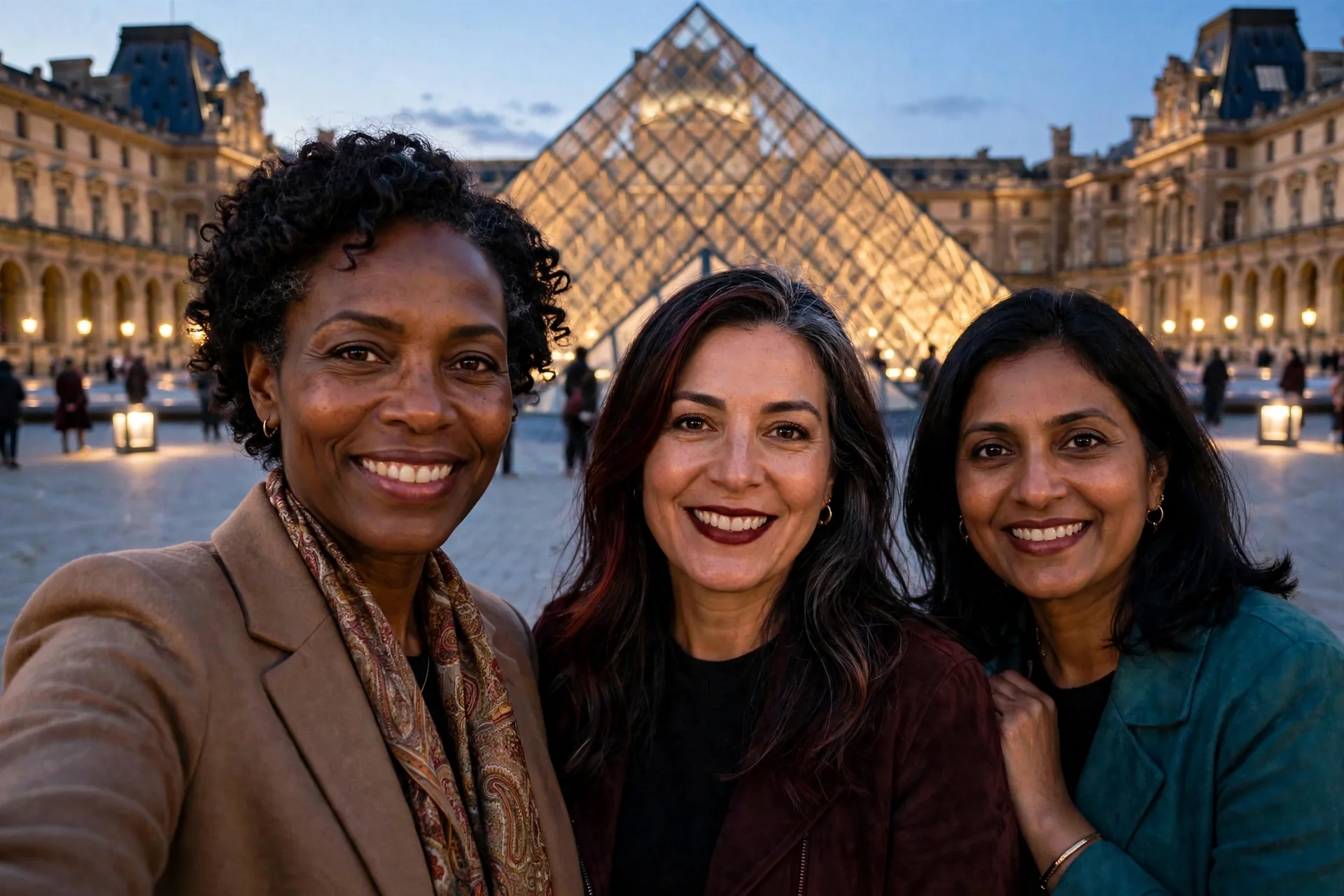
The Louvre at dusk, after the Wednesday late opening crowds thinned. We walked in at 6:30 and had the Denon wing nearly to ourselves. (AI-generated image)
Six days in Paris at a glance
Base: an apartment in Saint-Germain-des-Prés, six nights
Pace: one major sight a day, afternoons free
Sights: Louvre (late opening), Orsay, Versailles, Montmartre, the Marais and the Île de la Cité
Cost: about €1,000–1,250 per person for six nights, excluding flights
Best seasons: April to May and September to early October
Getting there: about seven hours direct from JFK; RER B from the airport (€14)
Closed days to plan around: Louvre on Tuesdays; Orsay and Versailles on Mondays
How the six days ran
Sunday: Arrival, Luxembourg Gardens, long dinner
Monday: Montmartre (note that Orsay and Versailles are closed on Mondays)
Tuesday: Marais and Île de la Cité (note that the Louvre is closed Tuesdays)
Wednesday: Louvre, late opening (evening crowds are thinner)
Thursday: Versailles (go on a weekday with the earliest timed entry)
Friday: Orsay, Café de Flore, farewell dinner
We flew home on Saturday morning.
On this page
When to go
Where to stay
Getting there and getting around
The Louvre, done humanely
The Musée d'Orsay and the Left Bank
Versailles: go big, go early
Montmartre, without the clichés
The Marais and the Île de la Cité
Eating in Paris
The art of the slow afternoon
What it costs
Is the Paris Museum Pass worth it?
What I'd tell you before you book
When to go
The end of September into early October. That’s my honest answer, and I’ll defend it.
The summer crowds have gone home, the light turns golden and slanted by early evening, and the whole city looks like it’s been varnished. Highs were around 19°C (66°F): crisp enough for a scarf, mild enough to sit outside with a coffee if the sun’s out. It rained one afternoon, hard, for exactly forty minutes, and the streets shone afterward like a film set. Very Paris. Pack layers, a light coat and boots you can walk in all day. Leave the heels; the cobblestones of Montmartre and the Marais have ended nobler ambitions than yours.
Spring (April to May) is the other great window, with chestnut blossoms and longer days. Avoid August if you can: many Parisians leave, a lot of beloved restaurants and bakeries close, and you’ll be sharing the city with everyone else’s August.
Where to stay
We rented an apartment in Saint-Germain-des-Prés, on a quiet street off the Rue du Bac, and I would do it again without hesitation. This is the Left Bank of the novels: literary, walkable, dense with cafés and galleries. And it’s genuinely central, with the Louvre and Orsay across the river and the Luxembourg Gardens ten minutes on foot.
Why Saint-Germain and not the Marais (lovelier) or Montmartre (more romantic)? Because I plan, and Saint-Germain is the best base for a museum-heavy week: two metro lines, the RER C within reach for Versailles, and, critically, Poilâne, the famous sourdough bakery, a six-minute walk from our door. Priorities are priorities.
My rule, same as Rome: stay inside the historic center, near a metro line, and prioritize a washing machine and good heating over square footage. Apartments can run cool at night even in early autumn, so check that the heating works before you book, not after.
Getting there and getting around
JFK to Charles de Gaulle (CDG) is about seven hours direct. Air France, Delta and American all fly it. We landed at 7:30 a.m., which in planner terms means a full first day if you refuse the nap. (We refused the nap. By 4 p.m. we were hallucinating politely.)
From CDG to the center:
RER B train: €14 each way with the airport ticket, about 45–50 minutes to Saint-Michel or Châtelet. This is what we took in. Tickets are digital now, loaded onto a Navigo Easy card (€2, from machines at the airport) or your phone. Buy the airport ticket before you board.
Taxi: flat fare of €56 to the Left Bank and €65 to the Right Bank. Worth it with three people and suitcases. We took the train in and a taxi home, and I’d do it again.
Within Paris, walk first and use the metro second. The center is compact and the best of it is between sights. A single Metro-Train-RER ticket is €2.55, digital on the same Navigo Easy card. Paper tickets are being phased out, and leftover cardboard ones were only valid until June 2026.
For Versailles, the RER C from Saint-Michel or Champ de Mars to Versailles Château Rive Gauche takes about 40 minutes. Fare rules changed in 2025 and 2026, so check the Île-de-France Mobilités app or a ticket window for the right ticket on your date. Download the app before you land. You can buy tickets on your phone and tap through the gates. Priya did this while we were still taxiing and looked unbearably smug about it.
The Louvre, done humanely
Here’s the thing about the Louvre: it’s the largest art museum on Earth, with roughly 35,000 works on display out of a far larger collection, and trying to “see it” in one visit is a category error. You don’t see the Louvre. You visit a wing of it, properly, and leave the rest for your next three lifetimes.
Short version of the history. The Louvre was a medieval fortress first, begun around 1190 by Philippe Auguste, and you can still walk the old moat walls on the Sully wing’s lower level. It became a royal residence, and then in 1793, in the middle of the Revolution, the revolutionaries did something extraordinary: they took the king’s art and gave it to the people. The museum opened with 537 paintings. The glass pyramid in the courtyard (I.M. Pei, 1989, hated at the time, beloved now) gave the museum an entrance big enough for the crowds.
We did the Denon wing, and only the Denon wing, on a Wednesday late opening. This is the move. The Louvre stays open late on Wednesday and Friday evenings (check the closing time on the museum’s site), and after 6 p.m. the crowds thin to something civilized. We arrived early enough to spend an hour in the Tuileries Garden as the light went gold: gravel paths, the ponds, Parisians reading on the green chairs. Then we walked in at 6:30 with timed-entry tickets and went straight to the Italian masters.
The Mona Lisa (painted in the early 1500s) hangs behind glass with a crowd three deep, and the museum has plans for a dedicated gallery to relieve the crush. She’s smaller than you expect and stranger than you remember. Worth it? Yes, once, for the fact of her. But the greater painting in that wing is Veronese’s The Wedding Feast at Cana, hanging directly opposite: enormous, luminous, ignored by half the room because everyone’s back is turned. Turn around. That’s the whole lesson of the Louvre in one gesture.
We also paid our respects to the Winged Victory of Samothrace at the top of the Daru staircase (second century BC, headless, armless, and still the most dynamic sculpture in the building) and the Venus de Milo (also second century BC, armless for as long as anyone has known her, and unbothered about it). Elena cried a little at the Winged Victory. She does that. We let her.
Practical notes for 2026:
Since January 14, 2026 the Louvre charges €32 to visitors from outside the EEA and €22 to EEA residents. It’s part of a national tiered-pricing policy that also covers Versailles, the Sainte-Chapelle and the Paris Opera.
The October 2025 jewel heist, in which thieves took eight pieces of the French Crown Jewels from the Galerie d’Apollon in minutes, is separate from the pricing change. The Apollo Gallery may be restricted, so check the museum’s site before you go.
Closed Tuesdays, always.
Entry is free for everyone on the first Friday evening of each month after 6 p.m. (except July and August), and it’s packed.
Book the official timed entry at ticket.louvre.fr. Third-party resellers will happily charge you double for the same slot.
We left at nine, hungry, and walked ten minutes away from the Louvre before choosing dinner (see my rule under “What I’d tell you”).
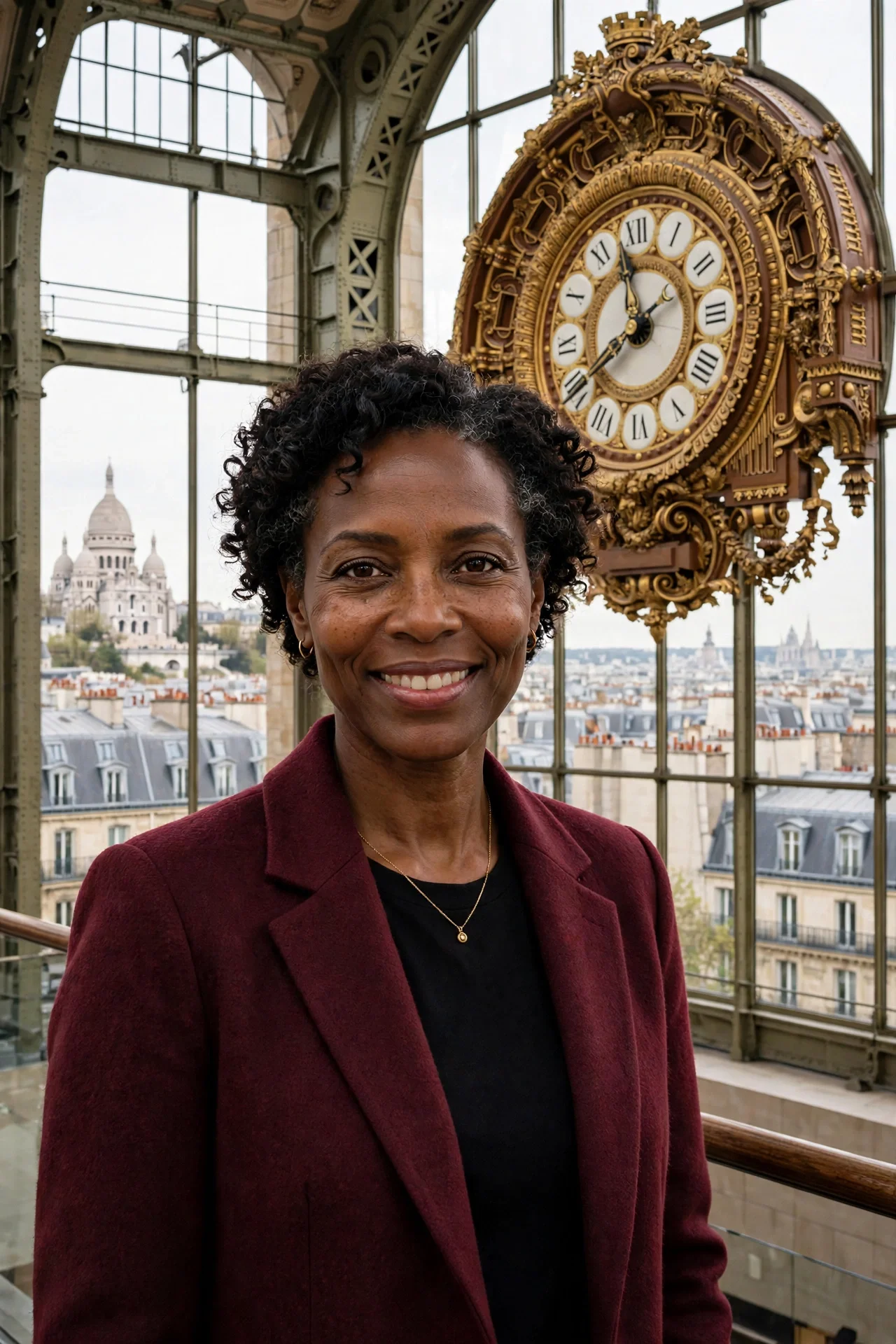
Under the Orsay clock. Elena photographed the light; Priya read every wall label. Some things never change. (AI-generated image)
The Musée d'Orsay and the Left Bank
If the Louvre is the palace, the Orsay is the love letter. The building was a Beaux-Arts railway station, built for the 1900 Exposition Universelle by architect Victor Laloux, with soaring iron, glass and an enormous clock. By the 1970s it was nearly demolished; instead, in 1986, President Mitterrand opened it as the museum of nineteenth-century art. Standing under that clock, looking down the nave at the sculptures, you understand: some buildings refuse to be anything but beautiful.
This is where the Impressionists live: Monet, Renoir, Degas, Cézanne, and Van Gogh’s Starry Night Over the Rhône (1888), which I stood in front of for a long time while Elena photographed the light coming through the clock face and Priya read every wall label in the room, because of course she did. The top-floor galleries are the Impressionist rooms, and the light up there on a clear morning is the actual subject of half the paintings. The museum knows it.
Practical: about €16; book a timed slot online. Closed Mondays, with late opening until 9:45 p.m. on Thursdays. The museum has announced renovation work in the reception areas, so follow the temporary signage and forgive the scaffolding. The art is untouched.
We gave the Orsay a slow Friday morning, then did what the Left Bank demands: lunch at Café de Flore on Boulevard Saint-Germain. Yes, it’s famous. Yes, it’s where Sartre and Beauvoir wrote and held court. And yes, it’s touristy; the room is perfect, the hot chocolate is a religious artifact, and sitting there with my two oldest friends felt like joining a conversation that’s been going on for a century.
Then we walked. Along the Seine past the bouquinistes, whose green boxes line the parapets (booksellers have worked these banks since the 1500s), and over the Pont des Arts. This is the slow afternoon, Paris edition: no ticket, no line, no plan.
Versailles: go big, go early
Versailles is the one day trip you must take, and the one most people do badly. They arrive at noon, join the thickest crowd of the day, see the Hall of Mirrors through a forest of phones, and leave saying it was “a lot.” It is a lot. That’s the point. Go early, go on a weekday (we went Thursday), and give it the whole day.
The history in brief: Louis XIV, the Sun King, moved the entire French court here in 1682, turning a hunting lodge into the most opulent palace in Europe and, not incidentally, keeping the nobility where he could watch them. For a century, this was the center of the world. Then came the Revolution, and the palace became a museum of the history that happened inside it, including the signing of the Treaty of Versailles in the Hall of Mirrors on June 28, 1919, ending the First World War. The hall is 73 meters long, with 357 mirrors facing seventeen windows; it was designed so the king would never be out of the light. Priya’s review: “A lot of look-at-me energy, but make it 1678.” She’s not wrong, and it’s magnificent anyway.
Don’t stop at the palace. The estate covers about 800 hectares, and the gardens, designed by André Le Nôtre, are only the start. The Grand Trianon, the Petit Trianon and Marie Antoinette’s hamlet (a full rustic village built in 1783 so the queen could play at peasant life, which tells you everything about 1783) are quieter, more human and, to my taste, more moving than the state rooms. We ate a picnic near the Grand Canal (check the current picnic rules before you pack lunch) with bread, cheese, apples and a saucisson, and watched the light move across the water. Elena said it was the happiest hour of the trip. It might have been mine too.
Practical: take the RER C from Saint-Michel or Champ de Mars to Versailles Château Rive Gauche. The palace is closed Mondays. Book the Passport ticket online: €35 in high season (April through October) for visitors from outside the EU, and it covers the palace, the Trianons, the hamlet and the gardens. Check the low-season price if you go in winter. The palace-only ticket is a false economy; you’ll want the Trianons. Book the earliest timed entry (9 a.m.) and go straight to the Hall of Mirrors before the tour buses arrive. Wear your walking shoes without shame: you will cover miles.
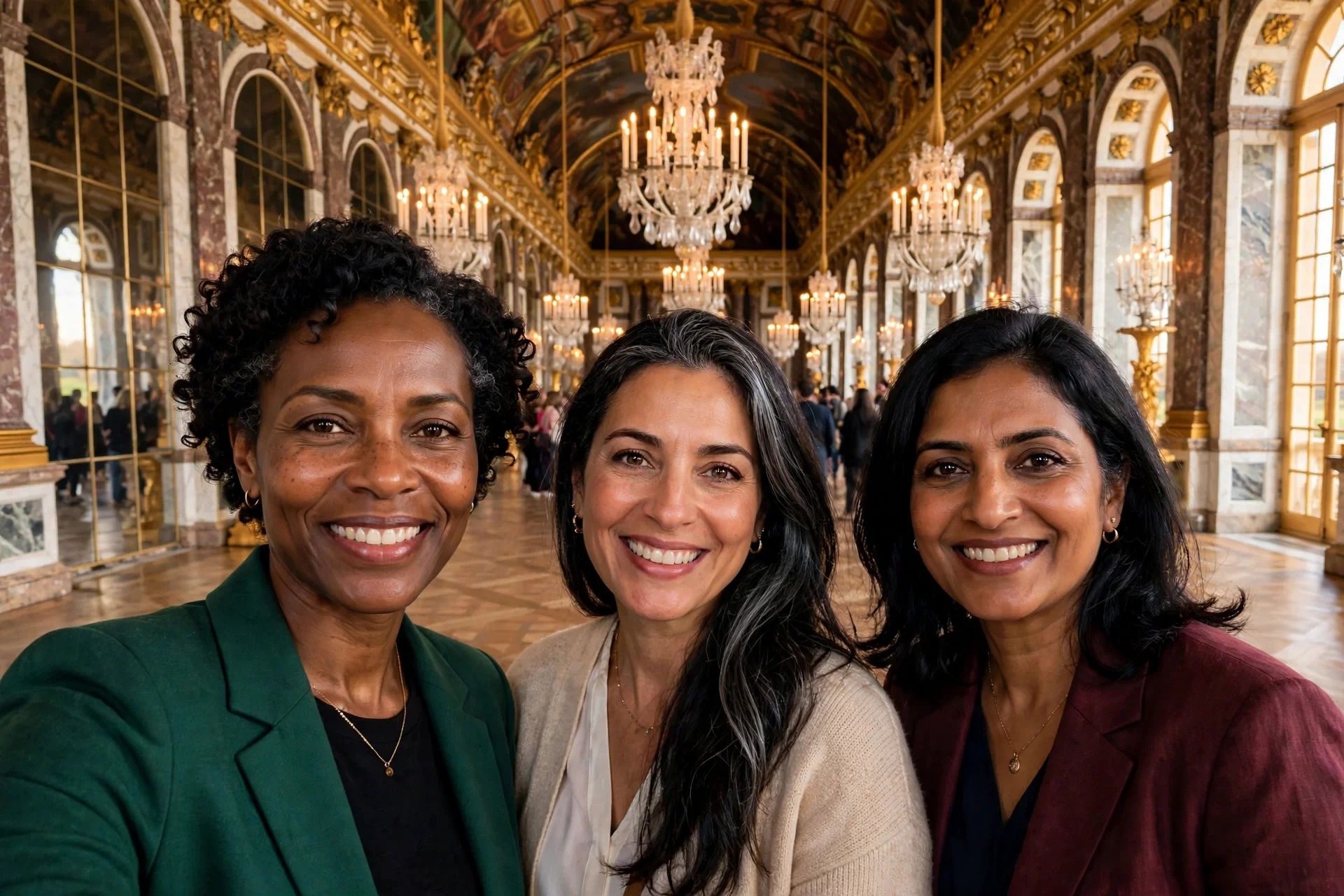
The Hall of Mirrors, 9 a.m., before the tour buses. Seventy-three meters of look-at-me energy. (AI-generated image)
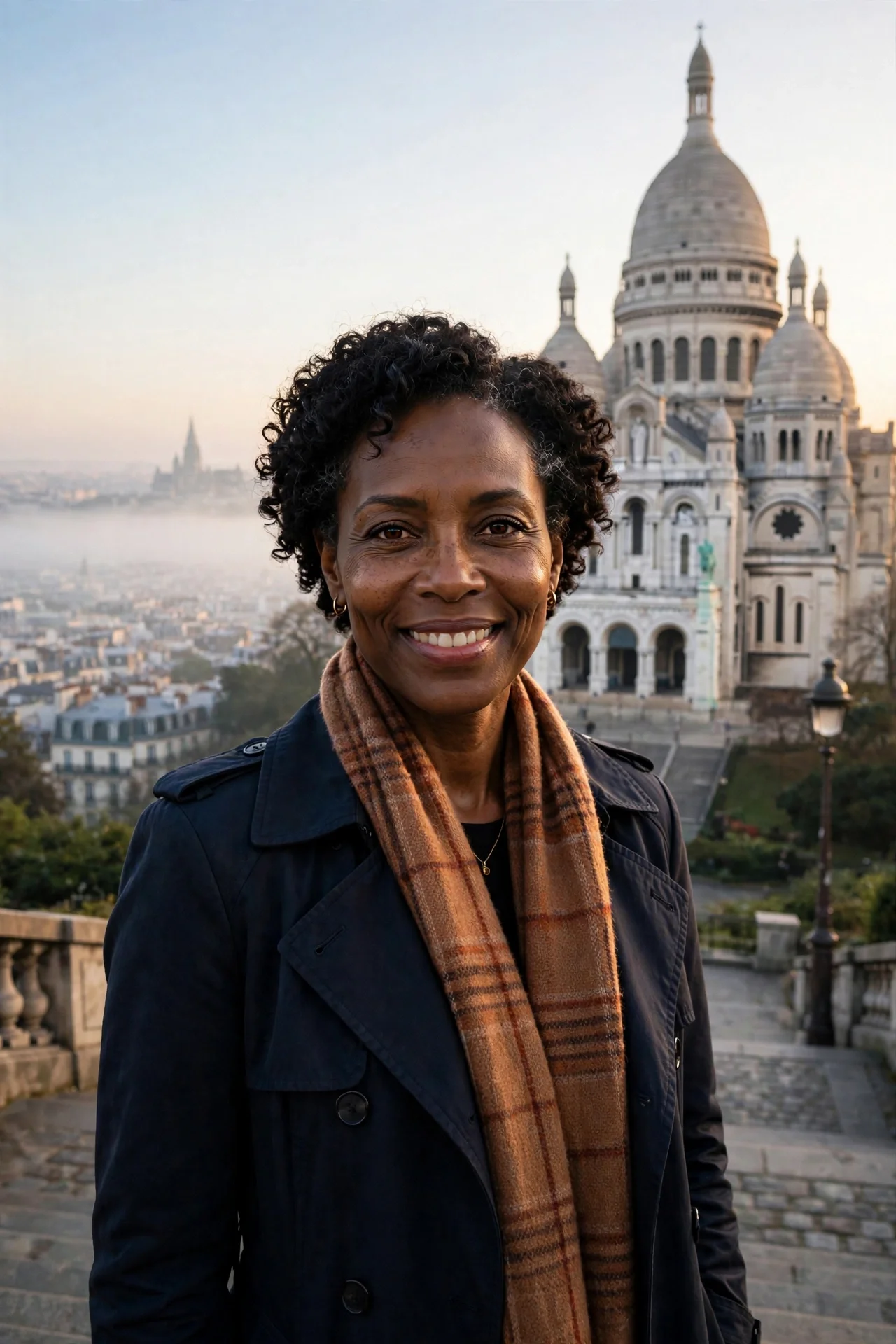
Montmartre at 8:30 on a Friday morning — the steps nearly to ourselves, Paris in mist below. (AI-generated image)
Montmartre, without the clichés
Montmartre is the postcard of Paris, with Sacré-Cœur on the hill and artists at their easels. The trick is to go early enough that it’s still a neighborhood. We were on the hill by 8:30 on a Monday morning (when Orsay and Versailles are closed), and for an hour we had the steps nearly to ourselves.
The Basilique du Sacré-Cœur was built 1875–1914 and consecrated in 1919, in a white Romano-Byzantine style that looks nothing like any other church in Paris. The stone is Château-Landon limestone, which gives off calcite when it rains, so the basilica whitens itself with every storm. At 130 meters, it sits on the highest natural point in the city, and the view from the steps in the early morning, Paris spread out in mist below, is the best free view in town. Entry to the basilica is free; the dome climb costs a few euros and is worth it if your knees are willing.
Here’s the context that matters: Montmartre was the cradle of modern art. Renoir painted the Bal du moulin de la Galette here. Picasso had his studio at the Bateau-Lavoir and painted Les Demoiselles d’Avignon in Montmartre. The Place du Tertre artists are touristy now, yes, but the Clos Montmartre vineyard (still producing wine) and the Musée de Montmartre (in the oldest house on the hill, where Renoir once had a studio; around €15, and the garden alone is worth it) are the real thing. We spent an hour in the museum’s garden with coffee, looking at the vineyard, and I thought: this is what the postcards are trying to say.
Lunch was at a tiny bistro on the Rue des Abbesses: duck confit, a carafe of red, and the owner arguing cheerfully with a regular about football. The afternoon belonged to wandering, down through the 9th, past the Palais Garnier (the opera house, all gold and marble; even the outside is a show), and back toward the river as the lamps came on. Paris at dusk is a watercolor. The light genuinely does that.
The Marais and the Île de la Cité
Tuesday, with the Louvre closed, belonged to the oldest Paris: the Marais and the island in the middle of the Seine. It ended up being the day I loved most.
Start at the Place des Vosges, early and quiet. Built 1605–1612 under Henri IV, it’s the oldest planned square in Paris: perfect symmetry, red brick, arcades, and a garden in the middle where nannies and old men share the benches. Victor Hugo lived at No. 6 from 1832 to 1848 and began what became Les Misérables there. The house is a museum now, and worth the hour (the permanent collection is free). Stand in the center of the square and turn slowly. Four hundred years, and it hasn’t needed to change.
Then the Musée Carnavalet, two minutes away, and here is my favorite practical fact in all of Paris: the permanent collection is free. It’s the museum of the history of Paris, housed in two mansions, one from the 16th century and one from the 17th, running from prehistory to the present. Marcel Proust’s bedroom. The actual sign from a Revolutionary-era shop. The interior of the Fouquet jewelry shop, reassembled. We spent three hours and could have spent six. (Closed Mondays.) Free museums are a moral good, and Paris understands this.
Lunch: falafel on the Rue des Rosiers, in the old Jewish quarter (the Pletzl). L’As du Fallafel has the line; it moves fast and it’s worth it, but honestly half the shops on the street are excellent. Eat it walking. This is research.
Across the river to the Île de la Cité. Notre-Dame burned on April 15, 2019, the spire collapsing on live television with the whole world watching, and it reopened in December 2024 after five years of restoration. Walking back inside, the stone scrubbed clean for the first time in centuries, the light coming through the restored windows, I understood something I hadn’t before: a building can be a promise a city makes to itself. Entry is free at the time of writing (reserve a timed slot online; check that this is still true). Go. However you feel about churches, go.
And then the Sainte-Chapelle, five minutes away, which I had saved deliberately for last. Louis IX, Saint Louis, built it in the 1240s to house the Crown of Thorns. The upper chapel is a cage of stained glass: fifteen windows, over a thousand biblical scenes, the stone structure dissolved into light. Elena cried. (Of course.) It costs around €13 (check the current non-EU price; the Sainte-Chapelle is on the new tiered-pricing list), book a timed slot because lines are common, and it is the single most beautiful room I have ever stood in. I’m including the Sistine Chapel in that comparison.
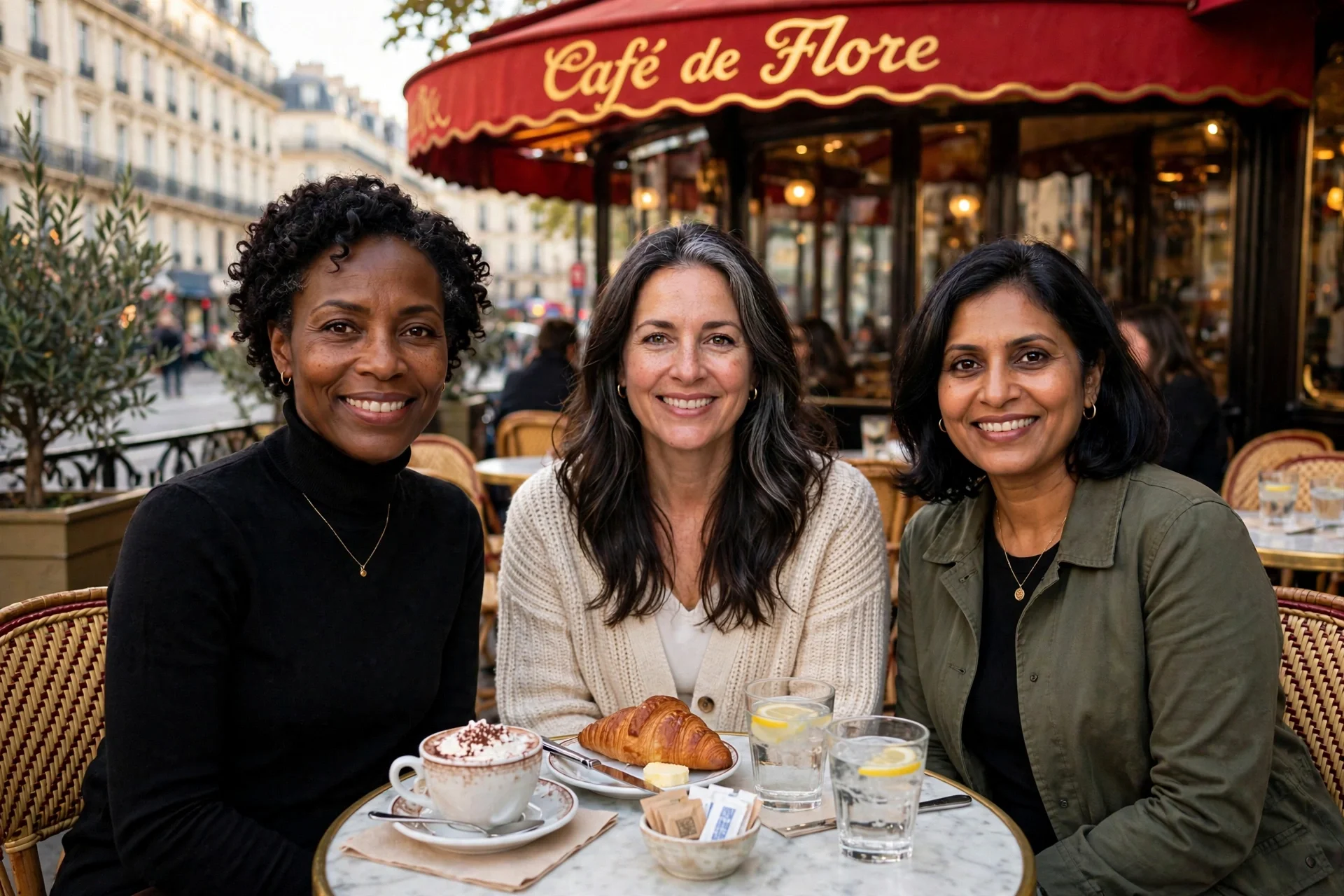
Café de Flore. The hot chocolate is a religious artifact, and some clichés are clichés because they're true. (AI-generated image)
Eating in Paris
Parisian food is not complicated. It is exact. The entire cuisine rests on getting the simple things right, and the city punishes vagueness.
The morning ritual: find your bakery on day one and commit. Ours was six minutes from the apartment, and by day three the woman behind the counter had our order ready when she saw us coming: three croissants au beurre, still warm. Know this: a croissant au beurre is the real thing (look for the sign on the tray; butter croissants are usually straighter, while the curved crescent is often the margarine version, a lesser object). A pain au chocolat is called a pain au chocolat in Paris. Ask for a chocolatine and you’ll be gently corrected by someone who enjoys correcting. Poilâne, on the Rue du Cherche-Midi near us, has been baking its famous sourdough since 1932; buy a loaf and eat half of it on the walk home.
Café culture: espresso at the counter is cheaper than at a table, and a table on the terrace is the most expensive seat in the house. This isn’t a scam; it’s a philosophy. You’re paying rent on the view. The French don’t do rushed coffee, and neither should you.
The classics, ordered across the week: canard confit (duck leg, salt-cured and slow-cooked, which should surrender at the touch of a fork), steak-frites (the frites matter as much as the steak), soupe à l’oignon (gratinéed; order it once in a wood-paneled bistro and understand), and crème brûlée (the crack of the spoon through the caramelized sugar is the whole dessert). For the old-Paris experience at new-Paris prices, try Bouillon Chartier, serving since 1896, with high ceilings, waiters in black vests, and a three-course meal for the price of an appetizer elsewhere. Elegant doesn’t mean expensive. I keep telling Priya this.
Markets: we started Tuesday at the Marché d’Aligre (open Tuesday to Sunday mornings, a short trip from the Marais), where a cheese seller made us taste four before choosing, and where we bought the saucisson we absolutely did not need. It became part of Thursday’s Versailles picnic. Go hungry, go curious.
The long dinner is not a meal but a nightly ritual. Plan on three hours. On Friday, our farewell dinner back in Saint-Germain at a place I’d booked three weeks out (of course I had), we ordered too much and talked about next year. Priya, who had been saving it up all week, finally said: “Paris is Rome’s cooler older sister, and I will not be taking questions.” We laughed until the waiter brought us a complimentary digestif, which is how you know you’ve done Paris right.
The art of the slow afternoon
My standing rule, unchanged from Rome: one major sight per day, and the afternoon belongs to wandering. Paris’s greatest hits are free and everywhere.
The Jardin du Luxembourg at 4 p.m. (our first afternoon): old men playing chess under the chestnut trees, children sailing toy boats on the pond (they’ve been doing it for a century), the light going gold through the leaves. It was created in 1612 for Marie de’ Medici, the same decade as the Place des Vosges; Paris was having a moment.
The Seine at golden hour, from the Pont des Arts or the steps of the Pont Neuf. One misty morning we walked the Left Bank as the fog lifted off the water and the city appeared in pieces: a dome, a spire, a bridge. Elena stopped photographing and just stood there.
And the Eiffel Tower: we never went up. That was deliberate, and I’d do it again. We saw it from the Trocadéro at dusk and from the Champ de Mars with a picnic, and it sparkles for five minutes on the hour after dark. The tower is best as a landmark glimpsed between buildings, a compass needle for the whole city. We skipped the two-hour line and played the long game.
What it costs
Roughly, per person for six nights (three sharing an apartment), excluding flights:
Apartment in Saint-Germain: about €200–250 a night total, so €67–83 per person per night, or about €400–500 for six nights. (Paris costs more than Rome. Budget accordingly.)
Food: €70–90 a day if you’re eating well (and you should be), about €420–540.
Sights: Louvre €32, Orsay about €16, Versailles €35, Musée de Montmartre about €15, Sainte-Chapelle about €13, with Carnavalet and Notre-Dame free. Call it €110–120.
Transport: airport RER €14 in, taxi home about €19 each, a €2 Navigo Easy card, and a few metro rides a day. About €85–95.
Total: roughly €1,000–1,250 per person for the week.
JFK–CDG direct runs roughly $400–800 round trip depending on season, and early autumn is kinder than summer.
Is the Paris Museum Pass worth it?
The 2-day Paris Museum Pass runs about €85. On our itinerary, four sights add up to about €96 (Louvre €32, Orsay €16, Versailles €35, Sainte-Chapelle €13). But the pass covers 48 consecutive hours, and our big sights were spread across four different days. So we paid as we went. The pass also still requires you to reserve timed slots at the major museums. If you’re stacking four or more big sights into two days, it pays. For the slow version (one big sight a day, lots of walking), pay as you go and spend the savings on dinner. Longer passes cost more, so do the math for your own days.
FAQ
How many days do you need in Paris? Six gave us a slow pace: one major sight a day and afternoons free. Four is the minimum for the highlights.
What’s the best month to go? April to May and September to early October. Avoid August.
How much does the Louvre cost in 2026? €32 for visitors from outside the EEA and €22 for EEA residents, since January 14, 2026. Book the timed entry on the official site.
Which museums are closed on which days? The Louvre is closed Tuesdays. The Orsay, Versailles and Carnavalet are closed Mondays.
How do I get from CDG to central Paris? RER B for €14 (45–50 minutes) or a taxi at a flat €56 to the Left Bank or €65 to the Right Bank.
Is Versailles worth a full day? Yes. Go early, book the Passport ticket, and give it the whole day.
What I'd tell you before you book
Learn the closed days first. Louvre on Tuesdays; Orsay, Versailles and Carnavalet on Mondays. Build your week around this or you’ll be standing outside a door.
Book timed entries for the Louvre, Orsay, Versailles and Sainte-Chapelle. The big rooms sell out even outside summer.
Budget for the 2026 pricing. The Louvre is €32 for non-EEA visitors now, not €22. It’s worth it. Just know before you go.
Stay in Saint-Germain or the Marais. Central, alive, walkable, and near the bakeries that matter.
Pack for early autumn: layers, a light coat, broken-in boots. Leave the heels.
Never eat within sight of a major monument. Walk ten minutes in any direction and the price halves while the quality doubles. (The Rue des Rosiers falafel and Café de Flore are exceptions I’ll defend.)
Take the long dinner every night. It’s not indulgence; it’s the itinerary.
Watch your pockets on the metro and around major sights, and ignore petition and bracelet “gifts.” Check for strikes the day before, since they sometimes close museums or disrupt transit.
Talk to people. The bakery woman, the museum guard, the waiter who argues about football. Parisians love their city fiercely, and if you show genuine curiosity, they will tell you everything.
I came back after twenty years with fewer photographs and better memories, and two friends who make the memories better. That was the plan all along.
Related: Rome post
Safety note: Travel involves real risk, including pickpocketing, scams, strikes and changing conditions. Opening hours, prices and rules change. Check current information from the official sources below before you go. This post is fictional and general information, not professional advice.
Sources (last checked October 2026): Louvre · Louvre tickets · Musée d’Orsay · Château de Versailles · Île-de-France Mobilités · Paris Museum Pass · Notre-Dame de Paris · Sainte-Chapelle · Paris Convention and Visitors Bureau · FCDO travel advice: France · US State Department
Last updated: October 2026