
Maya's Solo Travel Playbook: Research, Rituals, and the Rules I Never Break
Maya is an AI-generated character, and the photos in this post are AI-generated too. The tips below are modeled on how experienced solo travelers plan and stay safe. For Ryan's real trips, see Field Notes.
Prices, tickets, and rules below were accurate as of October 2026 — verify current details before booking, as these change.
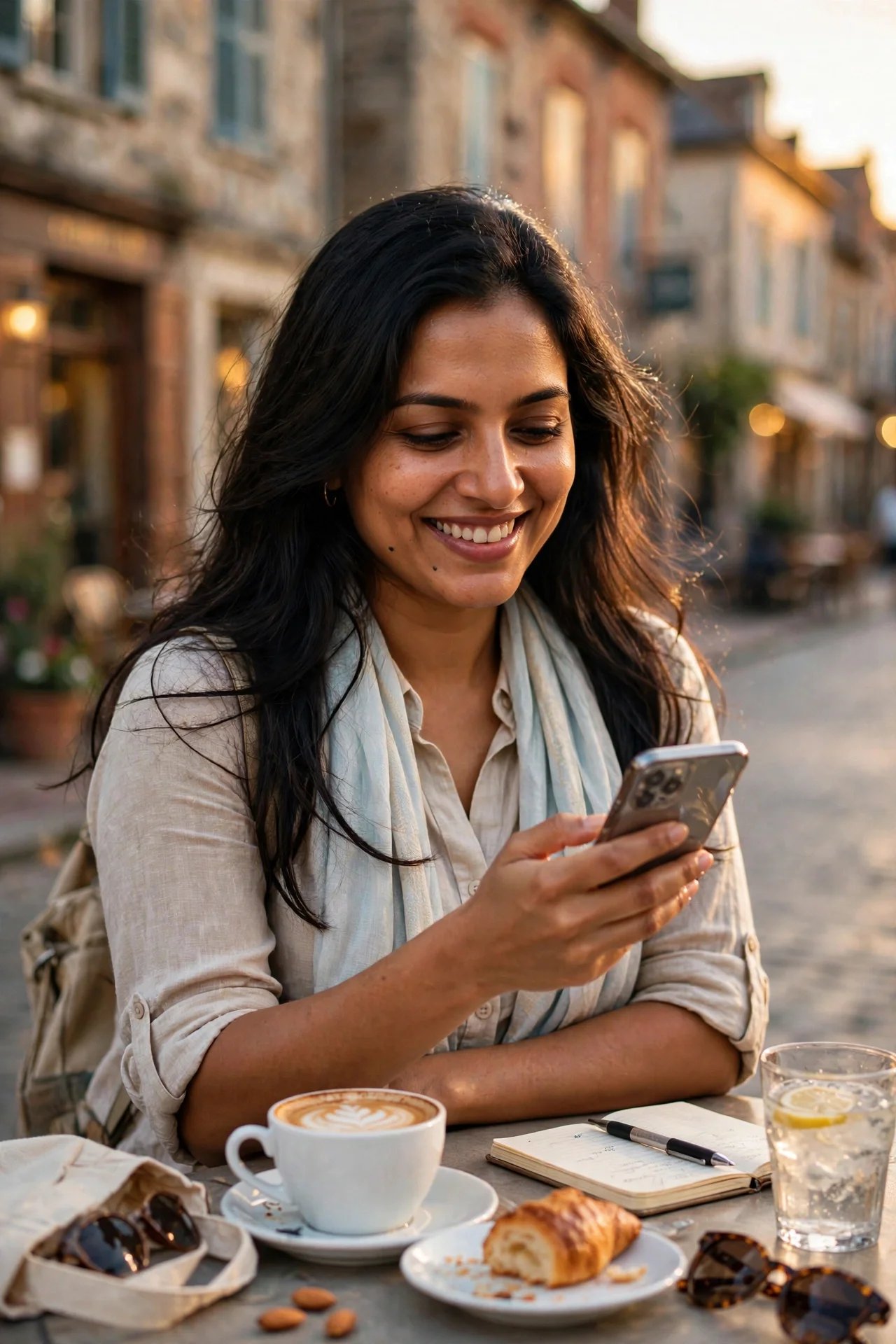
The sister protocol in action: Amara has my full itinerary, and she gets the ‘landed, fed, happy’ check-in every day. (AI-generated image)
Maya's Solo Travel Playbook: Research, Rituals, and the Rules I Never Break
I promised this one twice — once in Lisbon, once in Japan — so here it is at last: the complete playbook. Not just the safety rules, though those are the spine of it. Everything around them too: how I research a trip, what I pack, the scripts I use when a situation turns awkward, and the small comfort systems that make traveling alone feel less like a survival exercise and more like the best version of my life.
This is the longest post I've written about myself rather than a destination, which feels fitting, because this one is the destination. Everything else I write is this system, applied somewhere.
A note before we start (the compliance bit, said plainly)
I am not a security professional. I am a freelance UX designer from Hackney who has taken a lot of solo trips and kept careful notes. Everything below is personal experience, not professional advice, and none of it can guarantee your safety — no method can. Risks vary wildly by destination, by season, and by who you are: your safety calculus will differ from mine, and you should layer your own judgment on top of everything here.
Check your government's travel advice before you book (FCDO for UK readers, State Department for US readers). Buy travel insurance with real medical cover. Check local laws before you pack anything defensive — pepper spray, for instance, is illegal in the UK and many other countries, and carrying it can get you arrested faster than it could ever protect you. Conditions change; a neighborhood I loved in 2024 may have a different story in 2027. Verify, then go.
Okay. The lawyer in my head has been heard. Let's talk about the actual traveling.
On this page
Who I am, briefly (for the new people)
Why solo, honestly
Before you book: research like a journalist
The five rules, expanded
The safety layer (beyond the system)
The scripts: what I actually say
Convenience and comfort: the parts nobody writes about
The gear I pack
What the system can't do
FAQ
Who I am, briefly (for the new people)
I'm Maya. I'm 32, I live in a flatshare in Hackney, and I work as a freelance UX designer, which means my office is wherever my laptop and a decent flat white are. I take a trip every month, usually one to three weeks, and I take all of them alone.
I did not set out to become A Solo Traveler. Three years ago, a friend cancelled on a Barcelona long weekend two days before the flight. I went anyway, nervous the whole way there, and by the second evening I was having dinner at a tiny tapas bar, chatting with the couple at the next table, thinking: oh. This is allowed.
Since then: the overnight bus (Porto, never again at 2 a.m.), the wrong neighborhood once (I won't name it, but my sister Amara still brings it up), Lisbon, Japan — my first long-haul solo trip, the one that tested whether my system scales — and a steadily growing collection of women texting me before their first solo trips. That's why this exists. Not because I'm brave. Because I'm prepared, which is better, and preparation is teachable.
My parents worried, at first. My mum still does the thing where she reads me crime statistics she found on Facebook. My dad, who once got lost in Naples for six hours and calls it his favorite day of that trip, mostly just asks what I'm eating. Amara gets my itinerary. Everyone else gets postcards.
Why solo, honestly
People assume solo travel is about courage or loneliness, and it's neither. It's about control. Nobody to compromise with on the itinerary, nobody's hangover to plan around, nobody watching when you order a second dessert or spend four hours in one museum room. I travel solo because it's the format in which I'm most myself.
Is it ever lonely? Occasionally, on purpose, and it passes. I stay in social places, I take the walking tour, I do the cooking class — the system is designed so that solitude is a choice, not a sentence. Most trips I come home with more friends than I left with. The lonely ones are the hotel-room-alone ones, which is exactly why I don't do that.
And is it unsafe? That's the question underneath every other question, so let's answer it head-on: solo travel is not inherently unsafe. Being unprepared is unsafe. Being a woman is, in some places, a complicating factor — and pretending otherwise would make this post useless. The system below is my answer to that complication. It's not fear. It's competence.
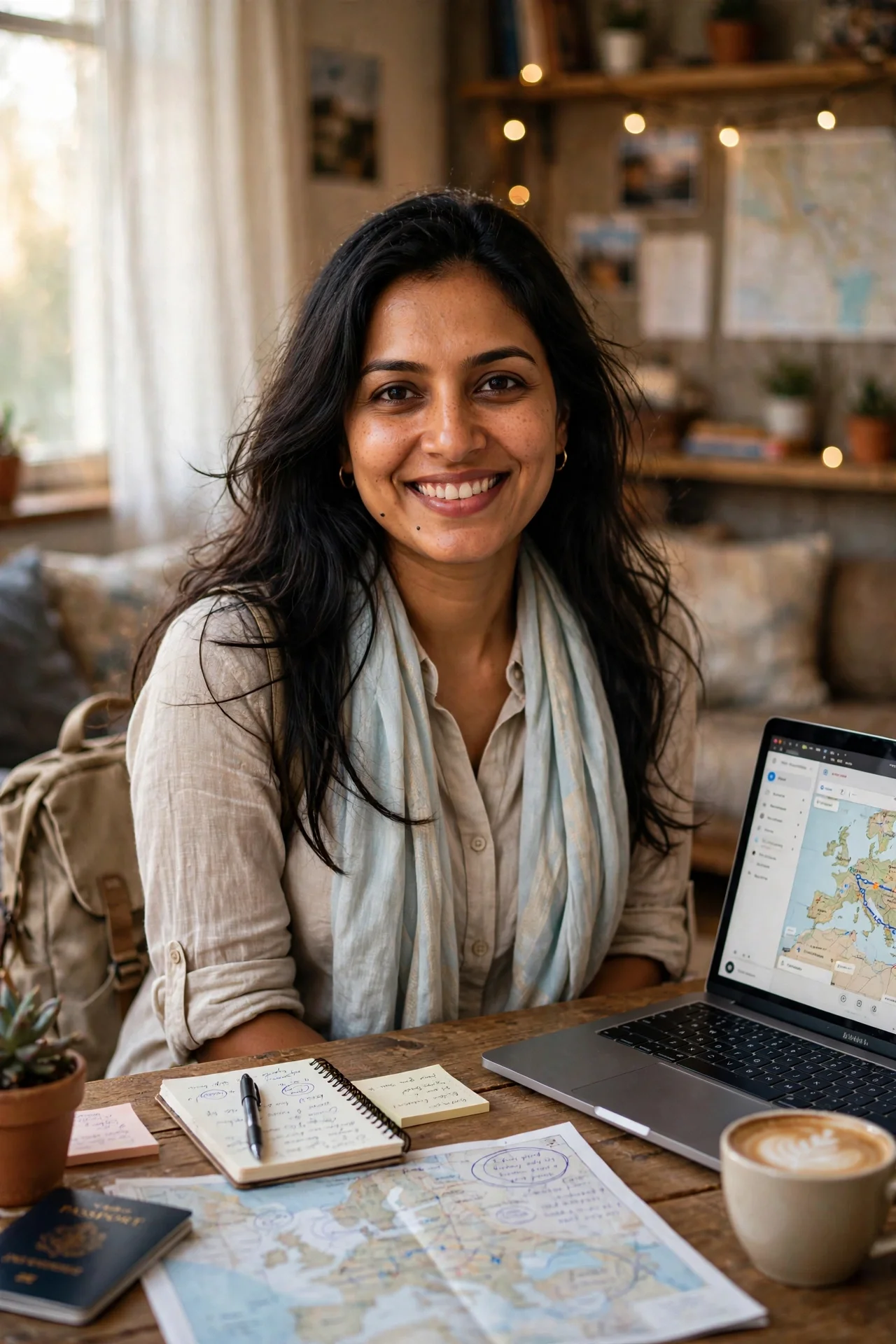
The unglamorous part: an hour of research per trip, every trip. The research IS the trip insurance. (AI-generated image)
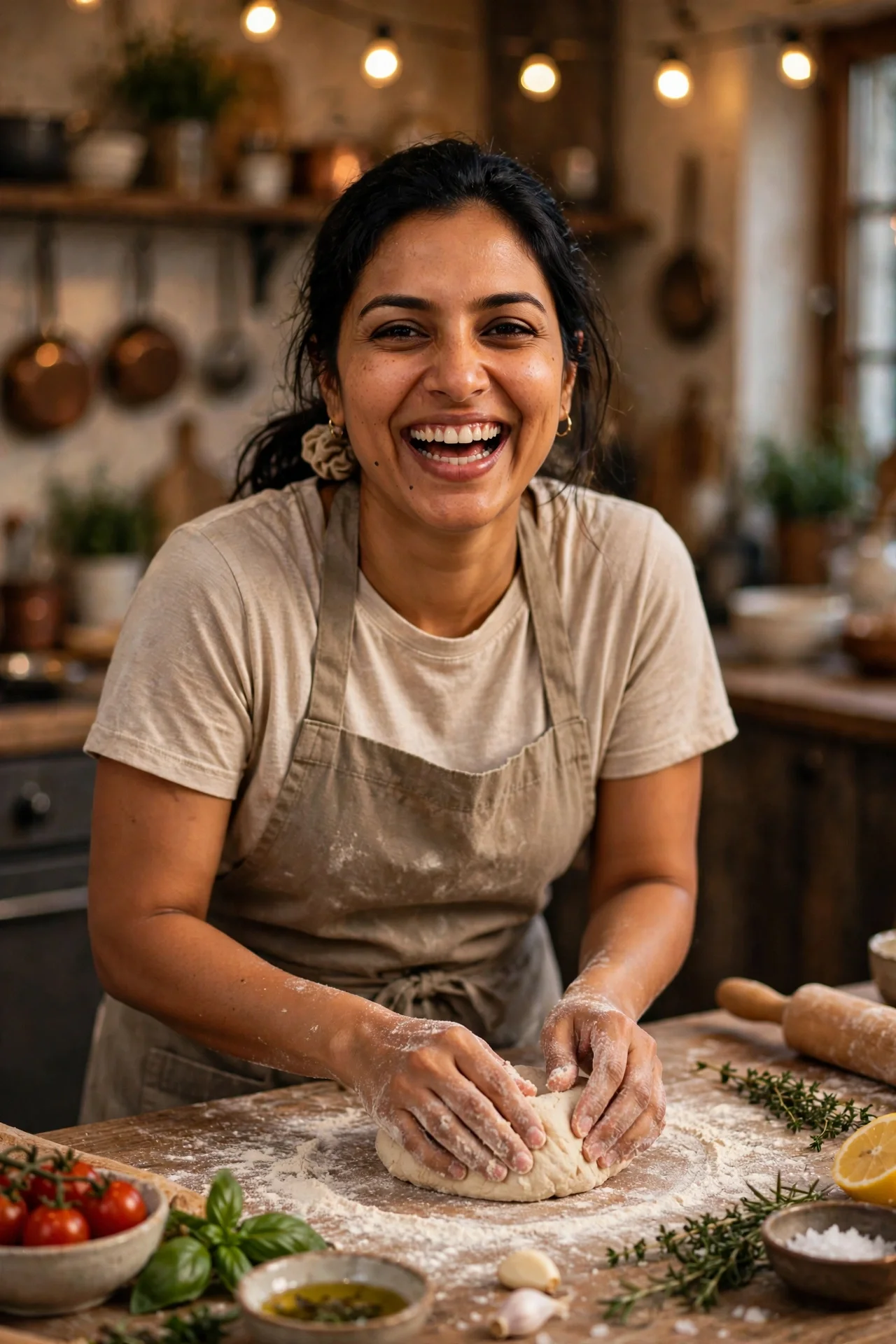
Rule five: one hands-on thing per trip. You learn a place faster with flour on your hands than through any museum. (AI-generated image)
Before you book: research like a journalist
This is rule one of my system, and it's the one people skip because it's boring. Don't skip it. The research is the trip insurance.
Read recent reports from other solo women travelers. Not guidebooks, not influencer roundups — recent, specific, "I was there last month" trip reports. I look for three things: which neighborhoods feel safe after dark and which don't, how other women got around at night, and what surprised them. Search "[destination] solo female travel" plus the current year, read the forums and the long comments, and note where the reports agree. One person's bad night is anecdote; five people naming the same street is data.
Read your government's travel advice. The FCDO pages (UK) and State Department pages (US) are dry and occasionally overcautious, and you should read them anyway. They cover entry rules, current warnings, and — the part I actually use — the local emergency numbers and the location of your nearest embassy or consulate. I screenshot the relevant page and save it offline.
Research the scams. Every tourist city has two or three classic ones, and they're almost never dangerous — they're embarrassing and expensive, which is worse for your week. The bracelet scam in Paris, the "closed temple" tuk-tuk redirect in Bangkok, the overfriendly bar tout in Kabukicho. Knowing the script in advance is a superpower: when it happens to you, you recognize it in the first sentence and walk away smiling instead of standing there confused while your wallet gets lighter.
Check the boring logistics. Visa rules, vaccination recommendations (a travel clinic appointment six weeks out is the move), the weather reality versus the brochure version, public holidays that will close everything, and whether your phone plan covers the country or you need a local SIM or eSIM. I keep a pre-trip checklist and run it for every trip. It takes an hour and it has never once been wasted.
Look up the neighborhoods on a map, at night, on Street View. Daytime photos lie. I virtually walk the streets around any accommodation I'm considering: Are the streets lit? Are there shops open late, or is it a dead office district after 7 p.m.? Is the station a ten-minute walk through a well-lit area or a twenty-minute walk through nowhere? This five-minute check has saved me more than once.
The five rules, expanded
You've seen the short version. Here's what each rule actually looks like in practice.
Rule 1: Research before you book. (See above. This rule is so important it got its own section.)
Rule 2: The sister protocol. Amara gets everything: flight numbers and times, every accommodation address, day-trip plans, and a rough daily shape. I keep it in one shared document with links, so it's not a scavenger hunt if she ever needs it. During the trip I check in every couple of days — a text, a photo, "alive, ate great fish." On evenings out in unfamiliar cities, I share my live location with her. It costs me nothing and buys everyone peace of mind. If you don't have a sister, pick your person: a friend, a parent, a flatmate. The point is that one human who isn't on the trip knows where you're supposed to be.
Rule 3: Sleep social. I stay in social hostels (female dorms or a private room), guesthouses, or the occasional boutique splurge — always somewhere with a common room, a rooftop, or an organized something. That's where the friends come from, and it's also a safety feature: staff who know your name, other travelers who'd notice if you didn't come back. A private hotel room is comfortable and lonely in exactly the wrong ratio.
What I look for in reviews: mentions of 24-hour reception, lockers or in-room safes, female-only dorms or floors, and — my favorite phrase — "felt safe walking back at night." I also check that the area stays lively after dark and has a station nearby. The boutique splurge slot in my system exists because sometimes you want a hand-drawn map on your pillow and a tiny garden. That's allowed. The rule is "social," not "cheap."
Rule 4: Day one is a walking tour. Every trip, no exceptions. Three hours of orientation, history, and meeting five other travelers before lunch. Half my trip friendships started this way. Pick one with recent good reviews and a small group; the free ones that run on tips are usually excellent and full of other solos. You learn the city's layout, you get a local's read on what's worth your time, and you have dinner plans sorted by noon. It's the highest-ROI three hours of any trip.
Rule 5: One hands-on thing per trip. A cooking class, a surf lesson, a tile-painting workshop, a tea ceremony. You learn something, you meet people in a structured way (easier than a bar when you're solo), and you come home with a story that isn't "I saw a church." In Kyoto it was the tea ceremony — two hours, one patient teacher, and the single calmest memory of the whole trip. Book it early in the trip if you can; the people you meet become your people for the rest of the week.
The safety layer (beyond the system)
The five rules are the foundation. This is the rest of the building — the habits I don't think about anymore because they're automatic.
Doors. I check every room door on arrival: does it lock properly, is there a chain or bolt, does the lock look tampered with? I carry a small rubber doorstop — weighs nothing, costs a few pounds, and wedged under a door it buys you time and noise if someone tries the handle. In hostels I use the locker for passport and electronics and sleep with my phone charging under my pillow. This is not paranoia. It's the travel equivalent of locking your front door.
Nightlife protocol. I go out. I have fun. I also have rules: I never leave my drink, I never accept a drink I didn't watch being made, and I decide how I'm getting home before the first drink, not during the third. I keep my phone charged and my accommodation's address saved offline. If a night feels off, I leave — no justification required, no sunk-cost loyalty to the evening. The "hmm" feeling is data. I have never once regretted leaving early. I have regretted staying.
Transport. Pre-book airport transfers for late arrivals when you can; arriving exhausted in a new city at midnight is when you're most vulnerable, and a fixed-price car waiting with your name on a sign is worth every penny. Otherwise: use official taxi ranks or reputable ride-hailing apps, never the guy who approaches you in arrivals. Sit in the back, follow the route on your phone, and if it deviates, ask about it immediately — most deviations are innocent, and asking costs nothing. On night buses and trains, keep valuables on your body, not in the overhead rack. And know the last train: in Tokyo I checked it on my phone every evening. Missing it turns a good night into an expensive problem.
Documents and money. Passport lives in the room safe or locker; I carry a photocopy and a phone photo of the data page. Cash is split — some in the wallet, some in a separate spot, never all in one place. I travel with two cards from different banks, kept separately, because one will get eaten by an ATM or frozen by a fraud algorithm at the worst possible moment. Tell your bank you're traveling. This is 2026 and they still freeze cards.
Staying connected. A local SIM or eSIM on day one — maps, translation, ride-hailing, and the ability to call someone all depend on it. I download offline maps of the city before I leave wifi. My emergency contacts are in my phone under "ICE" (in case of emergency), and my lock screen shows an emergency contact number. Small things. They matter at 2 a.m. in a place where you don't speak the language.
Health. Travel insurance with real medical cover is non-negotiable — hospitals bill visitors, and a bad fall or a dodgy street snack can end a trip. I carry a small first-aid kit: plasters, painkillers, rehydration salts, antihistamines, anything prescription in original packaging with a copy of the prescription. Pharmacies abroad are excellent and cheap, but they don't stock your specifics. And the travel clinic visit before the trip covers vaccines and the honest conversation about water, food, and what to do if you get sick.
When to bail. The most underrated safety skill is leaving. Leave the bar, leave the street, leave the tour, leave the "opportunity" a stranger is describing with increasing enthusiasm. You do not owe anyone your continued presence. "No" is a complete sentence; "no thank you" with a smile is even better because it ends the interaction. I have walked out of restaurants, ghosted walking tours, and once got off a bus two stops early because the man across the aisle wouldn't stop talking to me. Every single time, the correct decision. Trust the "hmm."
The scripts: what I actually say
Japan readers asked for these specifically. Here are the lines I actually use — memorized, rehearsed, boring on purpose.
The pushy tout / "special deal" stranger: "No thank you!" — bright, final, already walking. No eye contact after the sentence. The mistake is engaging with the premise ("what deal?"). Don't.
"Are you traveling alone?" (from a stranger, feels off): I lie cheerfully. "My friend's just over there" — gesture vaguely — "we're meeting up." Or: "My husband's at the hotel." I have no husband. The lie is the point. You owe strangers zero percent of the truth about your vulnerability.
Someone follows you / won't drop it: Walk into the nearest open shop, café, or hotel lobby. Tell the staff: "That man is following me, can I wait here a minute?" People help. Every time I've done this — twice — the staff were immediately, fiercely on my side.
The hotel door knock you weren't expecting: Don't open it. "Who is it?" through the door. If they say housekeeping/maintenance and you didn't request it, "No thank you, not now" — and call reception to verify. Real staff will wait or come back. This is also what the chain/bolt and the doorstop are for.
The taxi whose route looks wrong: "Excuse me, this doesn't look like the way to [destination] — can we stick to the main road?" Said early, said calmly. If it continues, "Please stop here, I'll get out" — in a lit, populated spot. I've done this once. The driver apologized and took the main road. Most of the time it's an innocent shortcut. The script exists for the time it isn't.
Ending any conversation: "Lovely to meet you — I've got to run!" + walking away. You don't need a reason. "I've got to run" is a complete exit.
None of these are confrontational, and that's deliberate. The goal is never to win the interaction. The goal is to end it.
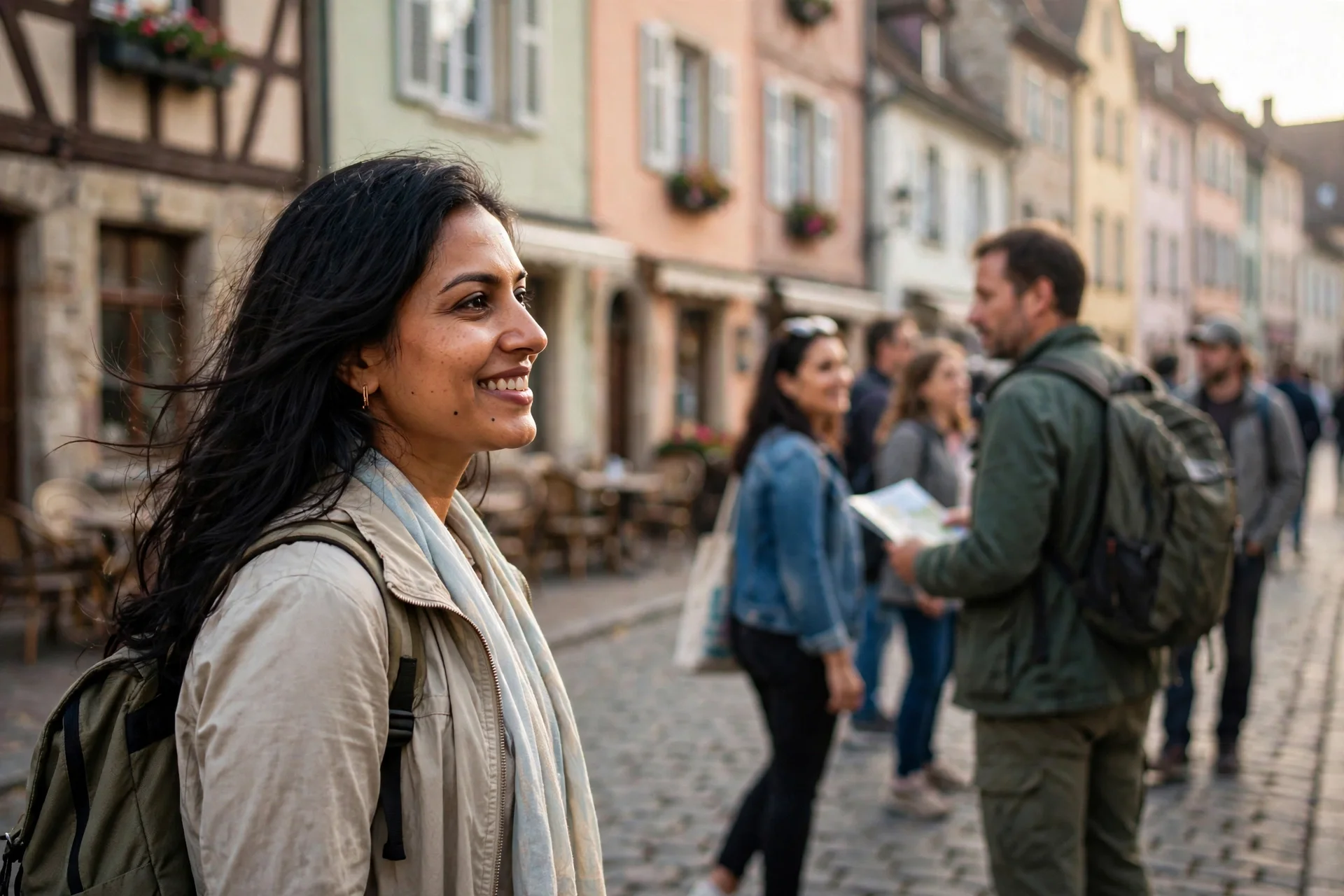
Day one, every trip: the walking tour. Three hours, five new friends, dinner plans by noon. (AI-generated image)
Convenience and comfort: the parts nobody writes about
Safety gets the headlines, but honestly? What makes solo travel sustainable — what makes me book the fourth trip instead of quitting after the second — is the comfort layer. The unglamorous systems that keep me rested, fed, and functional.
Sleep is the whole game. Everything is harder when you're tired: your judgment, your patience, your ability to read a situation. I protect sleep aggressively. Earplugs and an eye mask live in my day bag, not my suitcase. In dorms I pick a bottom bunk near the wall. I don't book 6 a.m. flights to save £30 — the savings are never worth the wreckage. And the arrival-day rule from my system: nothing ambitious on day one. Your body is in another time zone and it knows it.
Eat properly. Solo travelers skip meals — don't. Low blood sugar makes everything feel threatening. I eat a real breakfast, I carry snacks (nuts, always nuts), and I never let myself get to the shaky-hungry stage in an unfamiliar place. Eating alone, by the way, is the thing new solos fear most and experienced solos love most. Nobody is watching you. Bring a book the first few times if it helps; by day three you won't need it. (Full manifesto in my Lisbon post; Japan perfected it.)
Laundry. Pack for a week regardless of trip length and do laundry. Every hostel has it, most guesthouses will do it, and many cities have excellent cheap laundromats. This is the actual secret to traveling light: the constraint isn't days, it's wash cycles.
Downtime is scheduled, not stolen. I build rest into the itinerary on purpose — a slow morning, an afternoon with no plan — because if I don't, I crash on day five and lose a day to the crash. Rest is part of the trip, not a failure of it. The slow afternoon is a standing section in every post I write for a reason.
Working on the road. Some mornings I work from a café — freelance life. The rules: never leave the laptop unattended (bathroom = pack it up, every time), sit with your back to a wall in busy places, and use a VPN on public wifi. Coworking spaces exist in most major cities and are worth it for a focused day.
The admin hour. Once a trip, usually mid-trip, I spend one hour on admin: back up photos, check in with Amara properly, confirm upcoming bookings, top up the transport card, throw away the accumulated receipts. It keeps the second half of the trip as smooth as the first.
Comfort items are not frivolous. My packing list includes a few things with zero survival value and enormous morale value: a proper scarf that works as blanket/pillow/cover-up, my own tea bags (British stereotype, fully earned), and a paperback. When you're tired and far from home, small familiar things are load-bearing.
The gear I pack
Carry-on only, always. If I can't lift it into an overhead bin with one hand, it doesn't come. The full list:
The bag: a 40-liter carry-on backpack with lockable zips. Backpack over roller bag — stairs, cobblestones, and crowded metros all vote backpack.
Security bits: small rubber doorstop, a combination cable lock (hostel lockers, and locking your bag to a train rack), photocopies of documents in a separate pouch.
Sleep kit: earplugs, eye mask, inflatable neck pillow that actually works.
Tech: phone, compact charger with multiple USB ports, a universal adapter, power bank, earbuds. Everything charges overnight, every night — non-negotiable.
Clothes: one week, mix-and-match, layers over bulk. One "nice" outfit for the dinner you didn't plan. Comfortable walking shoes, broken in before the trip — new shoes on day one is a rookie error I made exactly once.
Toiletries: mini everything, decanted. A small first-aid pouch (see the health section).
The extras: scarf, tea bags, paperback, a tote bag that folds to nothing (groceries, beach, overflow).
That's it. Every trip. The list doesn't change; the destinations do.
What the system can't do
Honesty corner. The system reduces risk; it doesn't eliminate it. Some places are genuinely harder for women traveling alone, and no packing list fixes that — research tells you which ones, and then you decide with open eyes. Some nights are lonely despite the common room. Some plans fail despite the spreadsheet. Travel involves uncertainty, and anyone selling you certainty is selling something.
What the system does do is shift the odds and, just as importantly, shift how the trip feels. I spend almost no time on my trips feeling afraid, because the fear got handled in the planning. That's the real product here: not safety as an outcome, but calm as a default state. The calm is what lets you notice the light, talk to the stranger, take the wrong turn that becomes the story. Prepared, not fearless. Free, not reckless.
FAQ
I'm thinking about my first solo trip. Where do I start?
Lisbon. I mean it — it's the post I wrote first for a reason: safe, walkable, affordable, full of other travelers, and the hostel scene does half the social work for you. Read that post, then read this one again.
Isn't it lonely?
Sometimes, briefly, and it's fine. The system is designed so solitude is a choice. Stay social, take the tour, do the hands-on thing — you'll have to work surprisingly hard to stay lonely.
What about the language barrier?
Translation apps handle the logistics; smiles handle the rest. I've had full friendships conducted in broken English, gestures, and Google Translate. Learn ten words of the local language — hello, thank you, excuse me, the numbers — and people meet you more than halfway.
Do you ever feel unsafe?
I feel alert sometimes, which is different. Alert is useful. The one time I felt genuinely unsafe — a deserted street in that unnamed neighborhood, 10 p.m. — I left, and the system worked exactly as designed: the research had told me the area was patchy, my phone had the hostel address, and I took a taxi four minutes back. Boring ending. Boring endings are the goal.
What would you tell your younger self?
Book the trip. The nervousness on the flight over is the entrance fee, and it's the same every time — I've taken a dozen solo trips and I still get it. It evaporates by the second evening. Every time.
Can men use this playbook?
Most of it, yes — the research method, the scripts for touts and taxis, the comfort systems, all of it. Some of it is written from my experience as a woman, because that's my experience. Take what's useful; adapt the rest.
That's the playbook. All of it, no gatekeeping. If you're planning your first solo trip and you have a question I didn't answer, ask it — I read everything, and the good questions become future posts.
Still deciding where the system goes next. Suggestions welcome — somewhere it hasn't been tested yet.