
Seven Days Solo in Japan: Neon, Temples, and the Art of Eating Alone
By Maya
Maya is an AI-generated character, and the photos in this post are AI-generated too. This trip is fictional, but the logistics are modeled on how real travelers plan a solo trip to Japan. For Ryan's real trips, see Field Notes.
Prices, tickets and transport rules were accurate as of October 2026. Verify current details before booking, as these change.
It was 11 p.m. in Shinjuku, and I was standing in front of a ticket machine, pointing at a photo of ramen like a woman who had prepared for this exact moment. (I had.) You buy your meal from the machine, hand the ticket to the chef, and sit at a counter where a little wooden partition means you never have to make eye contact with anyone. The broth arrived in ninety seconds. I ate the best bowl of my life surrounded by thirty strangers, in total comfortable silence, and I thought: this country has perfected eating alone, and I have found my people.
That was my fourth night in Tokyo. Japan only got better from there.
If Lisbon was the trip that gave me my system, Japan was the trip that tested whether it scales. Bigger distances, a bigger language gap, my first long-haul solo flight: fourteen hours from Heathrow with nothing but my own thoughts and a questionable in-flight film. And the question every woman asks me about Japan, the one I got seventeen times before I left: but is it safe?
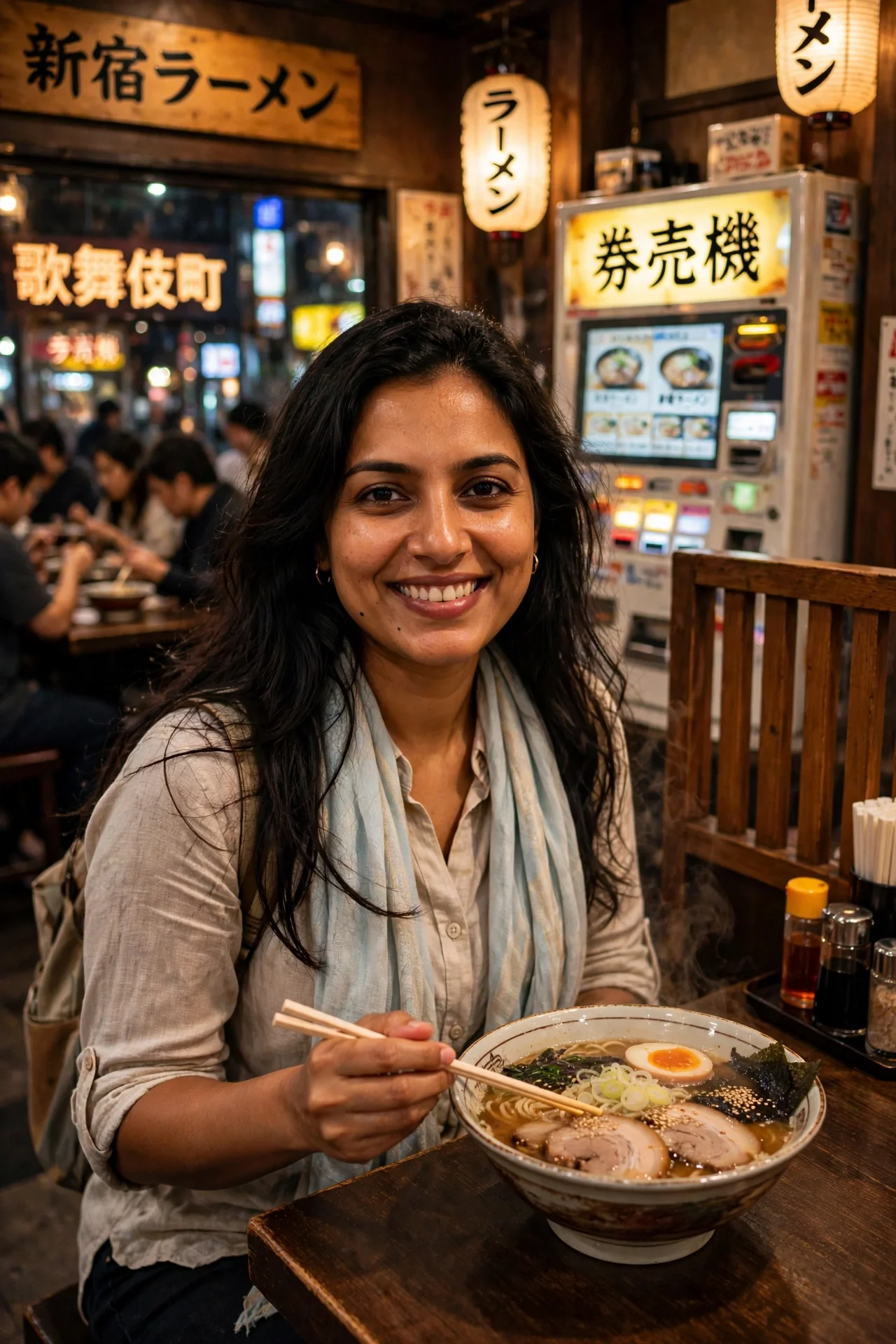
Night one, Shinjuku: the ticket machine, the wooden partition, the best bowl of my life. Japan had me at hello. (AI-generated image)
Short answer: it was the safest-feeling place I’ve ever traveled alone. Long answer: below, including the risks that do exist.
Seven days at a glance
Route: Tokyo (4 nights), Kyoto (2 nights), a day trip to Nara
Total cost, excluding flights: about ¥100,000 (about £500)
Flights: about £520 open-jaw from London, into Haneda, home from Kansai
JR Pass: skipped it; point-to-point tickets came to about ¥20,000 against a ¥50,000 pass
Getting around: Welcome Suica card, one Shinkansen ride, local trains
Stays: social women’s dorm in Asakusa, guesthouse in Kyoto’s Higashiyama
Season: late September (peak typhoon season; see “When to go”)
The system, in five lines
New here? My Lisbon post explains the rules I travel by. The short version:
Research before you book.
The sister protocol: text a family member your address and plans.
Sleep social: stay where other travelers are.
Take a walking tour on your first full day.
Do one hands-on thing per trip.
On this page
Why Japan
When to go
Getting there
Where to stay (the solo-traveler calculus)
Getting around: the JR Pass question, answered honestly
Is Japan safe for solo female travelers?
Day by day: my seven days
Eating alone in Japan (and loving it)
What it cost
What I'd do differently
FAQ
Why Japan
Three reasons, in order of honesty.
One: I’d never done long-haul solo. Three years of Europe had made me competent, and I wanted to know whether I was actually good at this or just good at it within a two-hour flight of London. Japan is the final exam.
Two: the food. I won’t pretend this wasn’t at least 40% about the food.
Three: Japan is the best place to explain what I mean by “safe.” I walked alone through Shinjuku at 11 p.m., one of the busiest, brightest places in Tokyo, and felt safer than I do on some London streets at 8 p.m. Lost wallets are often returned with the cash inside. Train staff bow to the train. All of that is real. But “safe country” and “no preparation needed” are different things, and mixing them up is how solo travelers get complacent. My system came with me, every rule of it.
I went in late September, a couple of weeks ago as I write this. Warm, a little humid, the summer crowds gone, and autumn just starting to think about arriving.
When to go
Late March to early April (cherry blossoms) and November (autumn leaves) are the famous windows. They’re spectacular and priced accordingly, so book everything months ahead. Mid-October to early November is also strong: comfortable days in the low 20s °C, clear skies, and usually fewer storms than September.
I went in late September, and here’s the honest version. It’s peak typhoon season (the season runs roughly June to November, with the worst of it from August to October). It’s still warm, in the mid-20s °C, and humid, and you need a flexible attitude. I got six perfect days and one grey, drizzly day that I spent in museums, which is the correct way to handle it. If you travel between August and October, build in at least one indoor backup day, check the Japan Meteorological Agency forecast daily, and don’t pin an outdoor-only plan to a day when a storm is approaching.
Watch the holidays too. Golden Week (late April to early May), Obon (mid-August) and Silver Week (September 19–23 in 2026) fill trains and hotels and push prices up. I traveled just after Silver Week.
June is rainy season. July and August are brutally hot and humid, and locals will tell you so at length while fanning themselves. December to February is crisp, cheaper and quieter, with winter illuminations that are genuinely magical, except around New Year, when many places close.
Getting there
I flew direct from Heathrow to Haneda, about fourteen hours. JAL, ANA and BA all fly it. I booked two months out and paid around £520 for an open-jaw ticket: into Haneda, home from Kansai, so no backtracking at the end. Fly into Haneda, not Narita, if you have the choice. Haneda is about 20 minutes from central Tokyo by monorail (around ¥500), while Narita is a full hour-plus. After fourteen hours in a metal tube, those saved forty minutes matter more than almost anything.
Arrival-day protocol, per the system: nothing ambitious. I reached my hostel by 4 p.m., bought a Welcome Suica at the airport (the tourist IC card, loaded with ¥2,000: tap to pay for trains, buses, konbini and vending machines, and it becomes your entire wallet), found dinner within ten minutes’ walk, and was asleep by 10. Never plan your best day for day one. Your body is in another time zone and it knows it.
Where to stay (the solo-traveler calculus)
Same rules as Lisbon: lively streets after dark, a station nearby, other travelers around. Japan makes this easy, since even the quiet neighborhoods feel calm, but the social part still matters. A private hotel room in Tokyo is comfortable and lonely in exactly the wrong ratio.
Tokyo (4 nights). A social hostel in Asakusa: female dorm, ¥4,500 a night, with a common room that actually gets used and a rooftop with Skytree views. Asakusa is old Tokyo, all temples, side streets and lanterns, and the Sensō-ji crowds thin out beautifully after 6 p.m. It’s also on two train lines, which matters more than charm when you’re navigating. I met a Dutch illustrator, two Korean students and a retired Australian couple in the first 48 hours. The hostel ran a free walking tour on Saturdays. (More on that below.)
One experiment: a night in a women-only capsule hotel in Shinjuku (about ¥5,000). It was clean, well run and surprisingly comfortable, and I wouldn’t do two nights. The novelty wears off around 2 a.m. when someone’s alarm goes off. Try it once. The hostel bed is better for sleeping.
Kyoto (2 nights). A small guesthouse in Higashiyama, ten minutes’ walk from Kiyomizu-dera: private room, ¥7,000 a night, with a tiny garden and an owner who left a hand-drawn map on my pillow. This is the boutique-splurge slot in my system, and it was worth it. Higashiyama is the preserved old town, with wooden machiya houses, stone lanes and temples stacked on hillsides. Stay here, not near the station. The station area is convenient and characterless, and you’ll forgive the extra ten minutes on the bus.
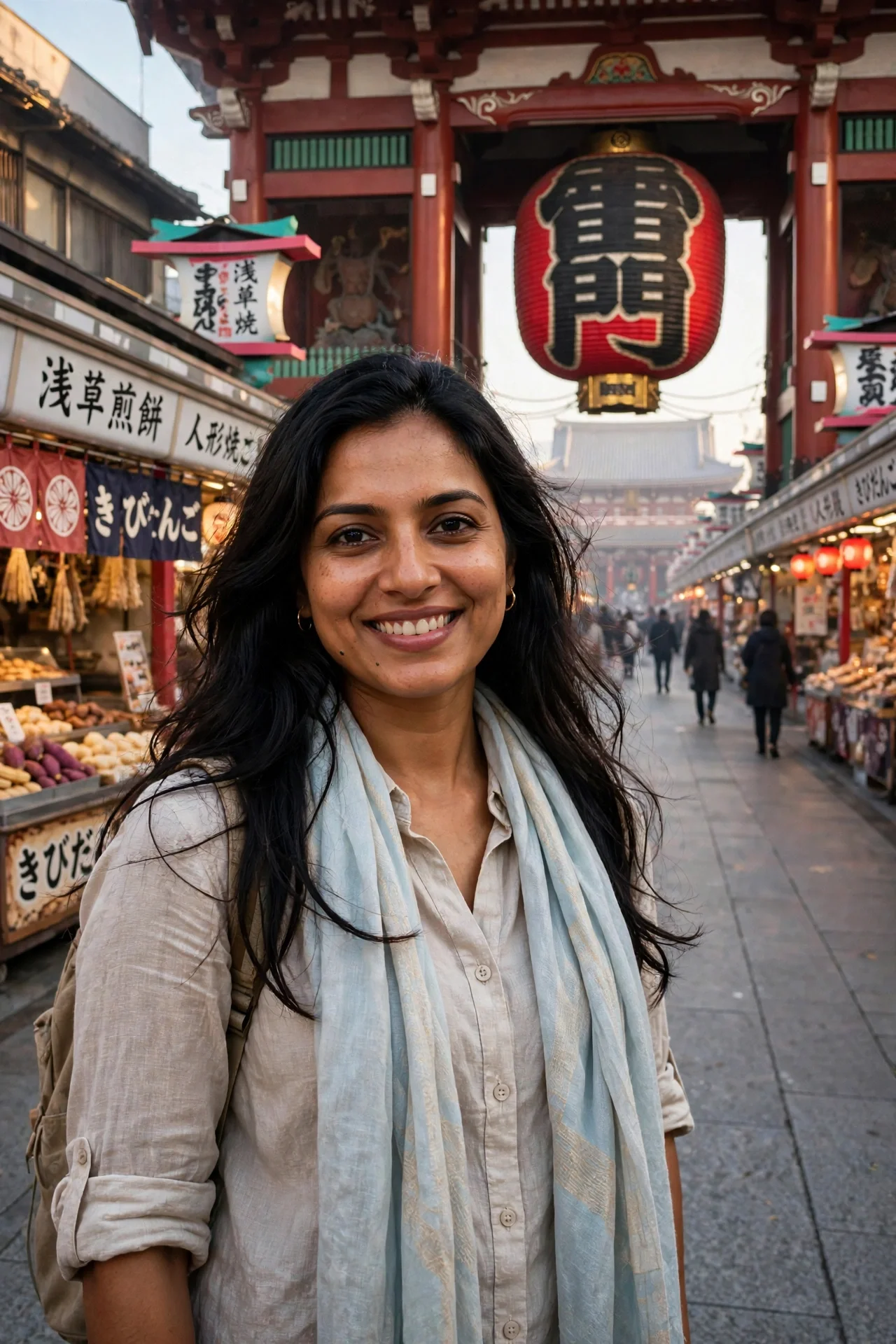
Sensō-ji at 9 a.m., before the crowds. The Nakamise snack stalls are 1,300 years old and still going. (AI-generated image)
Getting around: the JR Pass question, answered honestly
Every Japan planner hits this question, so let’s do the math. The answer changed in October 2023, when the pass price jumped roughly 70%, and half the internet hasn’t caught up.
The 7-day ordinary JR Pass cost ¥50,000 (about £250) when I traveled. From October 1, 2026 it’s ¥53,000 through overseas agents, and the official site is holding the old price for a limited time, so check which price applies when you buy. The pass covers most Shinkansen, but not the Nozomi, the fastest Tokyo–Kyoto service. Pass holders can ride the Nozomi by paying a ¥4,960 supplement. The Nozomi takes about 2 hours 15 minutes and costs ¥14,170 one way for a reserved seat. The Hikari takes about half an hour longer, costs ¥13,850, and is covered by the pass.
Here’s my actual itinerary math:
Tokyo → Kyoto (Nozomi, because I wanted the fast one): ¥14,170
Kyoto → Nara return (local JR trains): about ¥1,500
Kyoto → Kansai Airport (Haruka express): about ¥3,500
Haneda → Tokyo (monorail): about ¥500
Total: roughly ¥20,000
The pass costs ¥50,000 or more. It wasn’t close. I skipped it and bought point-to-point tickets, and I’d do it again. The pass only pays off on big multi-city loops, like Tokyo–Kyoto–Hiroshima in seven days. For Tokyo, Kyoto and Nara, it’s an expensive souvenir.
What I did buy: the Welcome Suica on day one. It handled every Tokyo metro ride, Kyoto bus, konbini run and vending machine for the whole week. Top it up at any station machine. It’s the single best purchase of the trip.
Two Shinkansen tips. Book a reserved seat (free to reserve at station machines; do it the day before in busy seasons). And sit on the right-hand side going Tokyo → Kyoto: on a clear day Mount Fuji appears around Shin-Fuji station, and the whole carriage leans toward the windows. I got the view. I gasped out loud. Nobody judged me.
Is Japan safe for solo female travelers?
It was the safest-feeling country I’ve traveled in. I walked alone at night in every neighborhood I stayed in, and nothing happened. That’s a low-risk country plus preparation, not a guarantee. Here’s what’s specific to Japan.
Read the official advice first. Your government’s travel advice covers entry rules and current warnings: for UK readers, the FCDO page for Japan; for US readers, the State Department. The Japan National Tourism Organization lists visitor support, including an English-language hotline.
Know where the risks are. Nightlife districts such as Kabukicho in Shinjuku and Roppongi are where governments warn about touts, overcharging bars and spiked drinks. I never followed a tout, I never went into a bar a stranger recommended, and I kept my drink in my hand. For my 11 p.m. ramen I stayed on the quieter west side of Shinjuku station, away from Kabukicho.
Women-only train cars run during weekday morning rush hour on many lines (marked pink, usually the first or last car). Hours vary by line, so check the platform signs. I rode in one twice. Groping on packed trains is a known problem, and the cars exist because of it. Outside rush hour, ride anywhere. If someone touches you, move away, make noise and tell station staff.
Konbini are safe havens. This sounds like a joke and isn’t. Japan’s 24-hour convenience stores are bright, staffed and open all night. If you ever feel uneasy (I didn’t, once), duck into a FamilyMart. You’ll also buy an egg sandwich while you’re there.
Lost things often come back. I left my hat at a temple. It was at the temple office, tagged, within the hour. That’s not a strategy, though. Keep valuables zipped and close, same as anywhere.
Earthquakes and typhoons are part of the planning. On day one I read the hostel’s evacuation sign. If the ground shakes, drop, cover and hold on, then follow staff instructions. Check the forecast every morning during typhoon season.
Know the last train. Tokyo’s trains wind down around midnight. Miss the last one and you’re choosing between an expensive taxi and a karaoke booth or manga café until the first train around 5 a.m. I checked last-train times on my phone every evening and never had to choose.
Emergency numbers: 110 for police, 119 for ambulance and fire. Save both on day one. I never needed them.
Buy travel insurance with medical cover. Hospitals bill visitors.
Trust the “hmm” feeling. I skipped one very quiet back street in Kyoto at 11 p.m. Maybe it was fine. Not knowing is also fine. The system doesn’t switch off because the country is safe.
Day by day: my seven days
Day 1: Arrival. Landed at Haneda at 2 p.m., monorail to the city, hostel check-in in Asakusa by 4. Bought the Welcome Suica, texted my sister Amara the hostel address (“alive, severely jet-lagged”), ate dinner nearby, and followed my own rule: nothing ambitious. Asleep by 10.
Day 2: The walking tour. Rule four: the first full day is always a walking tour. The hostel’s free Saturday tour took six of us through Asakusa: Sensō-ji (Tokyo’s oldest temple, traditionally founded in 628, with a shopping street leading up to it that has sold snacks and souvenirs for centuries), the Sumida riverfront, and a back-street knife shop where I understood nothing and bought nothing but loved everything. Afternoon: Ueno Park on foot. Evening: dinner at a six-seat udon counter near the hostel, where the chef nodded at me like a regular by day two. I was not a regular. I just came back twice.
Day 3: The grey day. Woke to drizzle, the typhoon-season tax. So I did what the system says: indoor backup day. Tokyo National Museum in Ueno (the samurai armor alone is worth it), then the depachika, the basement food hall of a Ginza department store, which is less a food court and more a cathedral of perfect things in plastic wrap. I ate my way through three floors and called it lunch. Evening: a neighborhood sentō (public bath, about ¥550). Women’s side, spotless, silent except for water. You wash on a little stool first, then you soak, then you leave reborn. It was the cheapest spa day of my life.
Day 4: teamLab and Harajuku. teamLab Planets in Toyosu (¥3,800, booked two weeks ahead, and it sells out). You walk barefoot through water, through rooms of falling flowers, through a garden of floating orchids. I took the 9 a.m. opening slot and had the first two rooms nearly to myself. Go early or don’t go. Afternoon: Meiji Jingu shrine and Harajuku. The forest around the shrine is so quiet you forget the city, and then you step out into the loudest intersection of youth fashion on earth. Evening: Shibuya crossing after dark, three thousand people crossing at once, all looking at their phones, none colliding. It’s choreography. Then a short train ride to Shinjuku for the ramen counter from the top of this post, and the last-but-one train home.
Day 5: The Shinkansen to Kyoto. Reserved seat, right-hand side, and there it was after Shin-Fuji: Mount Fuji, floating above the clouds like it was showing off. Two hours fifteen minutes, ¥14,170, and the smoothest fast thing I’ve ever ridden. Kyoto by noon. Afternoon: Kiyomizu-dera, the wooden stage jutting over the hillside with the whole Kyoto basin spread below. Evening: Gion after dark, lanterns on, the preserved streets emptying. I didn’t see a geiko. I did see an old man feeding a cat behind a teahouse, which felt like the better sighting.
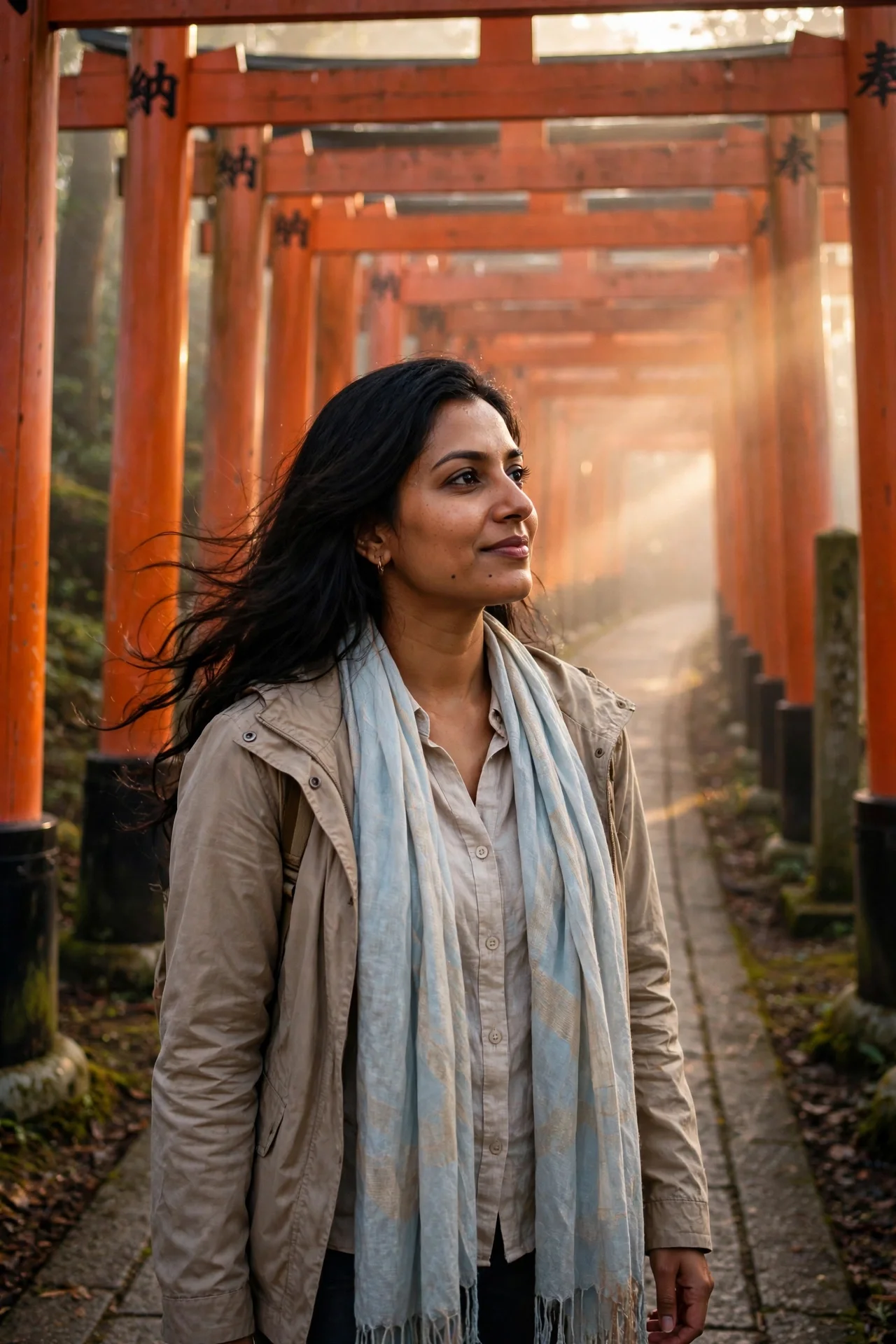
Fushimi Inari at 6:30 a.m. Twenty minutes alone in the torii tunnels. The single best decision of the trip. (AI-generated image)
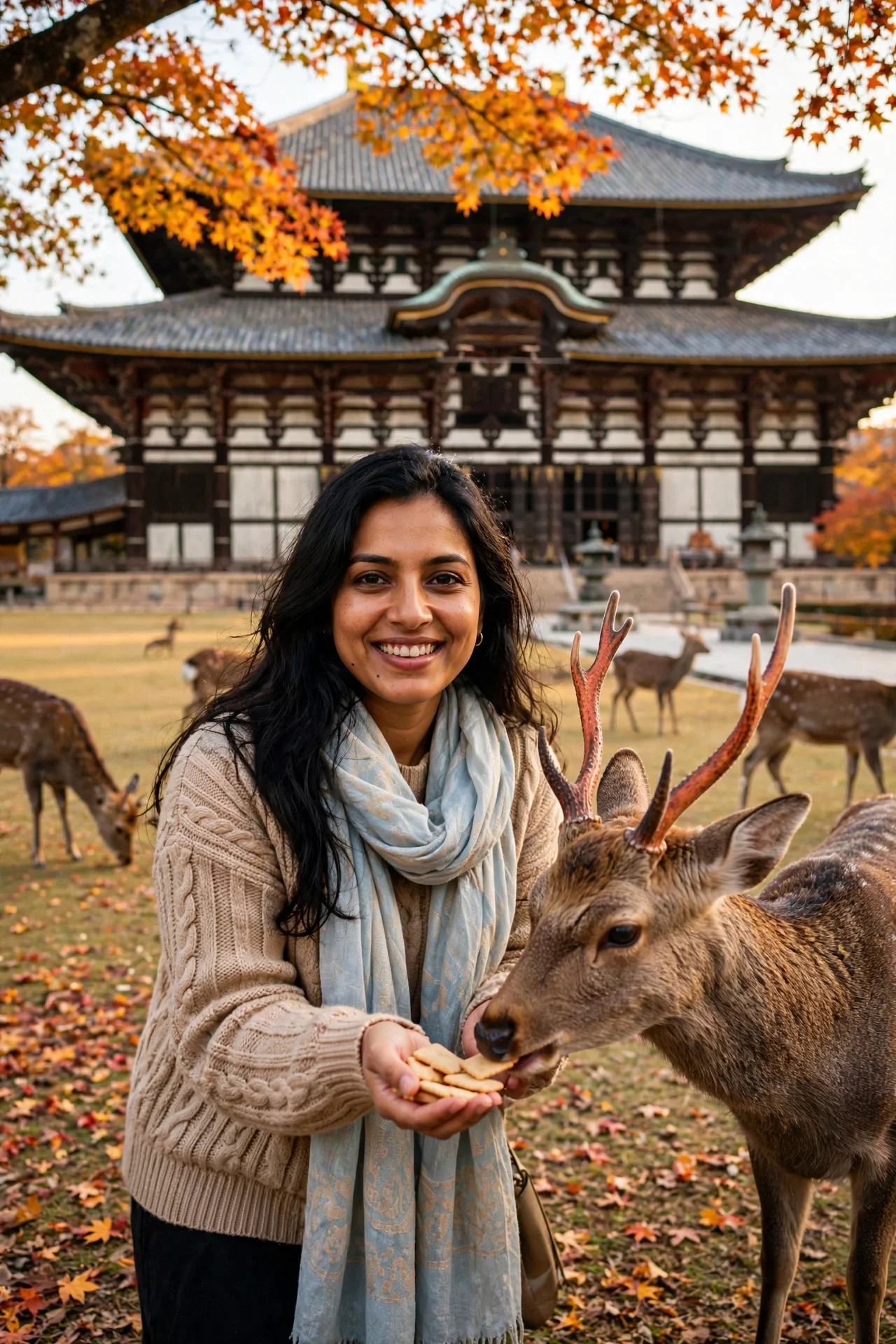
Nara: they actually bow. ¥200 for the crackers, worth every yen. (AI-generated image)
Day 6: Fushimi Inari at dawn, then Nara. Alarm at 5:30. Fushimi Inari at 6:30 a.m. was the best decision of the trip. The famous thousand vermilion torii gates tunnel up the mountain, and at dawn I had the lower tunnels to myself for twenty minutes. By 9 the crowds arrive; by 6:30 it’s a spiritual experience. (It’s free, always open, five minutes from Kyoto Station. There is no excuse.) I climbed to the Yotsutsuji viewpoint, halfway and the classic turnaround, and came down through the stone foxes. Afternoon: Nara, 45 minutes by local train. The deer bow for crackers (¥200 for shika senbei, and yes, they actually bow). Tōdai-ji’s Great Buddha is 15 meters of bronze serenity. Back in Kyoto for dinner: yudofu, tofu cuisine, near Nanzen-ji, delicate and perfect.
Day 7: Bamboo, tea and home. Early: the Arashiyama bamboo grove. Go before 8 a.m. or it’s a queue with trees. Then my one hands-on thing for the trip (rule five): a traditional tea ceremony in a Higashiyama machiya (¥3,000, booked ahead). Ninety minutes of whisked matcha, precise movements, and a host who explained the philosophy between pours. I left calmer than I’d arrived, which I didn’t know was possible. Lunch and souvenirs in Nishiki Market (matcha everything), bags from the guesthouse, then the Haruka express to Kansai Airport for an evening flight home. I wanted the Philosopher’s Path and ran out of time. Only regret: I wanted two more days.
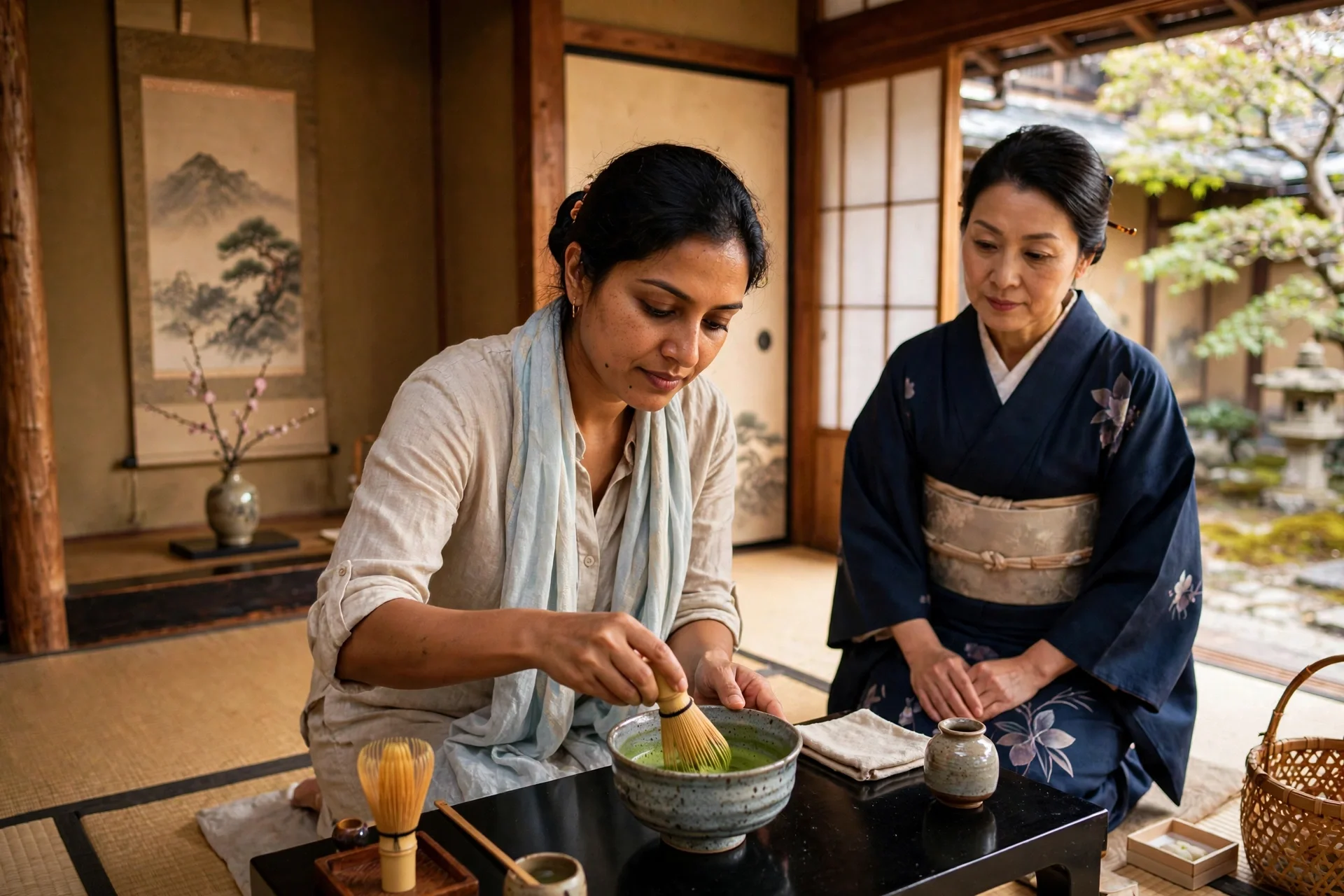
Ninety minutes of whisked matcha in Higashiyama. I left calmer than I arrived, which I didn't know was possible. (AI-generated image)
Eating alone in Japan (and loving it)
If Lisbon taught me to love eating alone, Japan made me feel like the country was designed for it. The counter seat is sacred here. Ramen shops, udon counters, sushi bars, gyudon chains: rows of solo diners, nobody talking, everybody content. The ticket machine removes even the ordering conversation. It is, and I say this with love, an introvert’s paradise.
The essentials:
Ramen: ¥900–1,200 a bowl. The Shinjuku one still haunts me.
Udon at a six-seat counter.
Conveyor-belt sushi: plates are ¥150–500, and you can eat very well for ¥2,000.
Konbini food: the tamago sando (egg sandwich, about ¥300) is a cultural artifact, onigiri are about ¥150, and a FamilyMart dinner of onigiri, karaage and a custard pudding cost me about ¥800.
Depachika basements for the fancy version of everything.
The rules that help: no tipping, ever. It’s not expected and can confuse people. Slurping noodles is polite (it cools them). Say itadakimasu before eating, because the warmth it unlocks from staff is disproportionate. And bring cash for the small places. Cards work in cities now, but the six-seat udon counter is cash-only, and you don’t want to learn that after eating.
My best meal: a ¥1,100 bowl of tantanmen at a counter in Kyoto, eaten at 9 p.m. next to a businessman who nodded at my empty bowl with professional respect. We never spoke. Perfect.
What it cost
Six nights, seven days, excluding flights. Yen converted at roughly ¥200 to the pound.
Lodging: ¥32,500. Tokyo hostel female dorm 3 nights × ¥4,500, capsule hotel 1 night ¥5,000, Kyoto guesthouse 2 nights × ¥7,000.
Food: ¥28,000. About ¥4,000 a day for ramen counters, konbini breakfasts, one proper dinner and the depachika incident.
Transport: about ¥27,000. Shinkansen ¥14,170, Nara return about ¥1,500, Haruka to Kansai Airport about ¥3,500, Suica top-ups (metros, buses, monorail) about ¥8,000.
Sights: about ¥12,000. teamLab ¥3,800, tea ceremony ¥3,000, Tokyo National Museum, Tōdai-ji, Kiyomizu-dera, the sentō, and walking tour tips.
Total: roughly ¥100,000, or about £500, for seven days.
Flights were about £520 open-jaw (Heathrow in, Kansai out), booked two months ahead. So the whole trip landed around £1,020, less than I spent on a long weekend in Paris last year.
What I'd do differently
Build in two flexible days, not one. I got lucky with the weather. Typhoon season peaks from August to October. If you can choose, late October or early November is calmer.
Book teamLab for the first slot, three weeks ahead, not two.
Learn katakana before going. You don’t need Japanese, but katakana (the script for foreign words) unlocks menus: ra-men, ko-hi, bi-ru. Thirty minutes of study, enormous payoff.
Stay nine days, not seven. I skipped Hiroshima and Miyajima and I feel it. The system scales. I just needed more runway.
FAQ
Is Japan safe for solo female travelers? Generally very safe by international standards, with specific risks: nightlife-district scams and spiked drinks, groping on crowded trains, earthquakes and typhoons. Read your government’s travel advice and see the safety section above.
Do I need a JR Pass for Tokyo and Kyoto? No. Point-to-point tickets for Tokyo, Kyoto, Nara and the airport came to about ¥20,000, against a ¥50,000 pass (¥53,000 through agents from October 1, 2026).
How much does a week in Japan cost? About ¥100,000 (about £500) excluding flights, staying in hostels and a guesthouse and eating at counters.
Which airport is better, Haneda or Narita? Haneda, if you can choose: about 20 minutes to central Tokyo by monorail, against an hour-plus from Narita.
Do I need to speak Japanese? No. Ticket machines and picture menus carry you a long way, and katakana helps.
Do I need a visa? It depends on your passport. Check the Ministry of Foreign Affairs of Japan and your government’s travel advice before booking.
When is the best time to go? Late March to early April and mid-October to November are the most popular windows. Typhoon season runs roughly June to November, peaking from August to October.
Japan tested the system at a much bigger scale: a longer flight, an eight-hour time difference, a language I can’t read. The week went smoothly because I’d done the dull preparation: research, the sister protocol, a social place to sleep, a walking tour on the first full day, one hands-on thing. The reward was a ramen counter at 11 p.m., where I pointed at what I wanted and ate in peace.
Next up: the complete solo-travel safety playbook I promised back in Lisbon, covering the full system, the gear I pack and the scripts I use when things go sideways.
Related: Lisbon solo travel post
Safety note: Travel involves real risk, including crime, accidents, natural disasters and changing conditions. Rules, prices and schedules change. Check current information from the official sources below before you go. This post is fictional and general information, not professional advice.
Sources (last checked October 2026): JR Pass · Japan Guide · Japan National Tourism Organization · Japan Meteorological Agency · FCDO travel advice · US State Department · teamLab
Last updated: October 2026