
Six Days Solo in Lisbon
By Maya
Maya is an AI-generated character, and the photos in this post are AI-generated too. This trip is fictional, but the logistics are modeled on how real travelers plan a solo trip to Lisbon. For Ryan's real trips, see Field Notes.
Prices, tickets, and opening rules below were accurate as of October 2026 — verify current details before booking, as these change.
Six Days Solo in Lisbon: What Portugal's Capital Taught Me About Traveling Alone
This post is in two parts. First: who I am, how I became a solo traveler, and the system I use on every trip. Then: six days in Lisbon, what I did, what it cost, and what I'd do differently. If you're thinking about your first solo trip, start at the top. If you just want the Lisbon logistics, skip to Part Two.
First things first: Get to know Maya
I'm Maya. I'm 32, I live in a flatshare in Hackney, London, and I work as a freelance UX designer — which means my office is wherever my laptop is, and some weeks that's a café in another country.
I didn't start out as a solo traveler. Three years ago, a friend cancelled on a long weekend in Barcelona two days before the flight, and I had a choice: eat the cost or go alone. I went alone. I was nervous the entire flight. By the second evening I was having dinner at a tiny tapas bar, chatting with the couple at the next table, and I thought: oh. This is allowed.
Since then I've done the overnight bus (Porto, never again at 2 a.m.), booked the wrong neighborhood once (I won't name it, but my sister still brings it up), and gotten steadily better at the whole thing. Now I'm the person other women text before their first solo trip. That's why this blog exists.
My system — the unglamorous part that makes it all work:
Research like a journalist. Before I book anything, I read recent trip reports from other women who've traveled solo where I'm going. Not guidebooks — recent, specific, "I was there last month" reports. I note which neighborhoods feel safe after dark and which don't.
The sister protocol. My sister gets my full itinerary — flights, accommodation addresses, day-trip plans — and I check in every couple of days. It's not dramatic. It's a text that says "alive, ate great fish."
Sleep social. I stay in social hostels (female dorms or a private room), guesthouses, or the occasional boutique splurge — always somewhere with a common room or rooftop. That's where the friends come from. A private hotel room is comfortable and lonely in exactly the wrong ratio.
First full day is a walking tour. Every trip. Orientation, history, and you meet five other travelers before lunch. Half my trip friendships started this way.
One hands-on thing per trip. A cooking class, a surf lesson, a tile-painting workshop. You learn something, you meet people, and you have a story that isn't "I saw a church."
I'm not fearless. I plan, and the planning does the brave part. Solo travel gets you something rare: nobody else's schedule. Nobody to compromise with, nobody's schedule but yours, nobody watching when you order a second dessert.
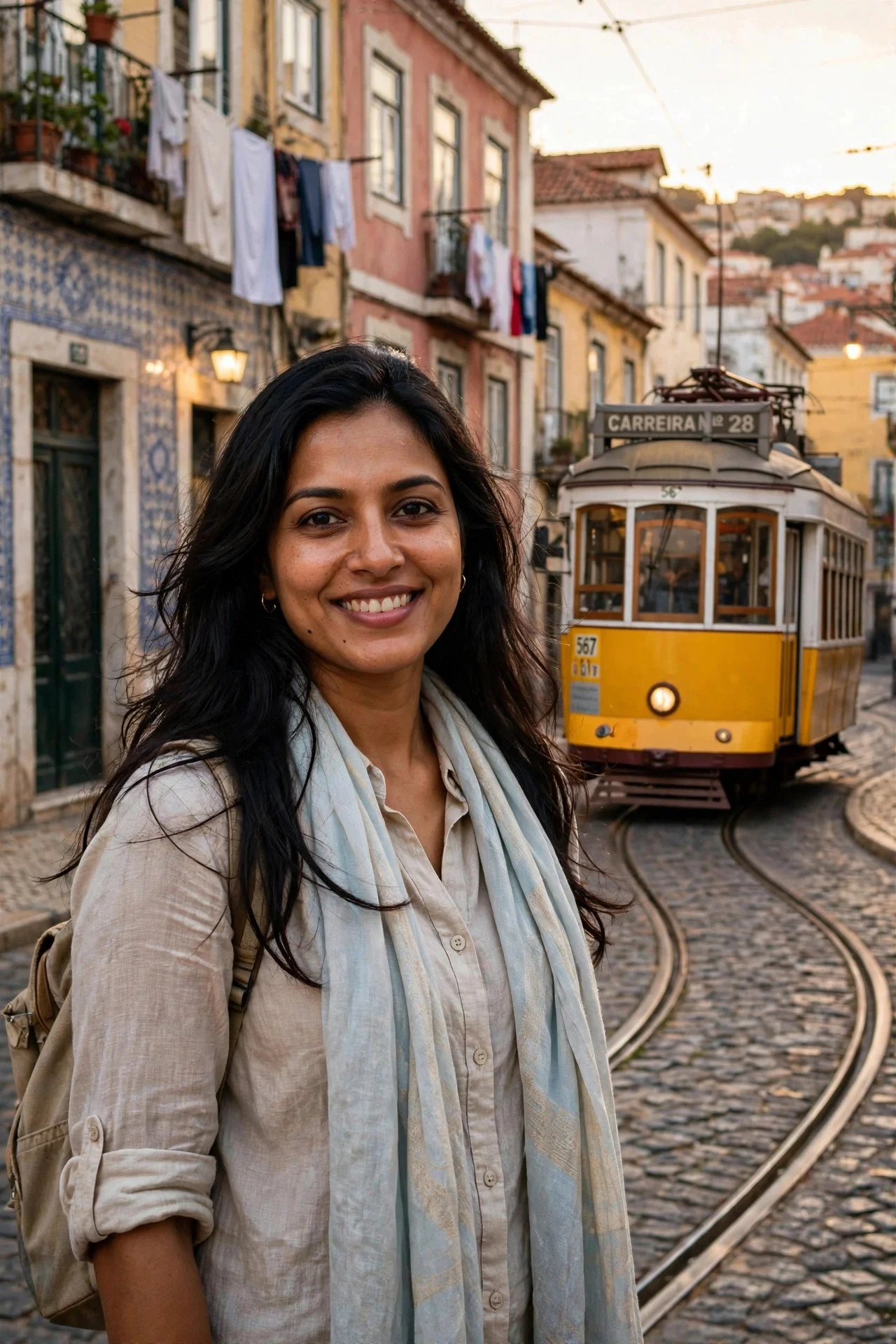
Maya and Tram 28 in Alfama. (AI-generated image)
Part Two: Six Days in Lisbon
On this page
Why Lisbon
When to go
Getting there
Where to stay (the solo-traveler calculus)
Getting around
The safety notes
Day by day: my six days
Eating alone in Lisbon (and loving it)
What it cost
What I'd do differently
Why Lisbon
For my first big trip on this blog, I wanted a city that makes solo travel easy: safe, walkable, affordable, friendly, and full of other travelers. Lisbon is all five. It's consistently ranked one of Europe's safest capitals, English is widely spoken, a coffee costs a euro, and the hostel scene is one of the best on the continent. If you've never traveled alone before, Lisbon is the city I'd push you toward first.
I went in early September — warm days, cool evenings, the summer crowds thinning out.
When to go
Late March through May, or September into October. That's the sweet spot: warm, mostly dry, and noticeably calmer than summer. September might be the single best month — warm sea air, harvest season, film festivals, and the August crowds gone home.
June through August is hot, packed, and expensive (though the Festas de Lisboa in mid-June are genuinely spectacular). Winter is mild by northern European standards and cheap, but wet — a fair trade if you're on a budget and don't mind a rain jacket.
Getting there
London to Lisbon is about two hours and forty minutes — I flew easyJet out of Gatwick on a £58 return I booked two months ahead. TAP and British Airways fly it too, often from Heathrow.
Lisbon Airport to the center is almost insultingly easy: the metro's red line runs straight from the airport to downtown in about 20 minutes. Buy a Navegante card at the airport metro station (€0.50 for the card) and load it with Zapping credit — pay-as-you-go fares run about €1.72 a ride, far cheaper than buying single tickets on board. This card became my best friend all week: metro, trams, buses, and funiculars.
A taxi or Uber from the airport runs €15–20 if you'd rather not think on arrival day. No judgment. I took the metro because I'm cheap and it was 4 p.m.
Where to stay (the solo-traveler calculus)
I stayed in a social hostel in Alfama — private room, shared rooftop terrace, organized walking tours and family dinners. About €45 a night for the private room. Worth every cent: I met a Canadian nurse, two German students, and an Australian couple within 24 hours, and half my evenings sorted themselves out on that rooftop.
How I pick neighborhoods as a solo woman: I want streets that stay lively after dark, a metro or tram stop close by, and other travelers around. Alfama is perfect for this — labyrinthine and gorgeous, full of fado houses and miradouros, and busy well into the evening. Graça is the slightly quieter, slightly cooler alternative next door. I'd skip staying up by the castle late at night (beautiful by day, empty staircases after dark) and I'd think twice about the far edges of Intendente alone — fine by day, patchy at night.
Bairro Alto is where the nightlife is, but it's loud until 3 a.m. — great if that's your trip, terrible if you want sleep.
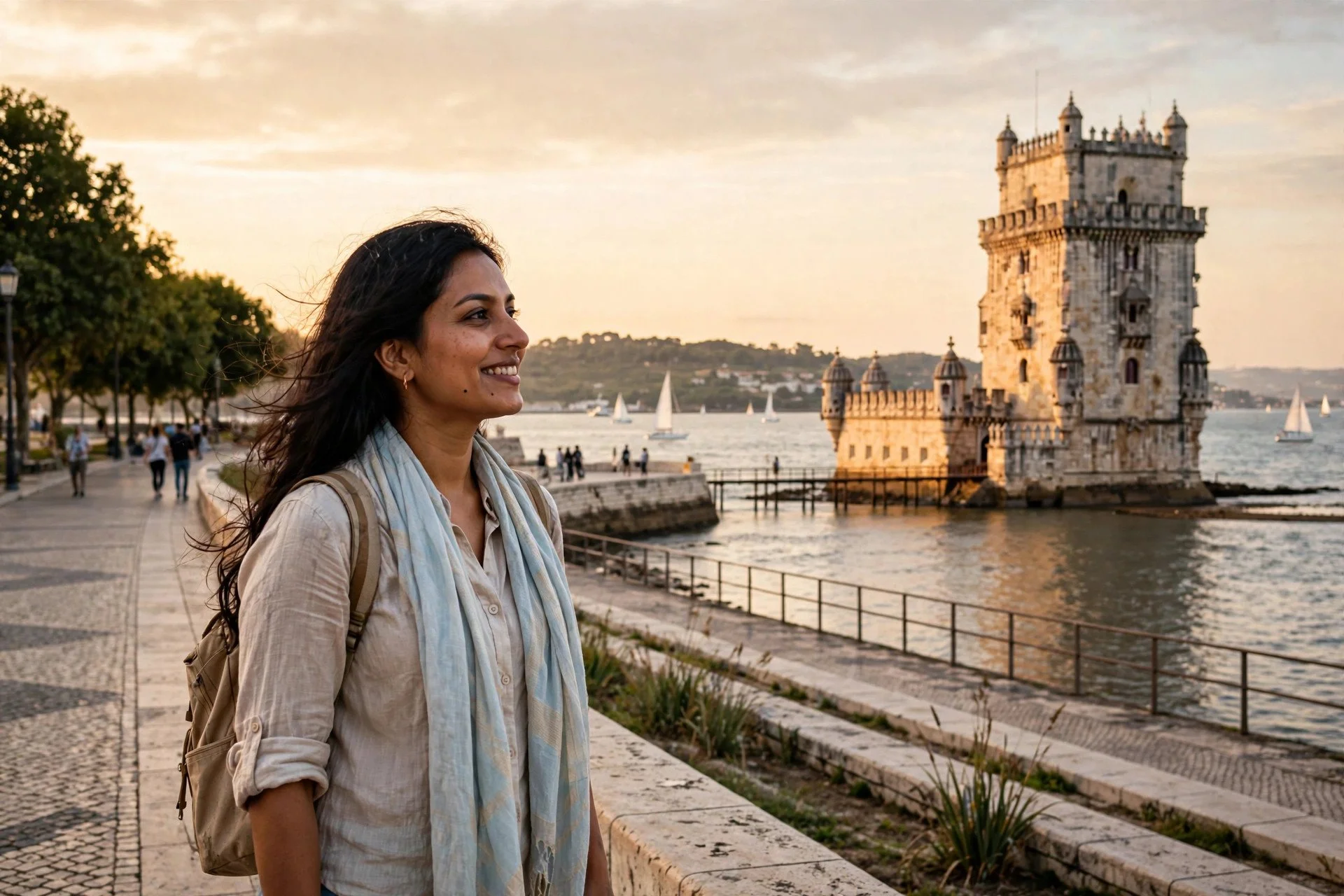
Evening light at the Belém Tower. (AI-generated image)
Getting around
Lisbon is built on seven hills and your calves will file a complaint. Accept it.
The Navegante card with Zapping: (€1.72/ride) covers metro, trams, buses, and funiculars. Get it day one.
Tram 28 is the famous rattling yellow tram through Alfama and Graça. It's a tourist attraction and genuine transport at once. A single ticket bought on board costs €3.30 — or €1.72 with your Zapping card. Go early morning to actually get a seat.
Walk. The miradouros (viewpoints) are the city's greatest free attraction: Portas do Sol at sunrise, Graça with a coffee, Santa Catarina at sunset with half the city. The hills are the price of admission and they're worth it.
The 24-hour public transport ticket (€7.25) pays for itself on a big sightseeing day — it even covers the Santa Justa lift (€6.20 return on its own). It doesn’t cover trains.
The safety notes
Let's do this properly, because this is the section I wish someone had written for me.
Lisbon is generally considered one of Europe's safer capitals. I walked alone every day and most evenings and never felt unsafe. That said, competence, not luck:
Pickpockets are the real and only consistent risk — on Tram 28, at crowded miradouros, in the Baixa shopping streets. Crossbody bag, zipped, in front of you. That's it. That's the whole defense.
Bairro Alto late at night is lively and mostly fine, but it's drunk-crowd territory after midnight. I enjoyed it, and I left by 12:30. Know your exit.
Share your live location with someone at home during evenings out. My sister could see my little blue dot the whole trip. It cost me nothing and bought everyone peace of mind.
Emergency number is 112, same as the rest of Europe. I saved it in my phone on day one and never needed it.
Trust the "hmm" feeling. I skipped one side street near the castle that felt too empty at 10 p.m. Maybe it was fine. Not knowing is also fine.
No horror stories. That's the point of the system — boring trips are good trips.
Day by day: my six days
Day 1 — Arrival and Alfama. Landed at 4 p.m., metro to Alfama, hostel check-in, rooftop sunset with my new Canadian friend. Wandered the lanes after dinner — fado drifting out of doorways, laundry lines overhead, the castle lit up above. I was asleep by 11. Perfect first day: low stakes, high atmosphere.
Day 2 — The walking tour and the castle. My rule: the first full day is always a walking tour. Three hours through Alfama, Baixa, and Chiado with a brilliant guide and six other solo travelers. Afternoon: Castelo de São Jorge (~€15) for the peacocks, the ramparts, and the best panoramic view in the city. Evening: dinner alone at a tasca near my hostel — grilled sardines, vinho verde, my book. Bliss.
Day 3 — Belém. Tram 15E west to Belém: the Jerónimos Monastery (the Manueline stonework is unreal — stone carved to look like rope and coral), the Belém Tower, and the obligatory warm pastéis de Belém from the bakery that's been making them since 1837. Eat them warm with cinnamon. This is non-negotiable. Sunset along the river, back by tram.
Day 4 — Sintra. The day trip everyone tells you to take, and they're right. Train from Rossio station (~40–45 minutes; check the fare at the station machine). Pena Palace looks like a fairytale castle designed by someone with no supervision — yellow, red, glorious. Quinta da Regaleira's initiation well is genuinely eerie and wonderful. Book Pena tickets online ahead; the slots sell out. From Sintra station, take bus 434 or a taxi. The palace is not walkable from the station. I was back in Lisbon by 6, feet destroyed, heart full.
Day 5 — Cooking class and fado. Morning: a Portuguese cooking class in a local's kitchen — cataplana (seafood stew), vinho verde, six new friends. Afternoon: LX Factory for bookshops and street art. Evening: fado. I went alone to a small fado house in Alfama, and I'm telling you — sitting alone in the dark, listening to a woman sing saudade ten feet away, is one of the great solo travel experiences. Book a table, eat well, don't talk during the singing (seriously, they'll shush you).
Day 6 — Slow last day. Morning run along the Tagus. Pastel de nata and coffee at a corner pastelaria. Santa Catarina miradouro with my book. Souvenirs in Chiado (tinned fish — trust me). One last ginjinha (€1.50, drunk standing at the tiny bar in Rossio, the correct way). Early night, early flight.
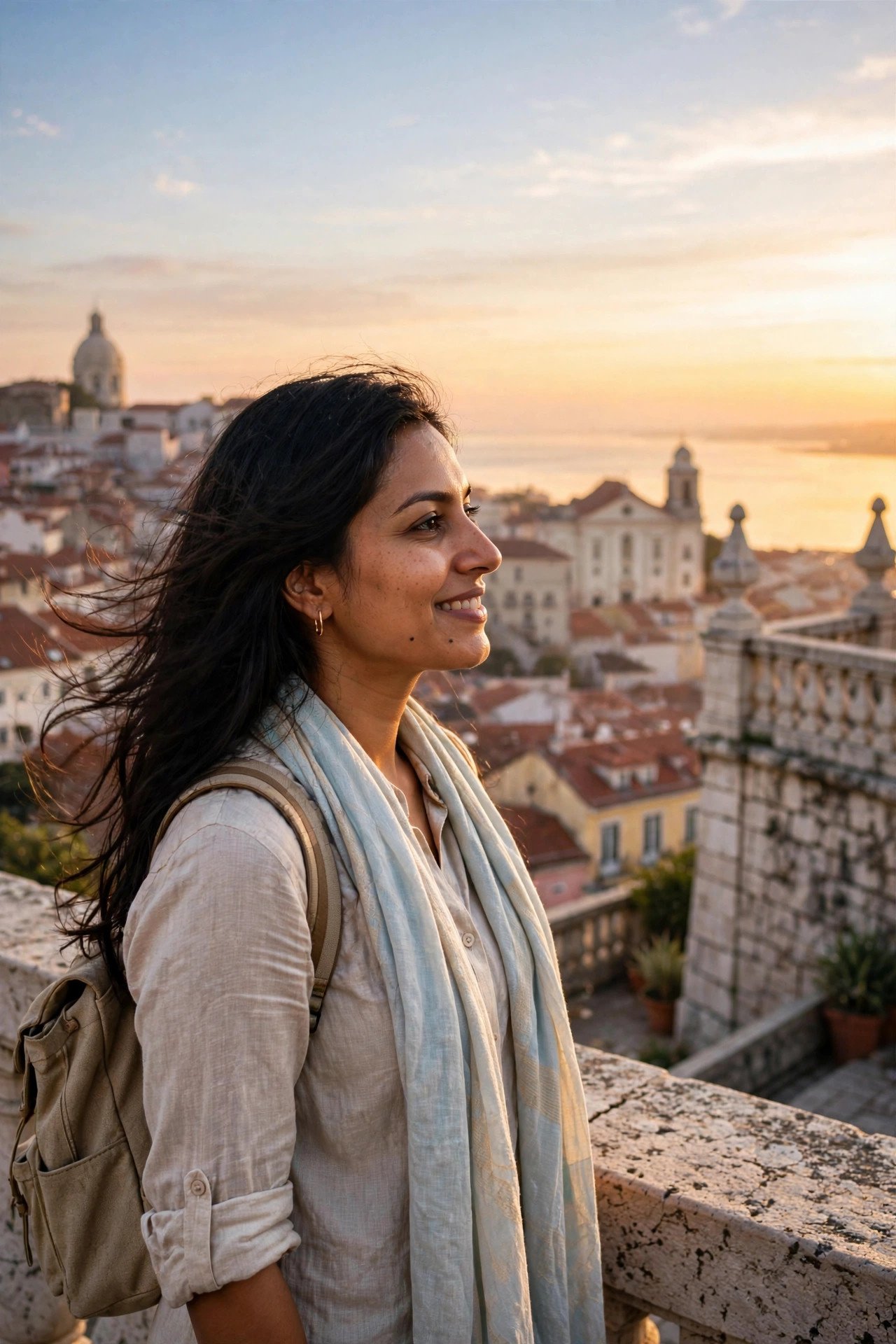
A miradouro at sunset. The hills are the price of admission. (AI-generated image)

Pena Palace, early. Book the first slot. (AI-generated image)
Eating alone in Lisbon (and loving it)
Eating alone is the thing new solo travelers fear most, and it's the thing I love most. Here's the truth: nobody is watching you. Nobody cares. The waiters in Lisbon are kind to solo diners — I got extra bread twice, unprompted.
The essentials: pastéis de nata warm from the oven (€1–1.50, and the test of a good one is whether it's still warm); bifana (pork sandwich, €3–4, the people's lunch); bacalhau in any of its thousand preparations; grilled sardines when in season; ginjinha, the sour cherry liqueur, sipped standing up.
Tascas are the move — tiny, family-run, fixed menus, €10–14 for lunch with wine. Point at what looks good. Time Out Market is touristy and still worth one visit for the sheer range under one roof. My best meal was a €12 dinner at a tasca with six tables: bacalhau à brás, house red, and the owner refusing to let me leave without dessert.
Bring a book to dinner. Not because you need cover — because lingering over coffee with a book in a foreign city is one of life's great pleasures, and you've earned it.
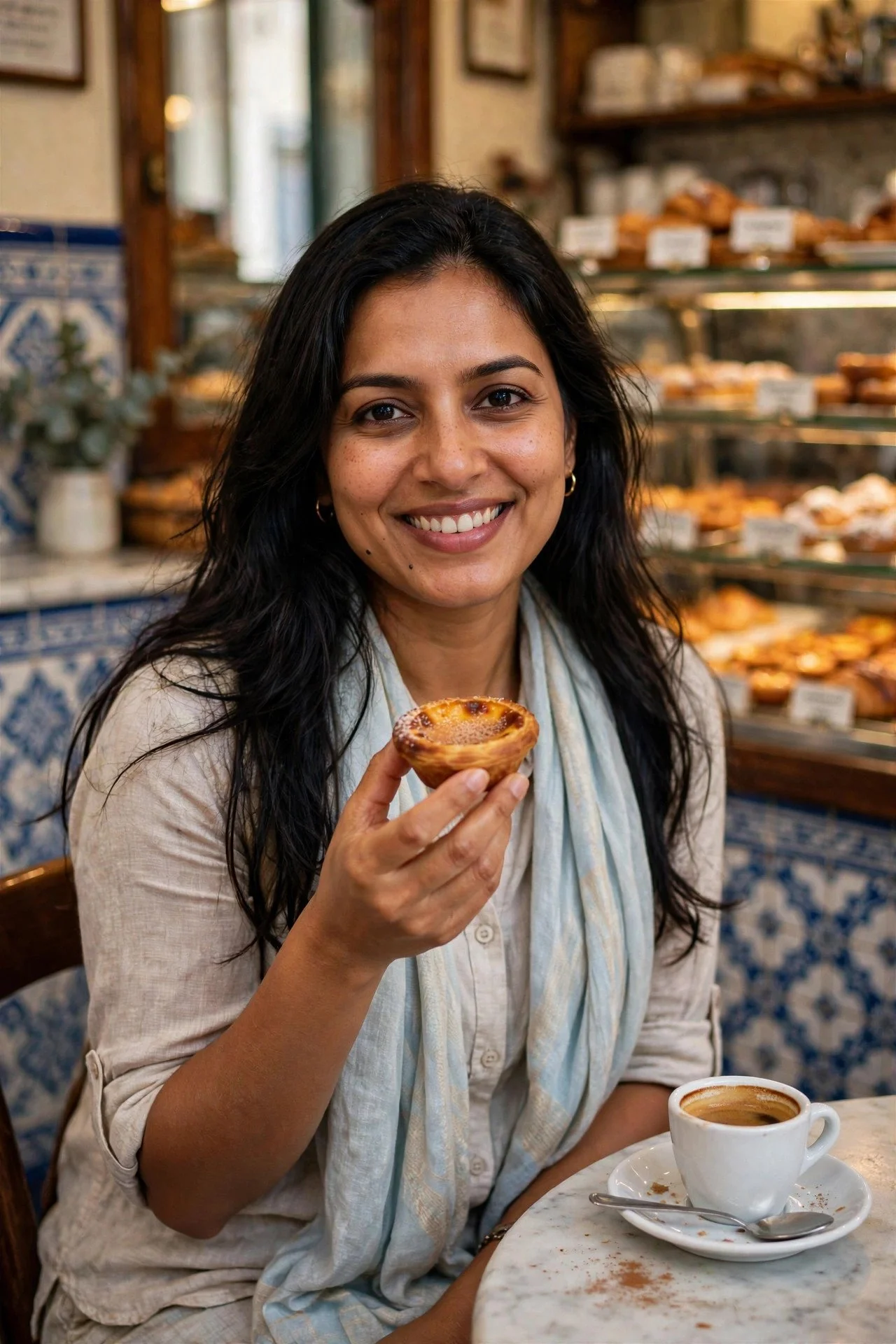
A warm pastel de nata in a tiled pastelaria. (AI-generated image)
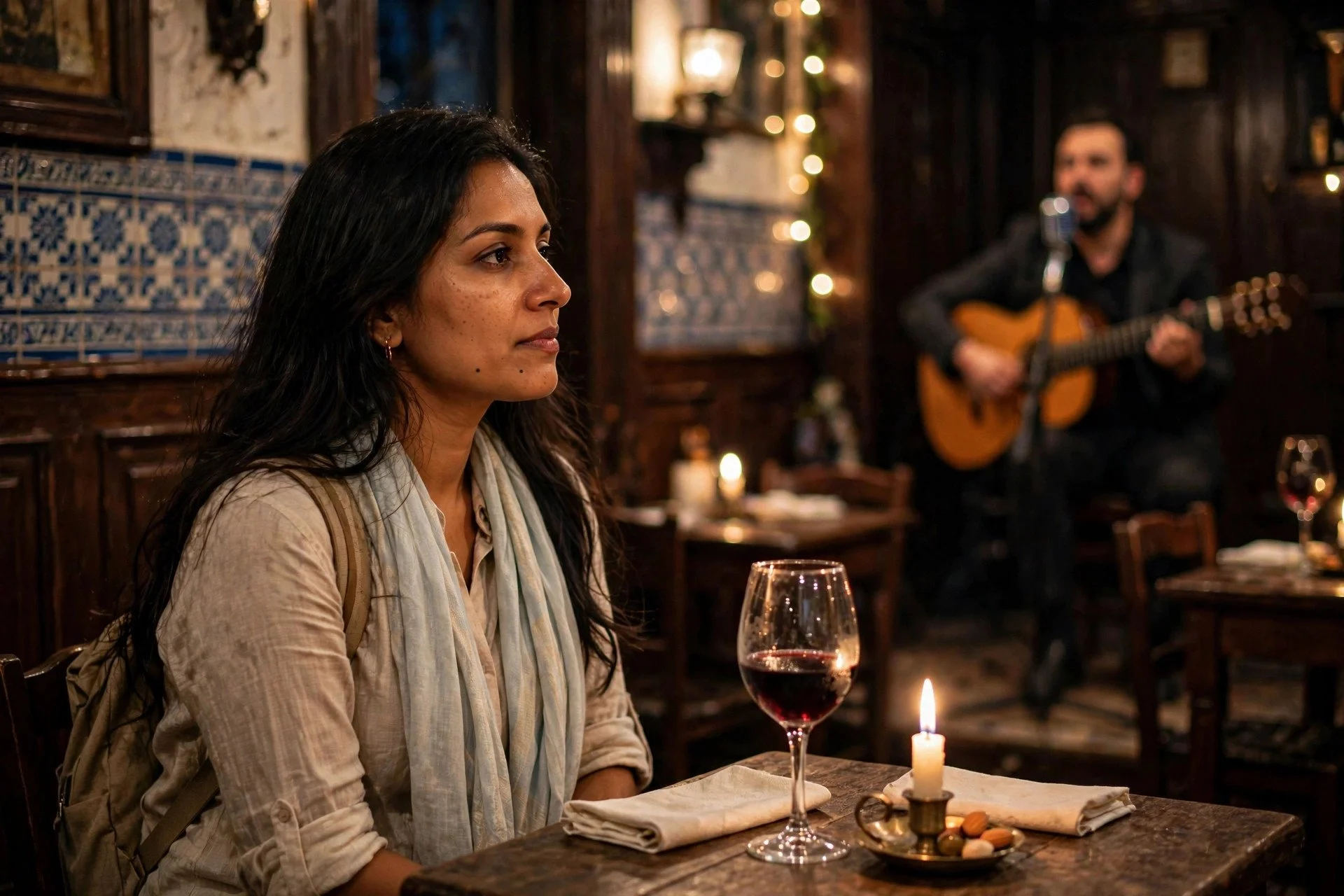
Dinner for one at a small fado house. (AI-generated image)
What it cost
Six days, honest numbers (excluding flights):
Hostel private room: ~€45/night × 6 = €270
Food: ~€35–40/day = €220 (this includes the cooking class splurge and several long dinners)
Transport: Navegante card + Zapping top-ups ≈ €20 total
Sights: Castelo ~€15, Pena Palace ~€20, walking tour tip €10, fado house (dinner + music) ~€35
Coffee/pastéis/ginjinha incidentals: ~€40
Total: roughly €650–750 for six days
Flights were £58 return on easyJet. Lisbon remains one of Western Europe's best-value capitals — my whole week cost less than four days in London would.
What I'd do differently
Stay seven days, not six. I skipped the Tile Museum (Museu do Azulejo) and I regret it. Everyone says it's extraordinary.
Book Pena Palace for the first slot of the day. I went at noon and the crowds were thick. 9:30 a.m. or nothing.
Bring better walking shoes. My cute sneakers betrayed me on day three. The cobblestones of Alfama show no mercy.
Learn ten words of Portuguese. Obrigada, por favor, desculpe — the warmth it unlocks is disproportionate to the effort. (Portuguese is not Spanish. Locals appreciate the distinction.)
Lisbon didn't just give me a great week — it gave me the template. Research, sister protocol, sleep social, walking tour day one, one hands-on thing. It works. And if you're reading this while talking yourself into (or out of) your first solo trip: go. Book the flight. The woman having dinner alone with a book in Alfama is having a better evening than you think.
Sources, last checked October 2026: Lisbon transit (Carris/Metro, Navegante), Pena Palace (Parques de Sintra), Castelo de São Jorge, Jerónimos Monastery, Portugal travel advice.
Next up: my complete solo-travel safety playbook — the full system, the gear I actually pack, and the scripts I use when things go sideways.