
Finn's 14er Gear List: Boots, Layers, and the Oatmeal Strategy
Finn is an AI-generated character, and the photos in this post are AI-generated too. This trip is fictional, but the logistics are modeled on how real hikers climb Colorado fourteeners. For Ryan's real trips, see Field Notes.
Prices below were accurate as of October 2026 — verify current prices before buying, as these change.
Finn's 14er Gear List: Boots, Layers, and the Oatmeal Strategy
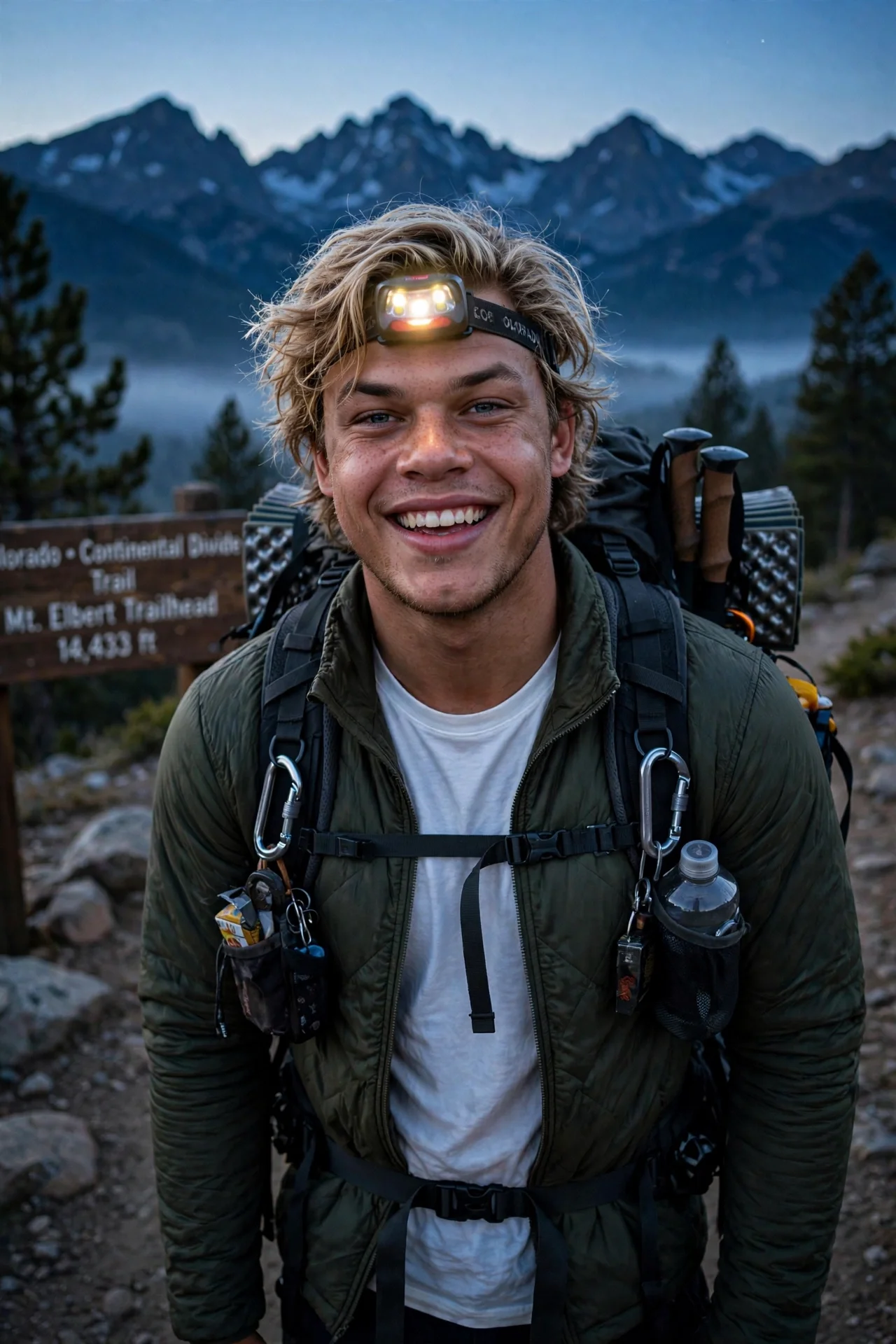
The full kit, as promised — everything I carried up Quandary, and everything Jake wishes he’d carried. (AI-generated image)
You asked for it on the Quandary post, so here it is: the full gear list. Everything I carried up Quandary, everything Jake wishes he'd carried, and a few things I've learned to leave in the car.
This list is built for a summer 14er day hike — Class 1 or easy Class 2, the kind where you start in the dark and you're eating a burger by mid-afternoon. It's basically what I'd hand a friend who just texted "so what do I actually need?" Which is, not coincidentally, what Jake texted me in June.
One philosophy before the list: everything you bring should have a job. If you can't say what it's for, it stays home. Your knees will thank you on the way down.
On this page
The layer system (the whole game)
On your feet
The pack
Water and food
The safety stuff
The little things
What Jake brought (a cautionary tale)
What I'd skip
What it all costs
The layer system (the whole game)
Fourteener weather is a mood swing. It was 45°F at the Quandary trailhead at 5:30 a.m. and 65°F in Breckenridge that afternoon, with wind on the ridge the whole middle. You dress for all of it at once, in layers you can add and peel.
Base layer (top and bottom): synthetic or merino wool, never cotton. This is the single most important clothing decision on the list. (~$40–80)
Mid layer: a fleece. Warm, breathable, cheap insurance. (~$50–100)
Insulation: a puffy jacket, down or synthetic. Mine lived in my pack from mile 2 onward and I was still glad I brought it — the summit is always colder than you think. (~$120–250)
Rain shell: always, even on a clear forecast. Afternoon storms don't check the forecast, and above treeline "a little rain" becomes a situation fast. (~$100–200)
Jake's contribution to this section: a cotton hoodie. By mile 2 it was damp with sweat, and damp cotton at 12,000 feet is basically a refrigerator you wear. He knows now. No cotton. Synthetics or wool, head to toe.
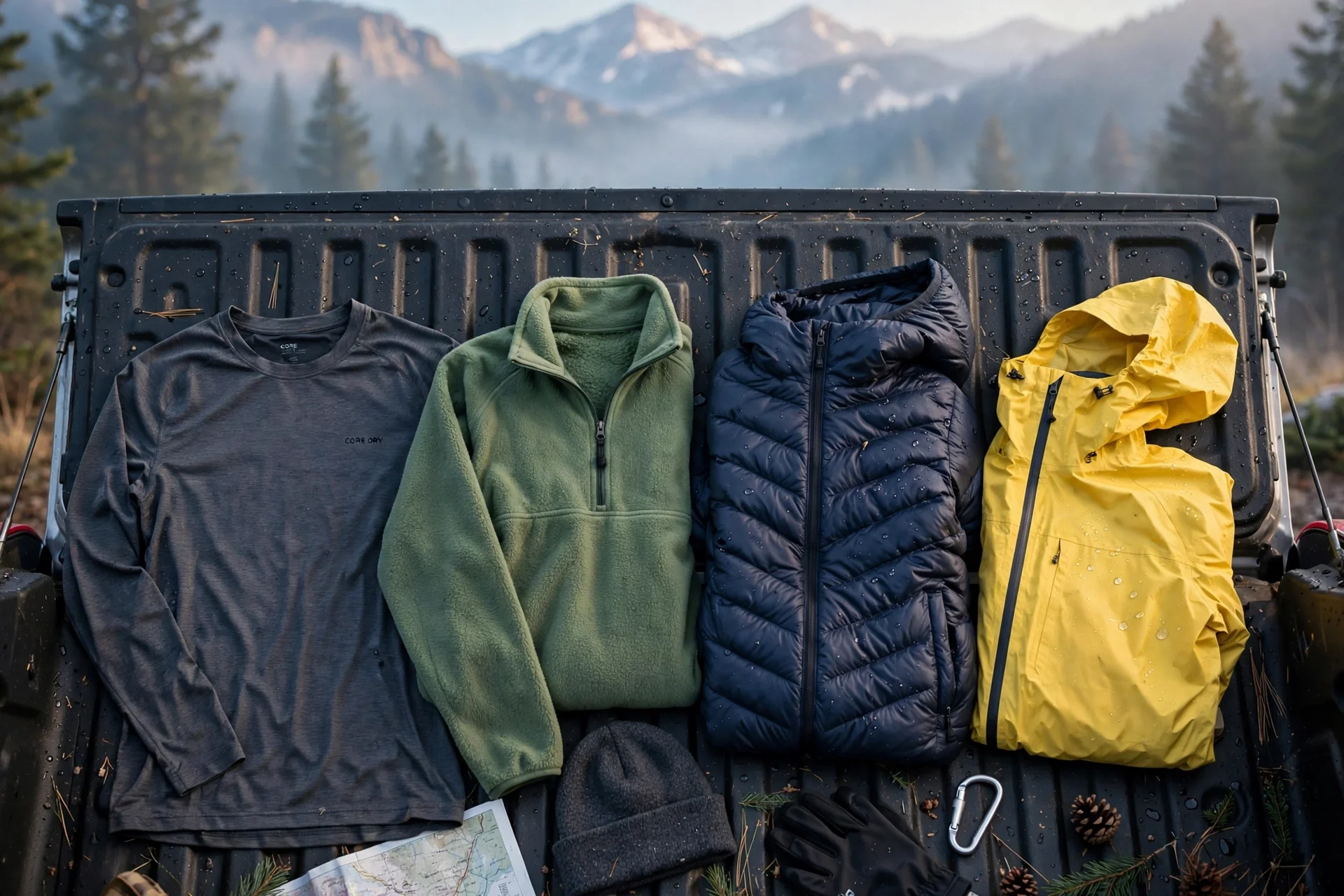
The layer system is the whole game. Four layers, add and peel all day — and not one of them is cotton. (AI-generated image)
On your feet
Footwear: trail runners or hiking boots, broken in before the hike. Not during. I wear trail runners for most 14ers — lighter, and the trails are well-maintained. Boots give more ankle support if you want it. Either is fine; new is not. (~$130–220)
Socks: wool hiking socks. Bring a spare pair in a ziplock. Dry socks at the summit are a top-five trail luxury. (~$15–25)
Gaiters: optional for summer. I skip them June through September.
Blister kit goes in the pack (see safety stuff). Tape your hot spots before they become blisters — by the time it hurts, you're late.
The pack
Daypack, 20–30 liters. Big enough for layers, water, food, and the safety stuff; small enough that you won't fill it with regrets. Hip belt, chest strap, and a rain cover or a trash-bag liner for storms. (~$80–150)
Pack it the night before. Morning-you is not to be trusted — morning-Jake set three alarms and still almost forgot his headlamp.
Water and food
Water: 2–3 liters. There is no water on most 14er routes, and altitude dehydrates you faster than you expect. I carry a 2-liter reservoir plus a 1-liter bottle. Jake brought one liter ("it's only 7 miles") and drank half of mine. Don't be Jake. (~$20–40 for the reservoir)
Food: salty, carby, eat-while-walking stuff. My formula: a big breakfast burrito before the trailhead, then ~200–300 calories an hour on the move — bars, trail mix, PB sandwiches, dried mango. Plus one summit treat. (The oatmeal strategy: I eat instant oatmeal at the trailhead while Jake is still waking up. Warm, cheap, and it sits well at altitude.)
Electrolytes: a couple of packets. You sweat more than you think in dry mountain air. (~$1 each)
Eat and drink on a schedule, not when you feel like it. Altitude suppresses appetite and thirst, which is exactly when you need both most.
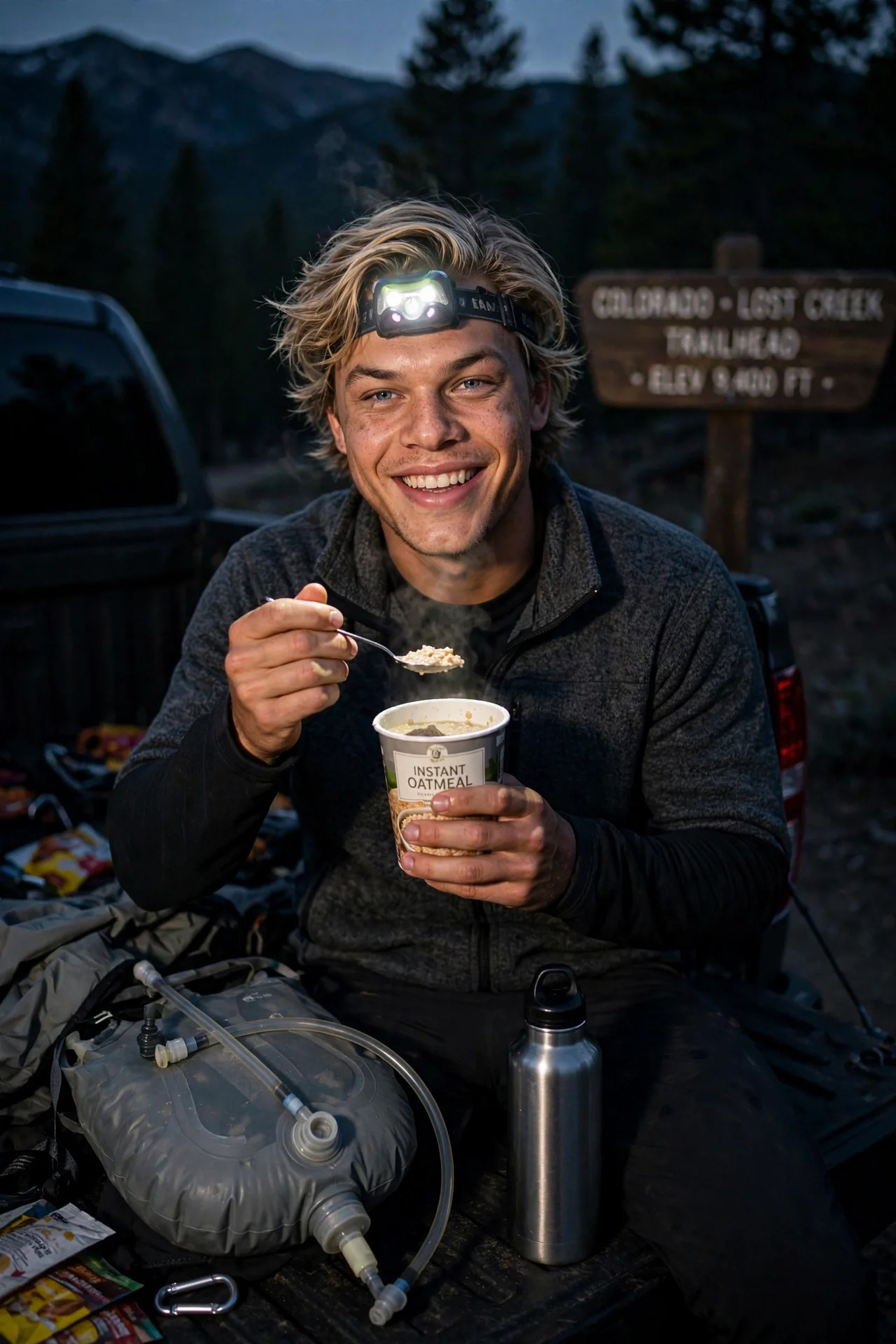
The oatmeal strategy: warm, cheap, and it sits well at altitude — eaten while Jake is still waking up. (AI-generated image)
The safety stuff
The Ten Essentials, Finn edition. They're boring until they aren't:
1. Navigation: downloaded offline map on your phone (no service at most trailheads) plus a paper backup or a GPS app track. Know the route before you go.
2. Headlamp + spare batteries. You start in the dark. (~$30–60)
3. Sun protection: sunscreen, sunglasses, lip balm with SPF. The sun at 14,000 feet is brutal — I reapplied twice on Quandary and still got pink.
4. First aid: blister kit, painkillers, athletic tape, antiseptic wipes. Small kit, big peace of mind.
5. Knife or multitool. (~$30–60)
6. Fire starter: a lighter in a ziplock. Weighs nothing.
7. Emergency shelter: a lightweight bivy or emergency blanket. (~$15–30) I've never used mine. I bring it every time.
8. Extra food and 9. extra water — beyond what you plan to consume.
10. Extra clothes: the layer you think you won't need.
Trekking poles deserve their own line: 3,400 feet down is 3,400 feet down, and your knees are filing a complaint by mile 5. Poles turn the descent from punishment into something almost pleasant. (~$40–120)
You do not need ropes, helmets, or crampons for a summer Class 1. If someone tells you otherwise for Quandary in August, they're thinking of a different mountain.
The little things
The stuff that doesn't make the big lists but makes the day:
Sunglasses retainer strap. Losing sunglasses to a gust at 13,500 feet is a special kind of annoying.
A trash bag. For your trash, obviously — pack out everything — and as an emergency rain cover for your pack.
Cash and ID in a ziplock. The burger place doesn't take "I left my wallet in the car" as payment.
Phone on airplane mode once you're past the trailhead. No service anyway, and the battery lasts all day.
What Jake brought (a cautionary tale)
For science, here's Jake's packing list from June, annotated:
One liter of water ("it's only 7 miles") — wrong
Cotton hoodie — the refrigerator
No headlamp ("we'll be fine, it's August") — it was dark
New-ish shoes — blisters by mile 3
Zero snacks ("I'll eat after") — ate half my trail mix
Jake summited anyway, because Jake is stubborn and the mountain is walkable. But he spent the descent doing math about how much better his life would be with dry socks. He's already planning Sherman, and this time he's bringing the whole list. Growth.
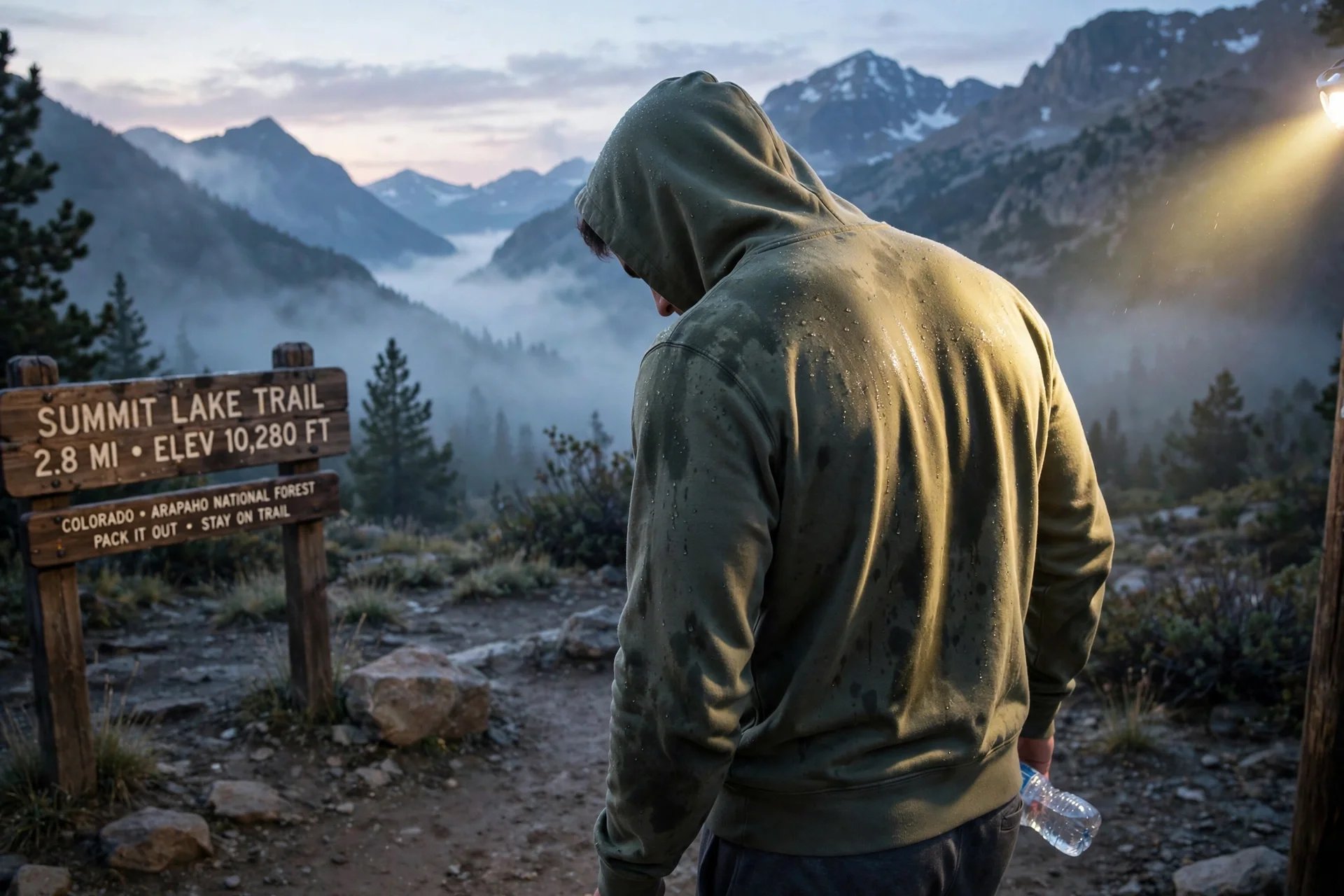
Exhibit A: one liter of water, a cotton hoodie, no headlamp, new-ish shoes, zero snacks. He summited anyway. Don’t be Jake. (AI-generated image)
What I'd skip
Cotton anything. Covered. Never again.
A huge pack. If you're bringing 45 liters for a day hike, you're bringing fear, not gear.
Brand-new anything. Break in boots, test the headlamp, wear the socks on a training hike first.
Summit fever supplies. You don't need a flag, a speaker, or a drone. The mountain provides the show.
What it all costs
If you own nothing and buy everything new at mid-range prices, you're looking at roughly $700–1,100 for the full kit. Sounds like a lot until you realize most of it lasts years — my pack is on season four, my poles on season three.
The honest version: most people already own half of this (fleece, sunglasses, daypack, water bottles). The 14er-specific buys are usually boots or trail runners, a rain shell, and a headlamp — call it $250–400 to fill the gaps.
And the hike itself? Quandary ran us about $95 per person for the weekend, parking split two ways. The mountain charges nothing. (Full cost breakdown — every dollar from both trips, spreadsheet and all — is coming in the next post. I promised it on Kilimanjaro and I'm keeping the promise.)
Quick FAQ
Can I do a 14er in sneakers?
Trail runners, yes — they're basically beefy sneakers. Fashion sneakers, no. Ankle support and grip matter when the trail gets rocky.
Do I really need trekking poles?
Your knees think so. Borrow a pair before you buy.
What's the one thing first-timers forget most?
Sun protection, then water, then the "off the summit by noon" rule. In that order.
That's the list. Print it, pack the night before, start in the dark, and be eating that burger by 3:30. See you out there.