
Seattle, Washington
Rain, Rockets, and Rainier: A Week in Seattle
Bradley and I flew out to Seattle in May, banking on the Pacific Northwest's brief window of "actually pretty nice" weather. We got lucky — mostly sunshine, with just enough rain to remind us we hadn't imagined the city's reputation. What followed was a week that took us from a 118-year-old farmers market to the inside of the world's largest building, fueled by more cups of coffee than either of us is willing to admit to in writing. Bring a rain jacket. You'll need it for about twenty minutes, tops.
Pike Place Market: The City's Beating Heart
We booked an Airbnb a few minutes' drive from downtown, close enough to Pike Place Market that it became our unofficial home base for the week — and it's easy to see why locals treat it the same way. Pike Place opened on August 17, 1907, after a group of local farmers got tired of selling their produce to price-gouging middlemen and successfully lobbied the city for a place to sell directly to the public. It sold out within hours on day one and has been doing brisk business ever since, making it one of the oldest continuously operating public markets in the country. It also survived a serious brush with the wrecking ball: in the early 1970s, the city had real plans to bulldoze it for redevelopment, and it took a citizens' initiative — passed by Seattle voters in 1971 — to save it.
Naturally, we treated our first morning there as a food tour, because if you've read the San Juan post, you already know that's non-negotiable wherever we go. This one might be the best we've ever done. It opened with a warm doughnut from Daily Dozen Donut Company, made fresh in a machine you can watch from the counter, chased with our first coffee of many that day. From there we worked our way to Pike Place Chowder for a bowl of New England clam chowder — yes, the best clam chowder in the country is arguably made three thousand miles from New England, a fact the folks in Newport, Rhode Island, know all too well after Pike Place Chowder walked into their own Great Chowder Cook-Off and won it three years running. We rounded things out with fresh fruit, a bottle of local ginger beer, and a stop at Chukar Cherries for dried Northwest cherries dipped in chocolate, which we may have eaten before we'd even left the building.
A City Powered by Coffee
If you've never been to Seattle, it's hard to overstate just how much the city runs on caffeine, and we did our part to keep the local economy humming. Somewhere between doughnuts and chowder, we paid our respects at the original Starbucks — though "original" comes with an asterisk. The very first Starbucks opened in 1971 around the corner on Western Avenue, not at the current 1912 Pike Place address; the shop didn't move to its now-iconic corner until 1976, after the first building was slated for demolition. The company's name comes from Starbuck, the first mate in Moby-Dick, chosen as a nod to Seattle's maritime and coffee-trading roots — the founders had briefly considered naming it after the ship itself, the Pequod, before deciding that a coffee called Pequod was a tough sell.
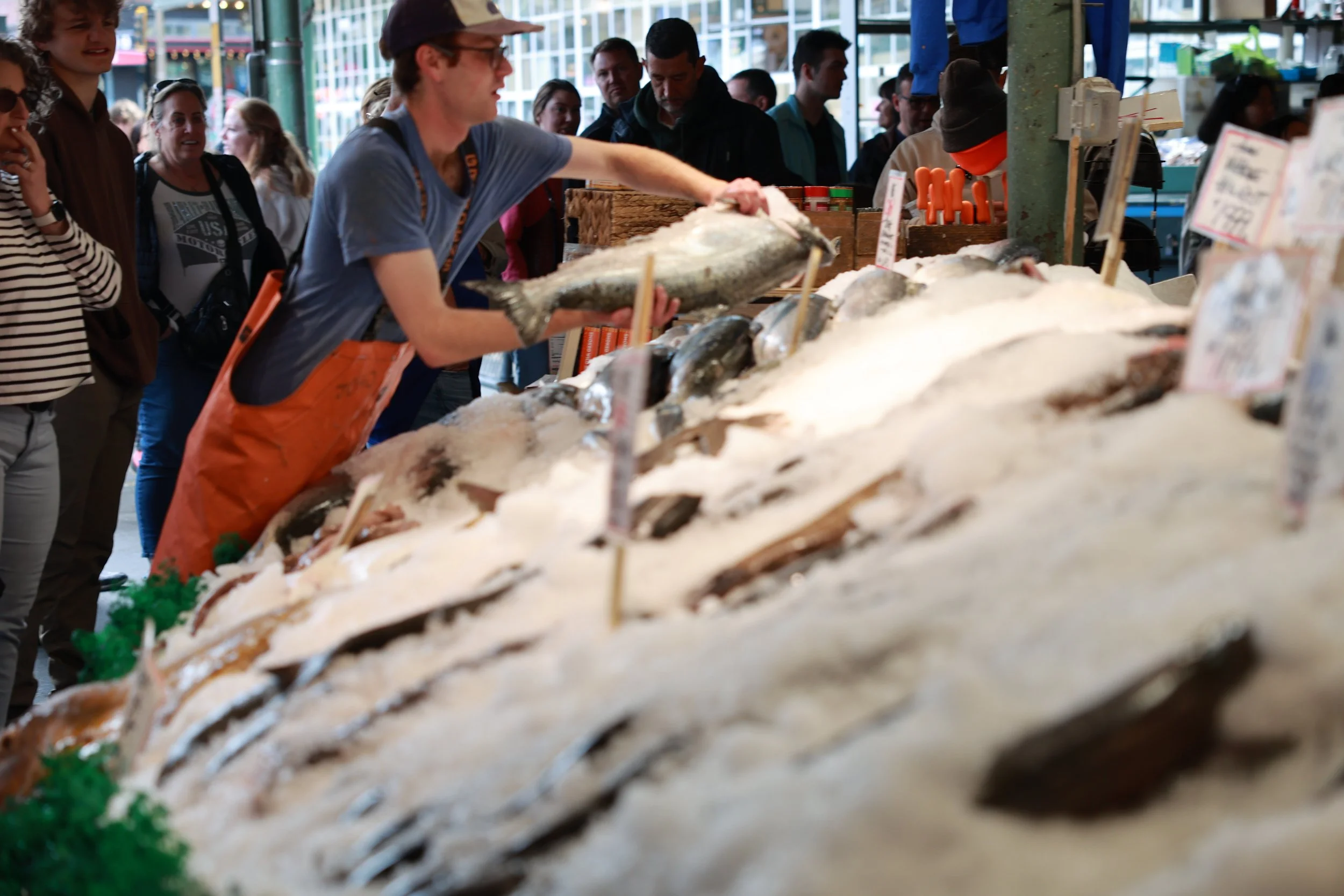
One of the market's famous fishmongers mid-toss at the fish stall — the salmon-throwing tradition that's made Pike Place's fish market a spectacle in its own right, camera phones included.
That was the appetizer. The real event was the Starbucks Reserve Roastery, a 15,000-square-foot temple to coffee that opened in Seattle's Capitol Hill neighborhood in 2014. Reserve Roasteries are a different animal entirely from a standard Starbucks: think hammered copper roasting silos, custom pneumatic tubes shuttling beans overhead, tasting flights, and a menu built around rare, small-batch beans rather than the usual drive-through lineup. At the height of the concept, there were only about six or seven of these in the entire world — Seattle, Chicago, New York, Milan, Shanghai, and Tokyo — because Starbucks originally imagined building hundreds and then scaled the plan back dramatically under new leadership. We're glad we made time for it, and glad we went when we did: the Seattle Roastery, along with the smaller Reserve store in SoDo, closed permanently in September 2025 as part of a company-wide restructuring, so if you're planning your own trip, cross Seattle off the Roastery list and add Chicago, New York, Milan, Shanghai, or Tokyo instead.
Mount Rainier: Look, Don't Touch (Yet)
We took a guided tour out to Mount Rainier, and if you're planning a May trip, manage your expectations: the mountain was still very much buried in snow, and heavy fog meant we spent most of our time looking up at where the summit was supposed to be rather than at the summit itself. Mount Rainier is an active stratovolcano that tops out at 14,410 feet, and it carries more glacial ice than any other peak in the contiguous United States — 25 named glaciers spread across its flanks, feeding five major river systems. That scale is part of why it's so temperamental with weather; the mountain essentially makes its own microclimate. We still got a solid hike in through old-growth forest, and thermoses of coffee in the parking lot made the fog a lot more bearable. If seeing the summit matters to you, aim for July or August instead, when the wildflower meadows at Paradise are also in full bloom.
North Cascades: The American Alps
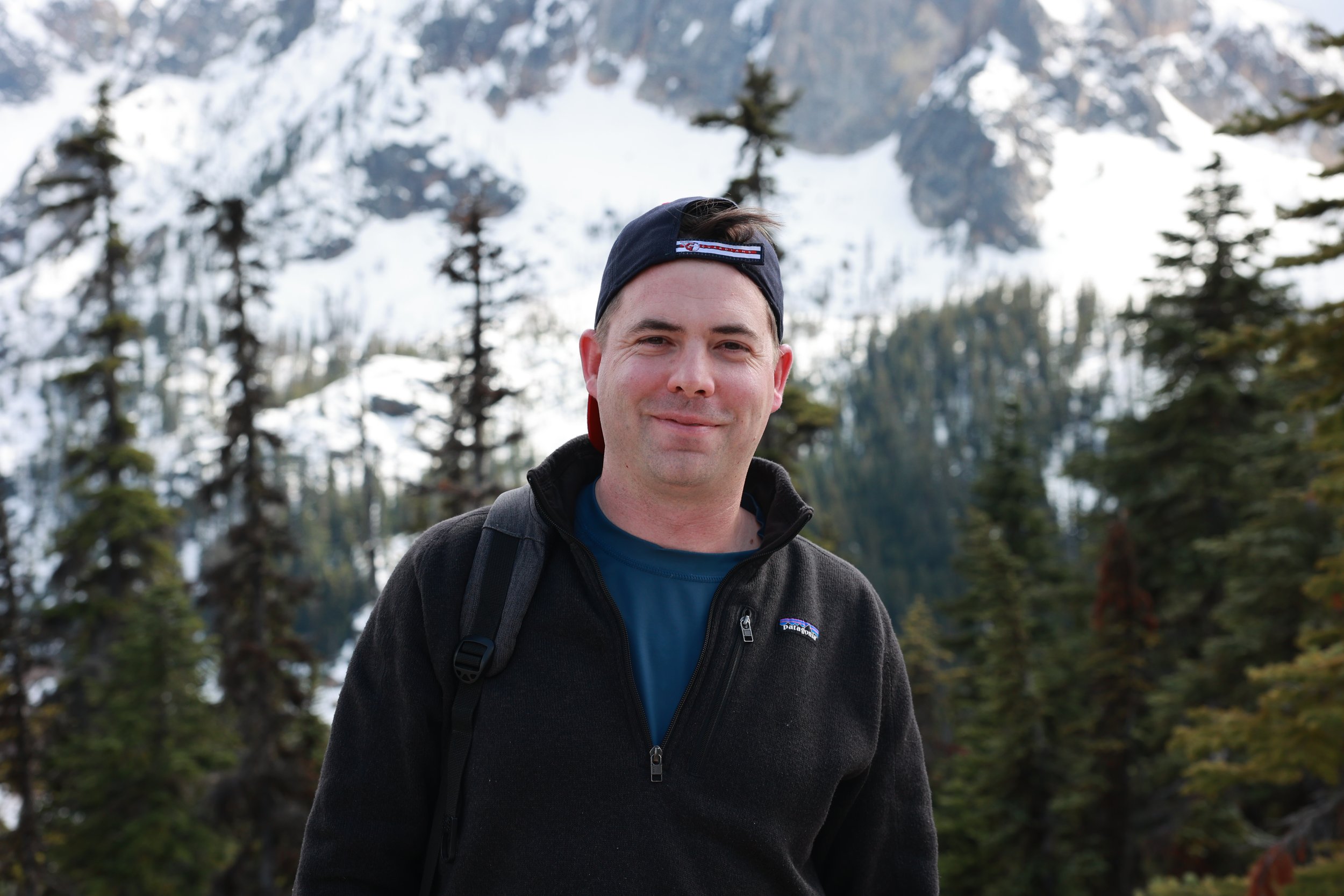
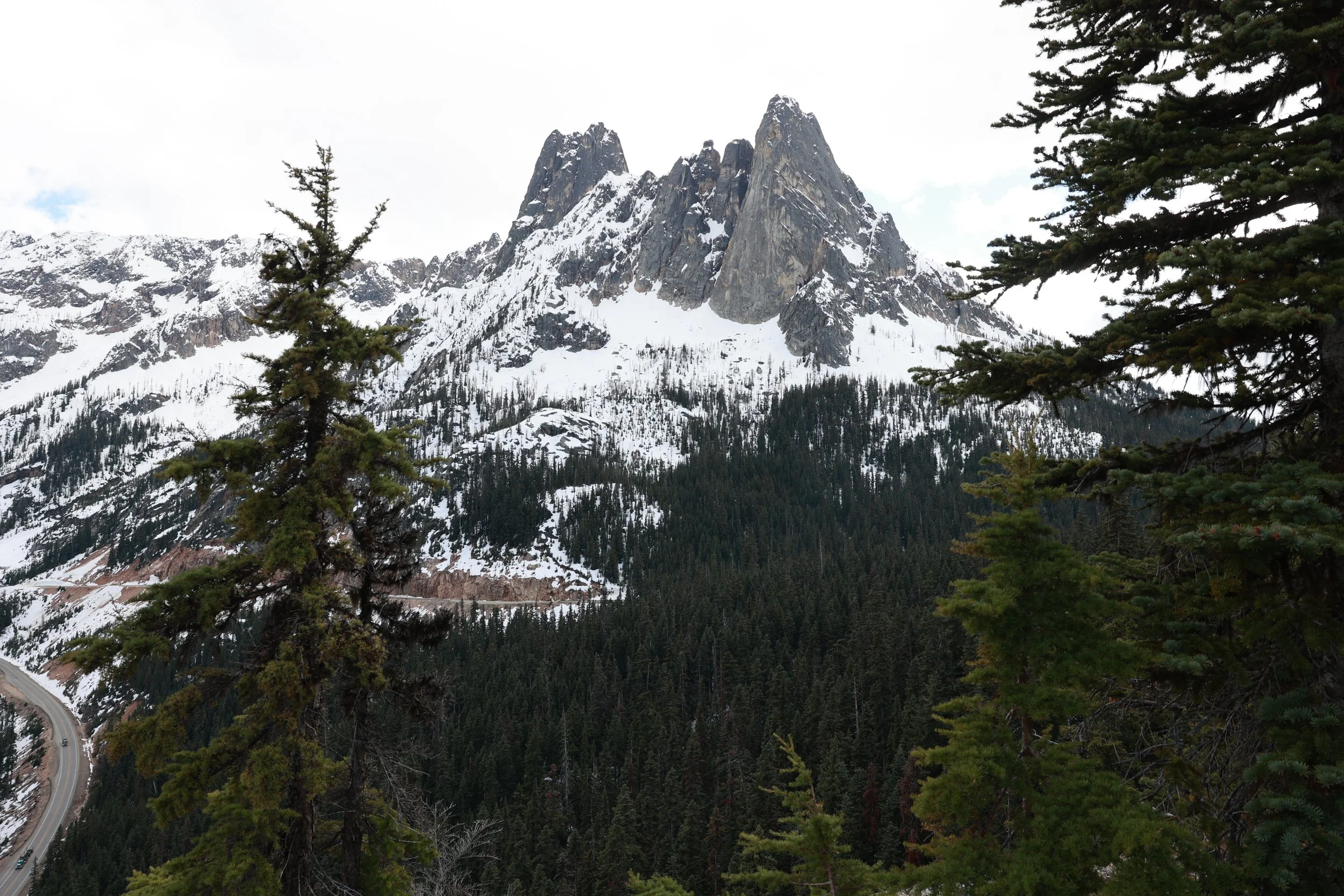
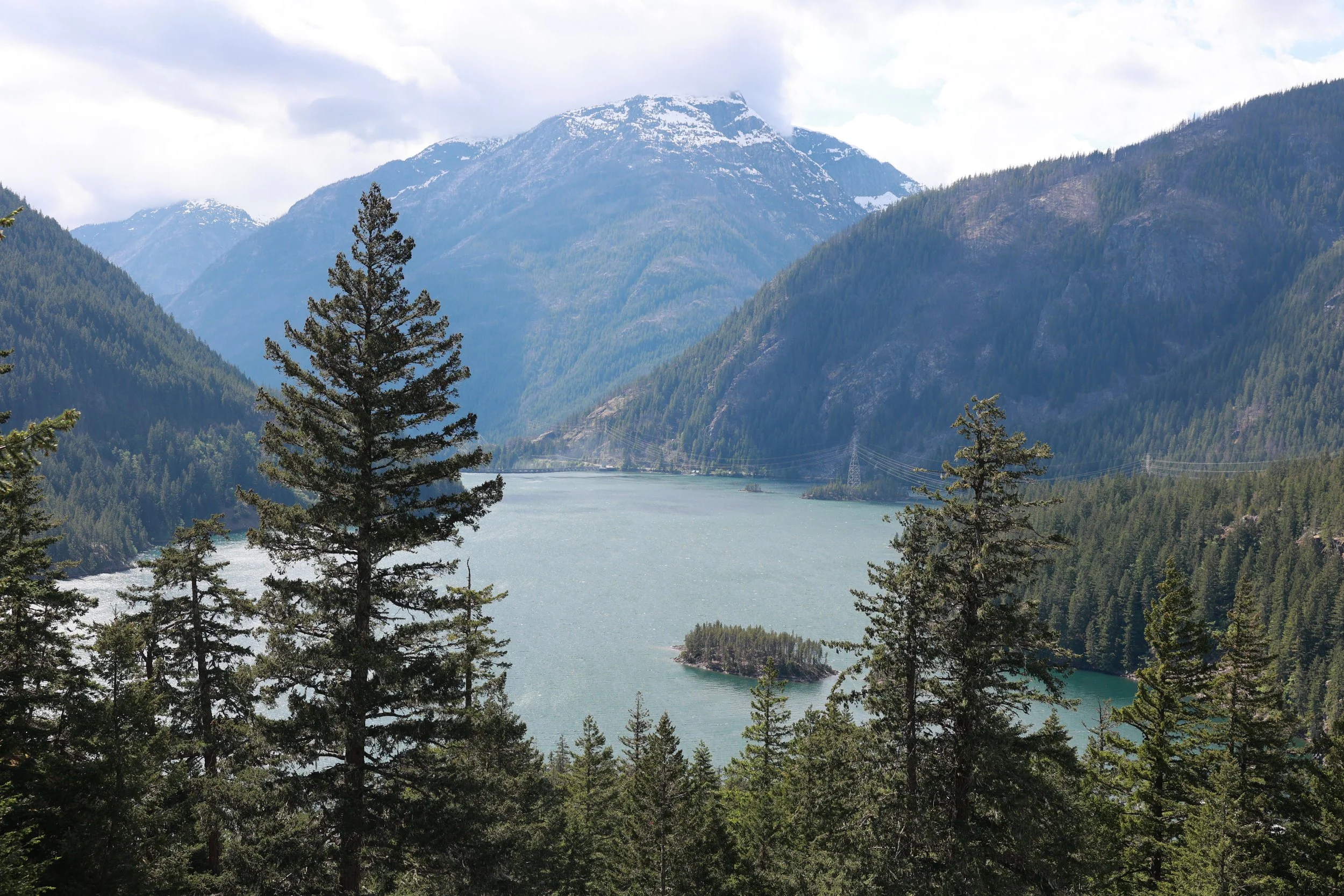
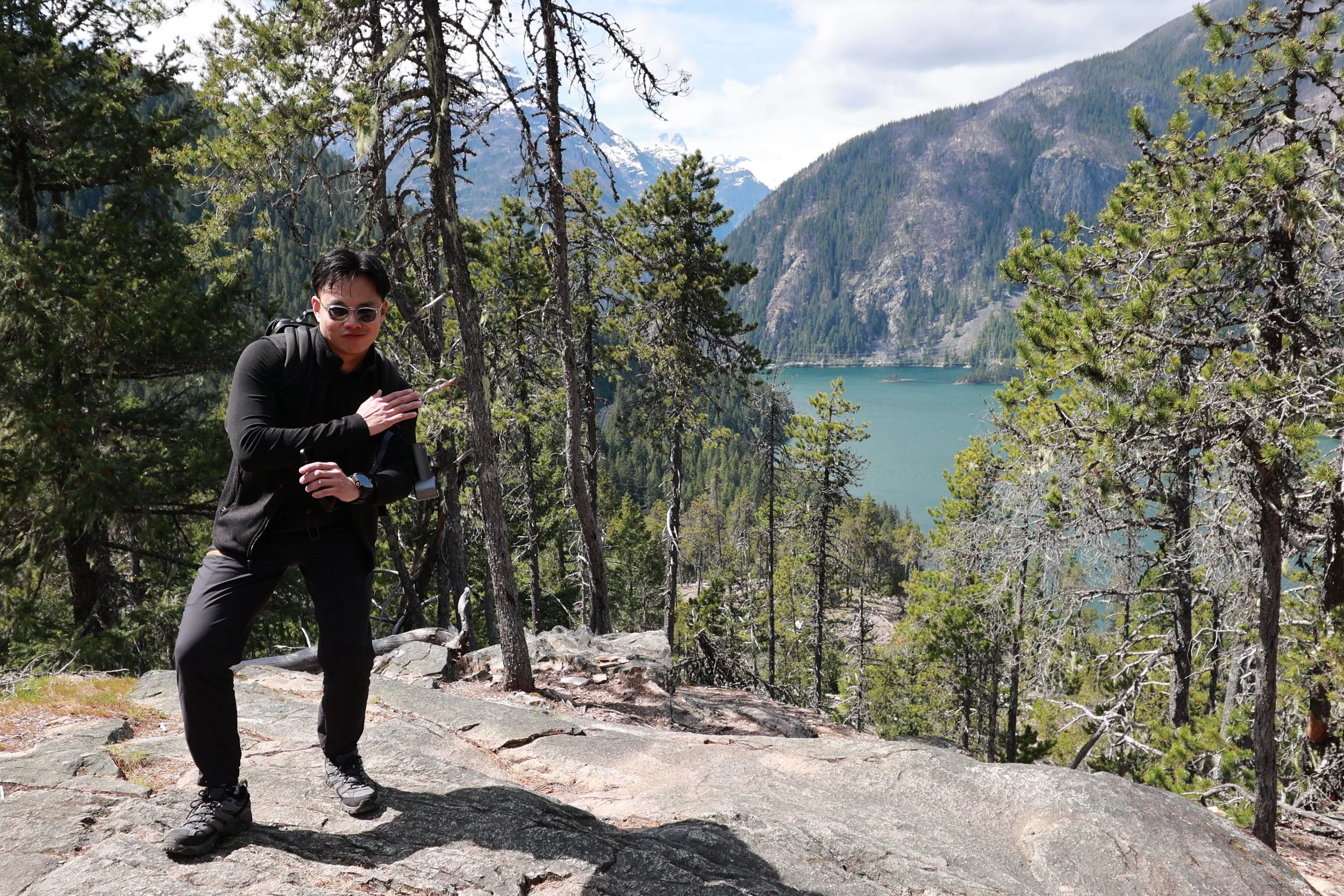
Not content with one mountain range, we rented a car and drove up through North Cascades National Park — often nicknamed the "American Alps" for a reason that becomes obvious about ten minutes after you cross into it. The park holds more than 300 glaciers, the largest collection in the Lower 48 outside Alaska, packed into jagged peaks and turquoise lakes colored by glacial silt so fine it stays suspended in the water. As with Rainier, May meant a lot of the high country was still snowed in and closed for the season, so we didn't get the full run of the park. What we did get — dense forest trails, alpine lakes, waterfalls tumbling out of hanging valleys — was still some of the most striking scenery either of us has seen in the U.S. We spent the night at a lodge near Winthrop, a small town in north-central Washington that leans hard into its Old West theme, and woke up to mountain fog burning off over the valley and a pot of surprisingly excellent lodge coffee, which is a pretty good way to start a morning.
Up the Space Needle
Back in the city, we did the obligatory trip up the Space Needle, and it earns the hype. It was built as the centerpiece of the 1962 World's Fair, whose theme was "The Age of Space" — the idea reportedly came to organizer Edward Carlson as a doodle on a napkin in a German café in 1959. At 605 feet, it was the tallest structure west of the Mississippi when it opened, and it was built to withstand both 200 mph winds and a magnitude 9.0 earthquake, which is either reassuring or slightly terrifying depending on how you think about it while standing on the observation deck. On a clear day you get Puget Sound, the Olympic Mountains, and Rainier all in one shot — although you can see from my picture we weren’t quite that lucky with the overcast skies.
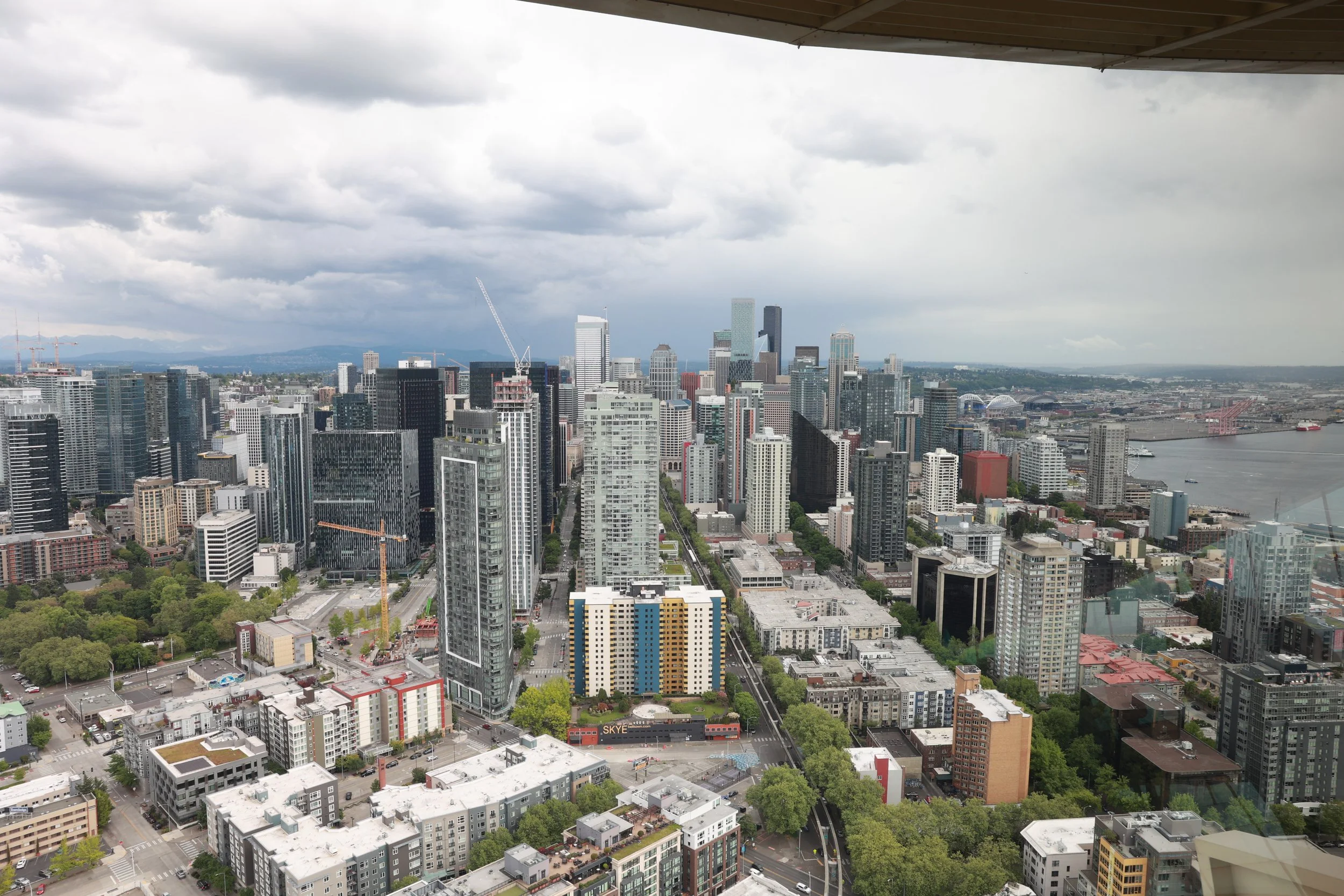
The Seattle Skyline as viewed from just below the main observatory deck of the Space Needle.
Elliott Bay by Ferry
One of the best photo decisions we made all week was hopping the ferry across Elliott Bay. There's no better way to get the classic Seattle skyline shot — Space Needle, downtown high-rises, and the water all lined up — than from the deck of a boat that costs about the same as a bus fare. We didn't have time to properly explore Bainbridge Island on the other side, but from what we heard, downtown Winslow is an easy walk from the ferry dock, the Bainbridge Island Museum of Art is worth a stop, and the island proudly claims to be the birthplace of pickleball, with dedicated courts at Battle Point Park for anyone who wants to pay their respects to the sport's origin story.
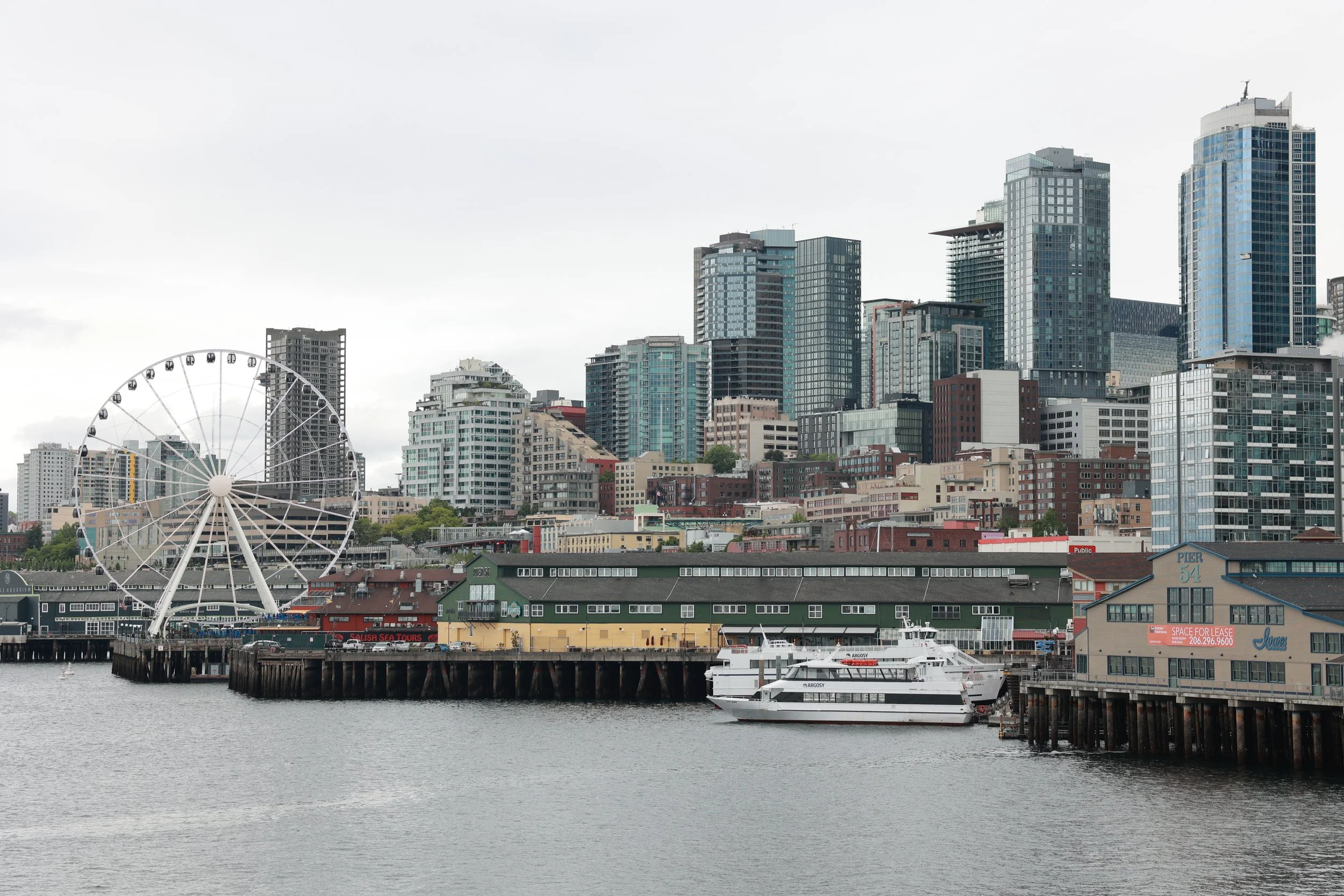
The Seattle skyline and Great Wheel from the water, the classic view you get crossing Elliott Bay by ferry.
Boeing Everett: Inside the World's Largest Building
This stop was mine, unapologetically. I'm enough of an aviation nerd that a trip to the Boeing Everett factory was never in question, and it delivered. The building itself is a Guinness World Record holder — 472 million cubic feet, the largest building on the planet by volume, big enough to swallow Disneyland with room to spare for parking. Boeing built it in a little over a year, starting in 1967, specifically to produce the 747, which made its first flight from the adjacent Paine Field runway on February 9, 1969, in a prototype nicknamed the "City of Everett." That plane, nicknamed the "Queen of the Skies," went on to be the world's largest passenger aircraft for nearly four decades and stayed in production for 54 years before the final one rolled out of this same building in 2022. Today the factory builds the 767, 777, and 787 instead. Watching a 787 fuselage come together on the production line, knowing the building around it is basically its own weather system, is the kind of thing that's hard to explain to someone who isn't already a little obsessed with airplanes. If you're even slightly aviation-curious, put this on your itinerary. If you're not, it might convert you anyway.
A Day Trip to Portland
We rounded out the week with a three-hour drive down to Portland, and the city's unofficial motto — "Keep Portland Weird" — turns out to be less a slogan and more an accurate product description (Portlanders will also admit, if pressed, that they borrowed the phrase from Austin, Texas). We took a guided tour to cram in as much as possible in one day, and it delivered on the reputation fast: we spotted street murals on nearly every block, passed a food cart pod with what felt like twenty different cuisines packed into one parking lot, and somewhere in the chaos caught a glimpse of the Unipiper, a local fixture who rides around town in costume playing bagpipes — sometimes flaming bagpipes — on a unicycle. Voodoo Doughnut's original Old Town location was a required stop too, mostly so we could say we'd seen a doughnut topped with a whole chili pepper in person.
Powell's City of Books was the highlight for Bradley, who reads more in a month than I do in a year. It's the largest independent bookstore in the world — an entire city block of new and used titles spread across nine color-coded rooms and more than a million books — and it started as one Chicago transplant's obsession with an old car dealership in 1971. I'll admit I tested my own patience waiting for him to emerge, and I have zero doubt he'd tell this story the same way in reverse if the topic were airplanes. We fueled the rest of the afternoon on, you guessed it, more coffee, before pointing the car back toward Seattle with a trunk full of books and a to-go cup for the drive.
What We Missed (So You Don't Have To)
A week barely scratches the surface of what the Pacific Northwest has to offer, and a few things kept coming up in conversation that we're already planning to chase down next time:
Olympic National Park — a few hours west, and one of the only places in the country where you can go from temperate rainforest to alpine peaks to Pacific coastline in a single day.
Chihuly Garden and Glass — Dale Chihuly's glass art installations sit right next to the Space Needle, and by every account we heard, it's worth pairing with the trip up the tower.
A Mariners or Seahawks game — Seattle takes its sports seriously, and catching a game at T-Mobile Park or Lumen Field is apparently as much about the crowd as the game itself.
Snoqualmie Falls — a 268-foot waterfall about 30 minutes from the city, higher than Niagara, and an easy half-day trip if you want scenery without committing to a national park.
Fremont Troll and the Fremont neighborhood — a giant concrete troll sculpture under a bridge, and the unofficial epicenter of Seattle's weirder side, in the best way.
Final Boarding Call
Seattle turned out to be a city of odd, well-matched pairs: a farmers market older than the state's own century-plus history sitting a few blocks from the birthplace of a global coffee empire, mountain passes that shut themselves down for half the year a short drive from a factory that builds machines meant to fly clean over them, and a metro area serious enough about software and aerospace to also produce a three-hour detour where the local hero rides a unicycle in a cape. Bradley left with a suitcase heavier in books, I left with a phone full of fuselage photos, and we both left with a caffeine tolerance neither of us had going in.
Photos from the whole trip — fog-shrouded Rainier, the skyline from the ferry, and yes, the doughnut with the chili pepper — are up in the gallery now. If you've done Seattle, Portland, or both: what did we miss that should already be on our list for next time?
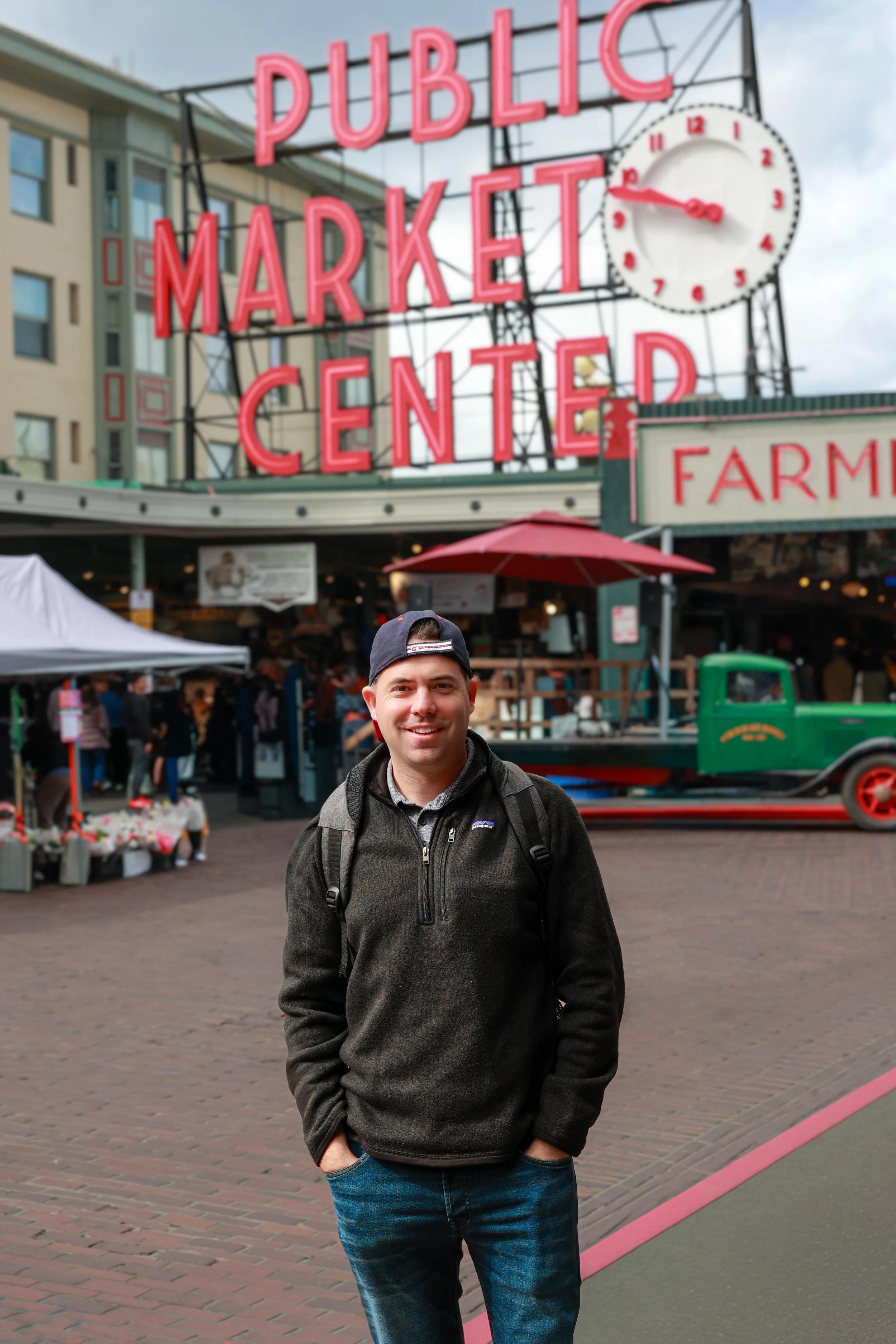
This is me, outside Pike Place Market, standing under the iconic Public Market Center clock and neon sign — the same clock that's been keeping time over the market since the 1920s.
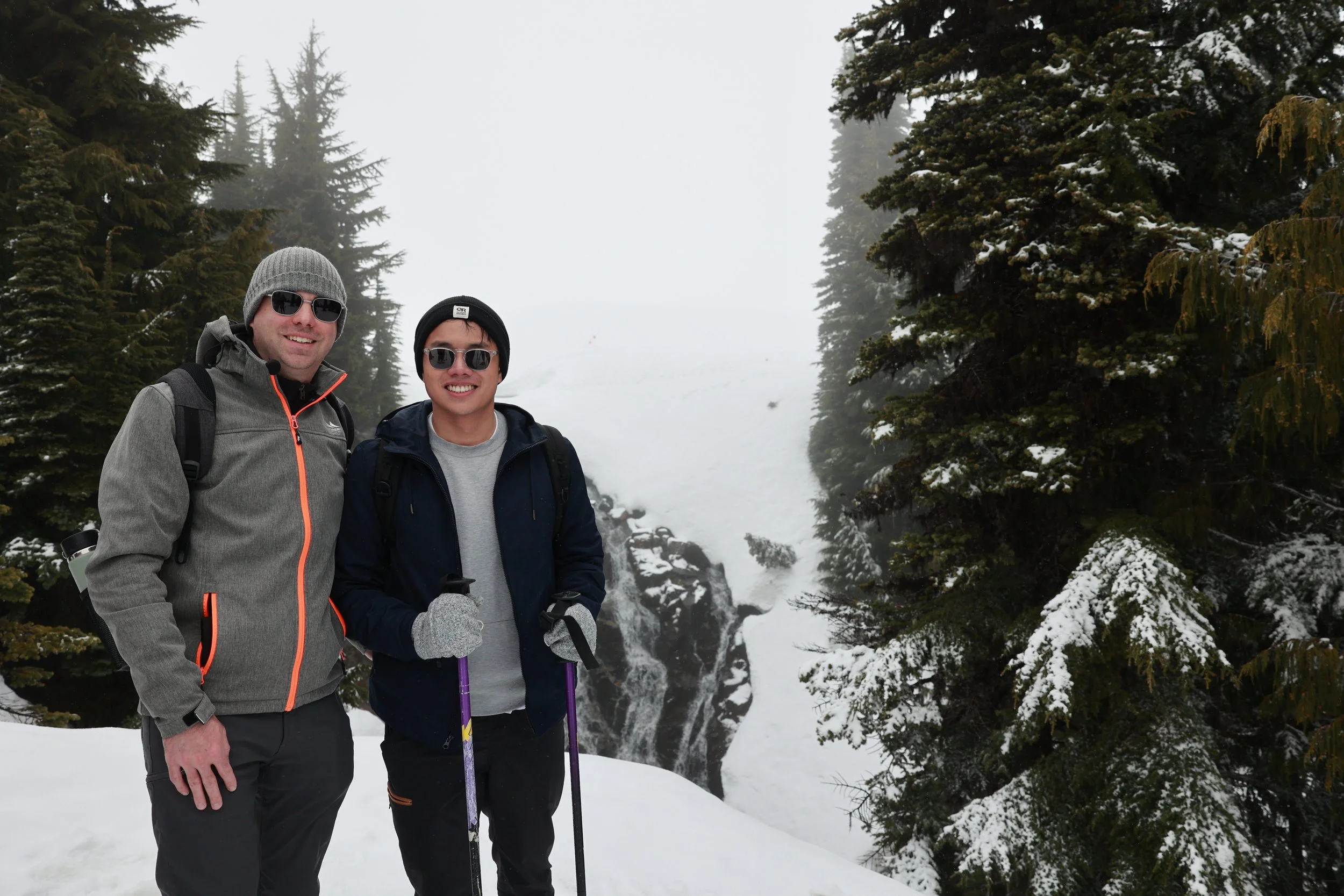
Two guys bundled up in the fog on Mount Rainier — proof that "May visit" and "clear summit views" don't always go together.
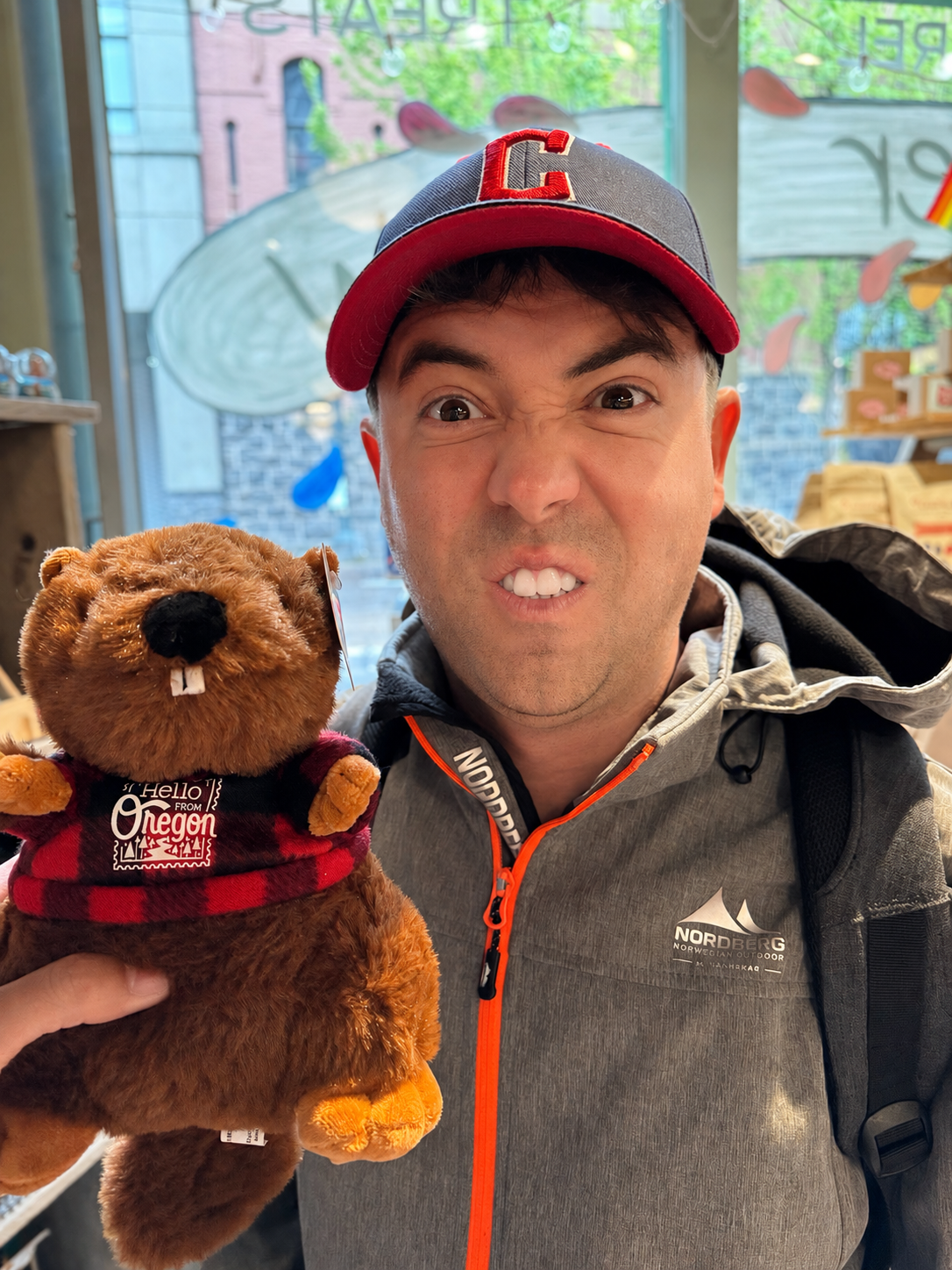
A very serious photo with a not-at-all-serious plush beaver, "Hello from Oregon" sweater and all — Portland gift shop energy, captured perfectly.