
San Juan, Puerto Rico
Proudly Puerto Rican: A Week in San Juan
Bradley and I left our dog with my parents in Florida (sorry, buddy!) and flew into San Juan with a loose itinerary and an aggressively long list of mofongo recommendations. What we came home with was a week that stacked 500 years of history under every meal, every swim, and every conversation we had. Also, considerably more rum knowledge than we walked in with. Grab a drink (piña colada, obviously) and settle in.
Old San Juan, One Cobblestone at a Time
Every good San Juan trip starts the same way: a walking tour of Old San Juan, and a quiet apology to your calf muscles for what the cobblestones are about to do to them. The city was founded by Spanish settlers in 1521, which makes it the oldest city under the U.S. flag — older than anything you'll find on the mainland, and it shows. Within a few decades, the Spanish crown started fortifying the place against English and Dutch raiders, and what's left standing today is genuinely impressive: nearly the entire original city wall, two massive forts, and streets paved in blue-tinted adoquines — stones that started their careers as ballast in the hulls of Spanish ships crossing the Atlantic before someone decided they'd make a nice road.
Naturally, we couldn't walk past Castillo San Felipe del Morro and Castillo San Cristóbal without stopping. Repeatedly. For photos. If you've never tried to angle a fortress and the Atlantic Ocean into the same frame while also not losing your hat to the wind, add it to the bucket list. El Morro guards the mouth of the bay, six levels of stone built up over 250 years to repel attacks by sea, and it never really lost a fight from that direction. San Cristóbal, a twenty-minute walk east, is the bigger of the two — by acreage, it's the largest fortification the Spanish ever built anywhere in the Americas. What eventually changed San Juan's fate wasn't a cannonball. It was 1898 and the Spanish-American War, which handed Puerto Rico over to the United States without a shot fired at these walls.
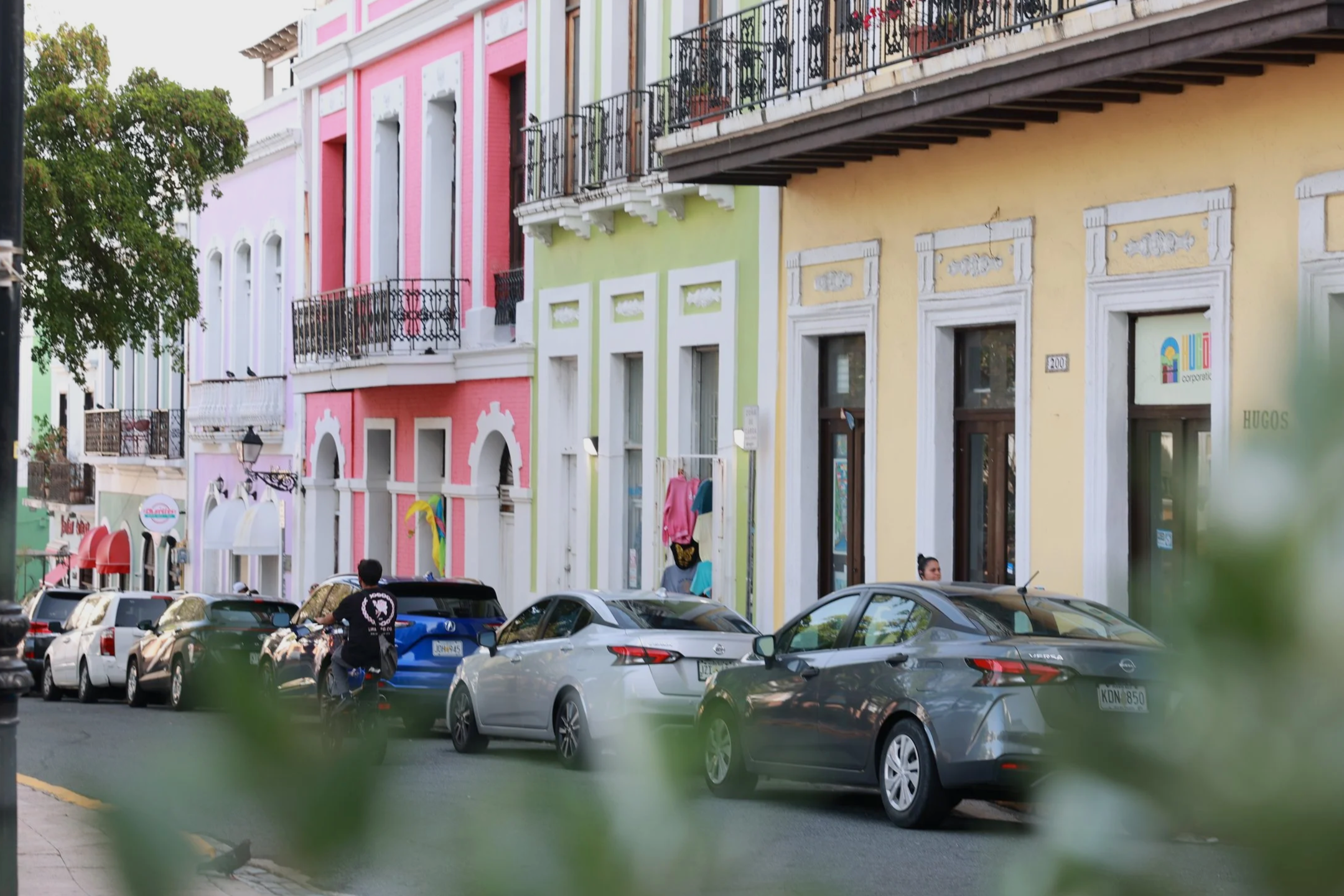
This is the row of colorful colonial facades on Calle Fortaleza in Old San Juan, featuring the pastel and coral-pink buildings with ornate iron balconies that make the district one big postcard.
Somewhere between forts, we stopped walking and just stared at the buildings for a while. This is a completely valid Old San Juan activity in its own right, if you ask us. The whole district is a wall-to-wall postcard: mustard yellows, coral pinks, seafoam greens, and the occasional shade that looks suspiciously like it was named "Tropical Regret" at the paint store, all packed shoulder to shoulder along narrow streets. Second-floor porches and balconies, wrapped in ornate ironwork, hang low enough over the sidewalk that you half expect someone to lean out and hand you a piña colada. None of it is accidental. Old San Juan is a designated National Historic Landmark district, and the Institute of Puerto Rican Culture has to sign off on exterior changes (paint colors included) before anyone touches a facade. That level of oversight is why the district still looks the way it did decades ago, and arguably why it still exists at all: in the late 1940s there was a real push to bulldoze the "decrepit" old buildings in favor of something modern, and it took a determined preservationist to convince the city that four-hundred-year-old buildings were a feature, not a problem. We're glad he won that argument. It made for excellent porch-staring.
Eating Our Way Through Old Town
The food tour was, hands down, the week's most enthusiastic workout for my stomach. We worked through a string of cafes and hole-in-the-wall spots in Old Town, hitting the staples one plate at a time — alcapurrias, bacalaitos, tostones, and enough mofongo to make some deeply questionable life choices. Mofongo, for anyone unfamiliar, is mashed fried plantain, usually loaded with garlic and pork cracklings and built into a bowl around shrimp or stewed meat. By day three it had turned into a full-blown competition: which restaurant had the best version. We never crowned a winner. We are, however, very qualified judges now.
We were staying at the Caribe Hilton, which happens to have a drink of its own to defend. The hotel's bartender, Ramón "Monchito" Marrero, is credited with mixing the very first piña colada there in 1954 — rum, coconut cream, and pineapple juice, blended into what officially became Puerto Rico's national drink in 1978. Old San Juan tells a different story: a plaque outside Barrachina restaurant (yes, we ate there!) claims the honor for 1963. We treated this as a research assignment and sampled both, several times, in the name of journalistic integrity. No conclusions were reached. Several piña coladas were, though.
Meeting the Bat: Casa Bacardí
No trip to San Juan is complete without paying respects to the bat, and I don't mean the flying kind you might find in a cave (more on that shortly). Casa Bacardí sits across the bay in Cataño, a short ferry ride from Old San Juan, and it's known locally as the "Cathedral of Rum" — a fitting title, given it's the world's largest premium rum distillery. The Bacardí family started distilling in Santiago de Cuba back in 1862, and after decades of expansion, they built out the Puerto Rico operation in the 1930s. Today it's the beating heart of the brand.
The tour walks you through the family's history, the aging process, and the story behind that iconic bat logo — inspired, appropriately, by fruit bats roosting in the rafters of the original distillery. It concludes with a guided tasting, which is either the best or worst part of the tour depending on how the rest of your day is planned. Between the history lesson and the cocktail in hand, it's easily one of the more entertaining "museum" visits either of us has ever done.
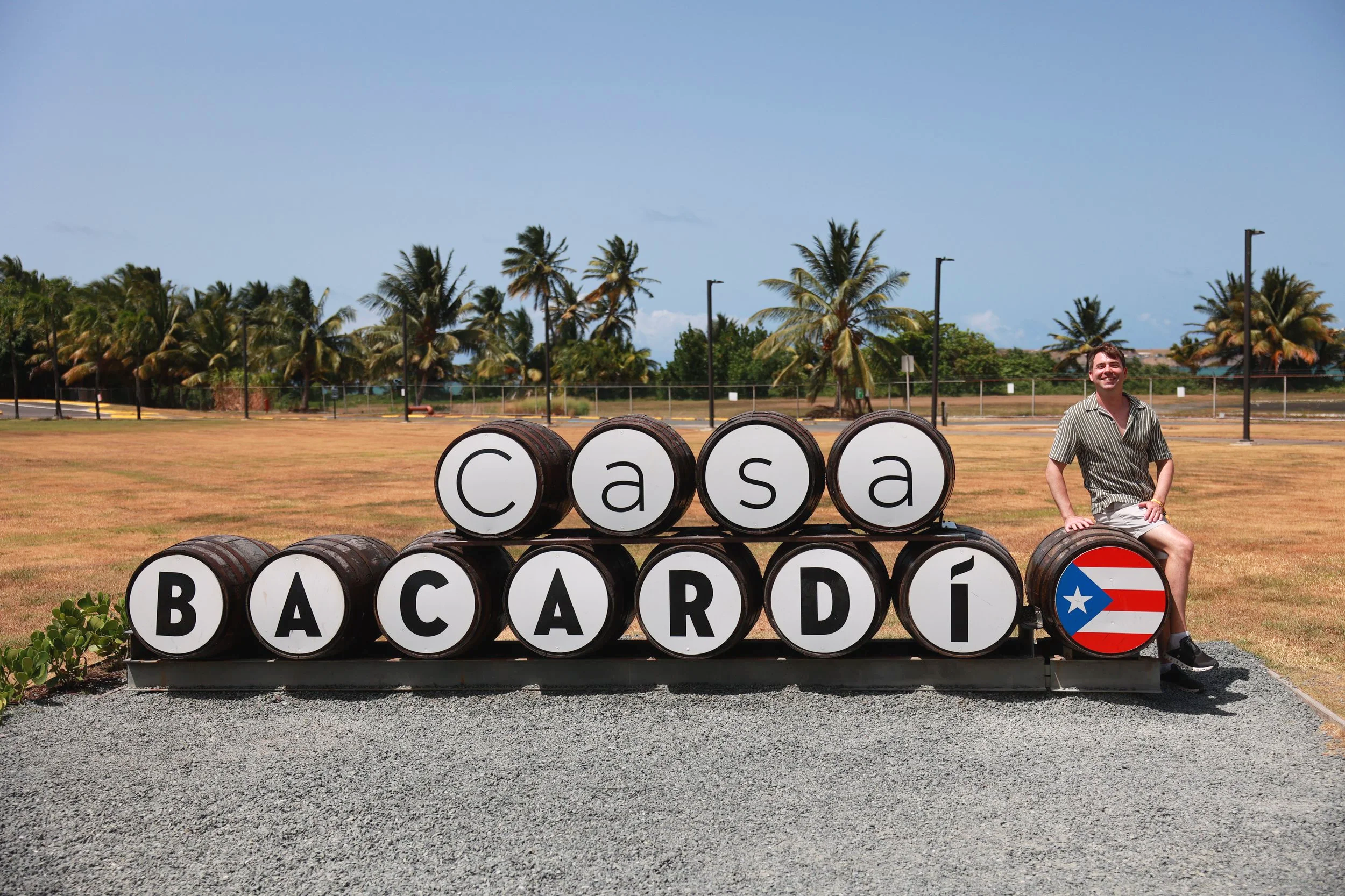
This is me smiling before our tour at Casa Bacardí, which sits directly across San Juan Bay from Old San Juan and is reachable by a short ferry ride.
The Bay by Sail
One afternoon we traded cobblestones for water and took a sail across San Juan Bay. Seeing El Morro and the city walls from sea level reframes the entire tour. You understand instantly why the Spanish built where they did. The fort sits on a bluff at the harbor mouth, positioned to spot trouble from miles out, and from the water it's obvious this was one of the most defensible ports in the Caribbean. That's exactly why Spain held onto Puerto Rico for nearly 400 years while other colonies in the region changed hands repeatedly. Also, and I cannot stress this enough: it is an extremely good spot for a sunset photo.
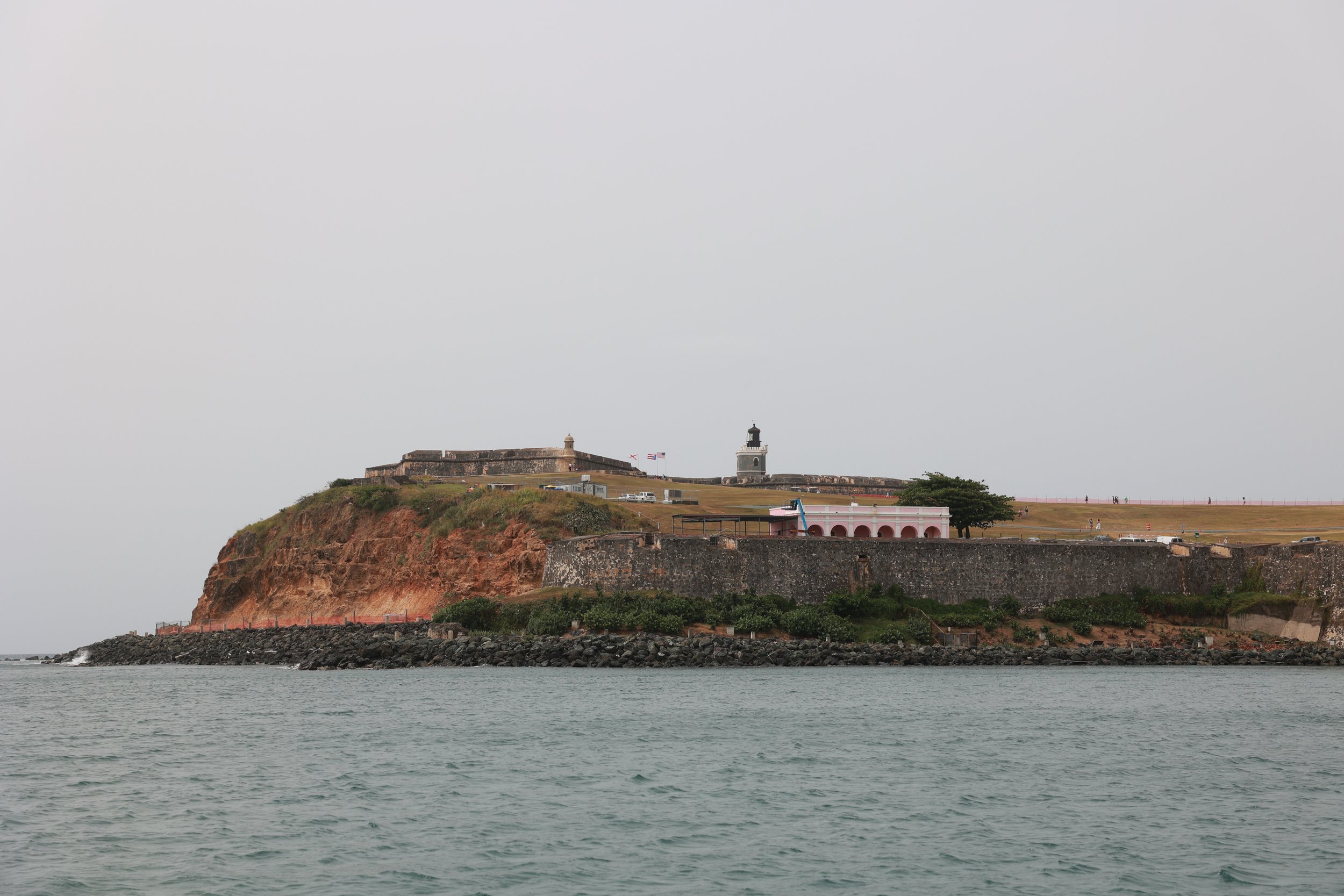
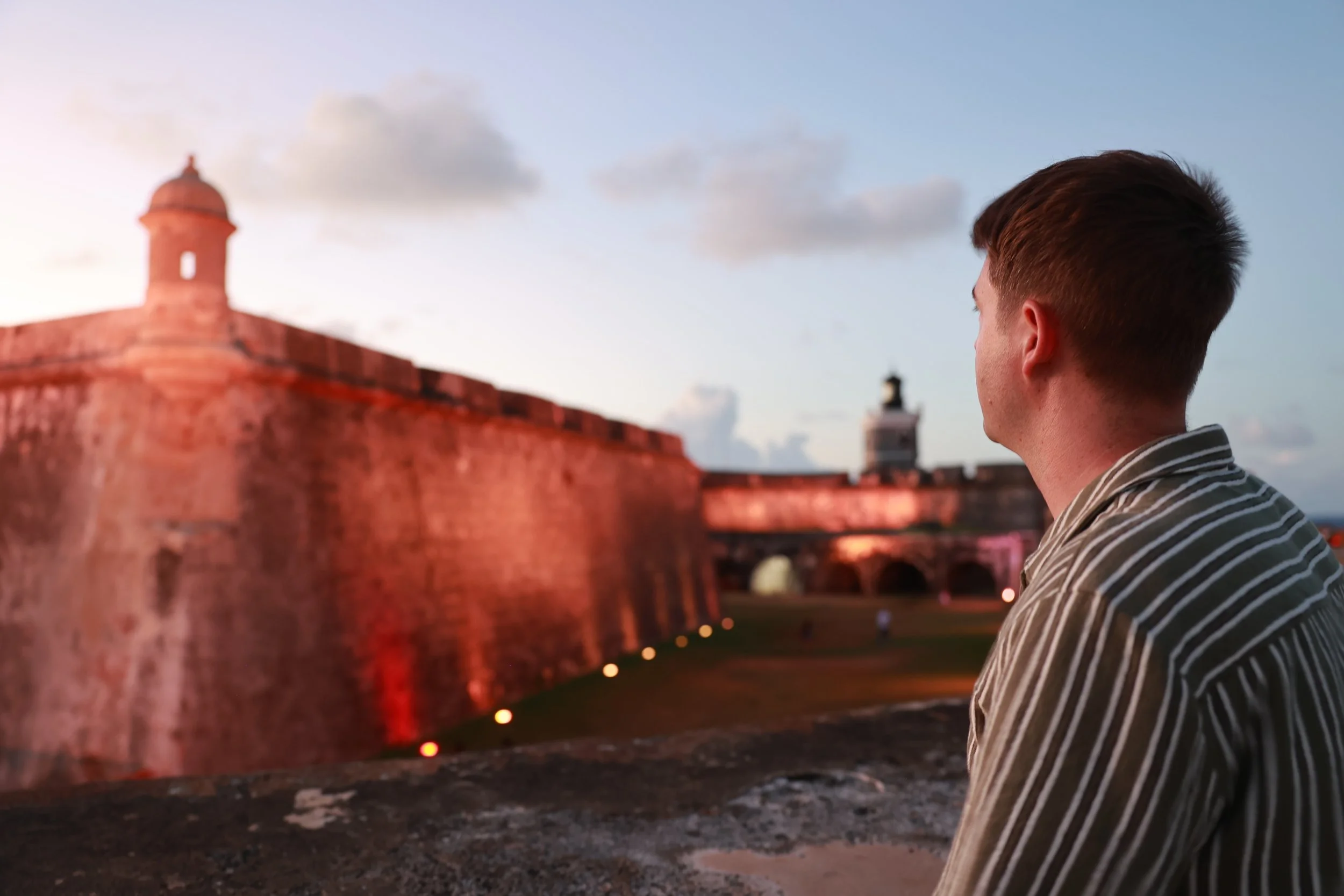
Castillo San Felipe del Morro guards the mouth of San Juan Bay — six levels of stone built up over 250 years, its sentry box still watching the same waters it was designed to defend against English and Dutch raiders.
Caves, Rivers, and a Waterfall
We rounded out the week with a day trip to the Arenales Caves and Charco Azul, out in karst country near Vega Baja. It's a completely different Puerto Rico from the one you see in Old Town — limestone caves carved by underground rivers, actual bats overhead (the promised non-Bacardí kind), Taíno petroglyphs still visible on the rock walls, and a hike down to a turquoise pool fed by a waterfall we swam straight into. The Taíno were the island's original inhabitants long before Columbus arrived in 1493, and their fingerprints are still everywhere here. You’ll find them in place names, in food, in carvings that have outlasted the empire that came after them. Between the swim and the scenery, it was the one day of the trip that had nothing to do with hotels, forts, or restaurant menus, and it might have been our favorite of the whole week.
What We Missed (So You Don't Have To)
No single week covers Puerto Rico. The island is bigger and more varied than the San Juan postcards let on, and there's a short list of things we didn't get to that came up constantly enough in conversation that they're clearly non-negotiable for next time. Don't make our mistake and skip these:
El Yunque National Forest — about 40 minutes from San Juan, and the only tropical rainforest in the entire U.S. National Forest System. Waterfalls, hiking trails, and a very good excuse to get out of the city for an afternoon.
Mosquito Bay, Vieques — widely regarded as the brightest bioluminescent bay in the world. Paddle out on a moonless night and the water lights up blue with every stroke. We heard about this one from three separate locals, unprompted, which is about as strong a recommendation as it gets.
Flamenco Beach, Culebra — a short ferry ride out to an island beach that regularly gets ranked among the best in the world. Bring your own shade; there's none on the beach itself.
La Ruta del Lechón, Guavate — a mountain stretch south of San Juan lined with roadside lechoneras slow-roasting whole pigs. If mofongo was our week's obsession, this is apparently the next level.
We'll be back for all of it. Consider this your permission slip to plan a few extra days.
What We Took Home
We came to Puerto Rico already aware that its relationship with the mainland is complicated: a U.S. territory whose people are U.S. citizens but have no vote in Congress and no electoral votes for president, a status that's been debated since 1898 and shows no sign of settling any time soon. What we didn't expect was how openly people would talk about it, or how consistently that conversation landed in the same place. Statehood, independence, staying the course — whatever someone's politics, the answer to "what are you" never wavered: Puerto Rican, first and completely. Curious if you've noticed the same thing elsewhere. Drop a comment if you've seen identity hold steady somewhere you've traveled, even when the politics didn't.
Status and politics aside, that pride showed up everywhere: in flags hanging from porches, in music spilling out of every other doorway in Old Town, and in the care people took explaining their food, their forts, and their island's four-hundred-year run of staying standing.
We landed for mofongo and piña coladas. We left with a much better understanding of what those things actually mean here — and a phone full of fortress shots, cobblestone close-ups, and a handful of spectacularly unflattering selfies we're weirdly proud of anyway.
Want the full visual tour? Head over to the photo gallery to see San Juan's forts, coastline, and colonial heritage for yourself — and if you've been to San Juan (or you're planning to go), I'd genuinely love to hear about it in the comments. Which piña colada origin story do you believe?
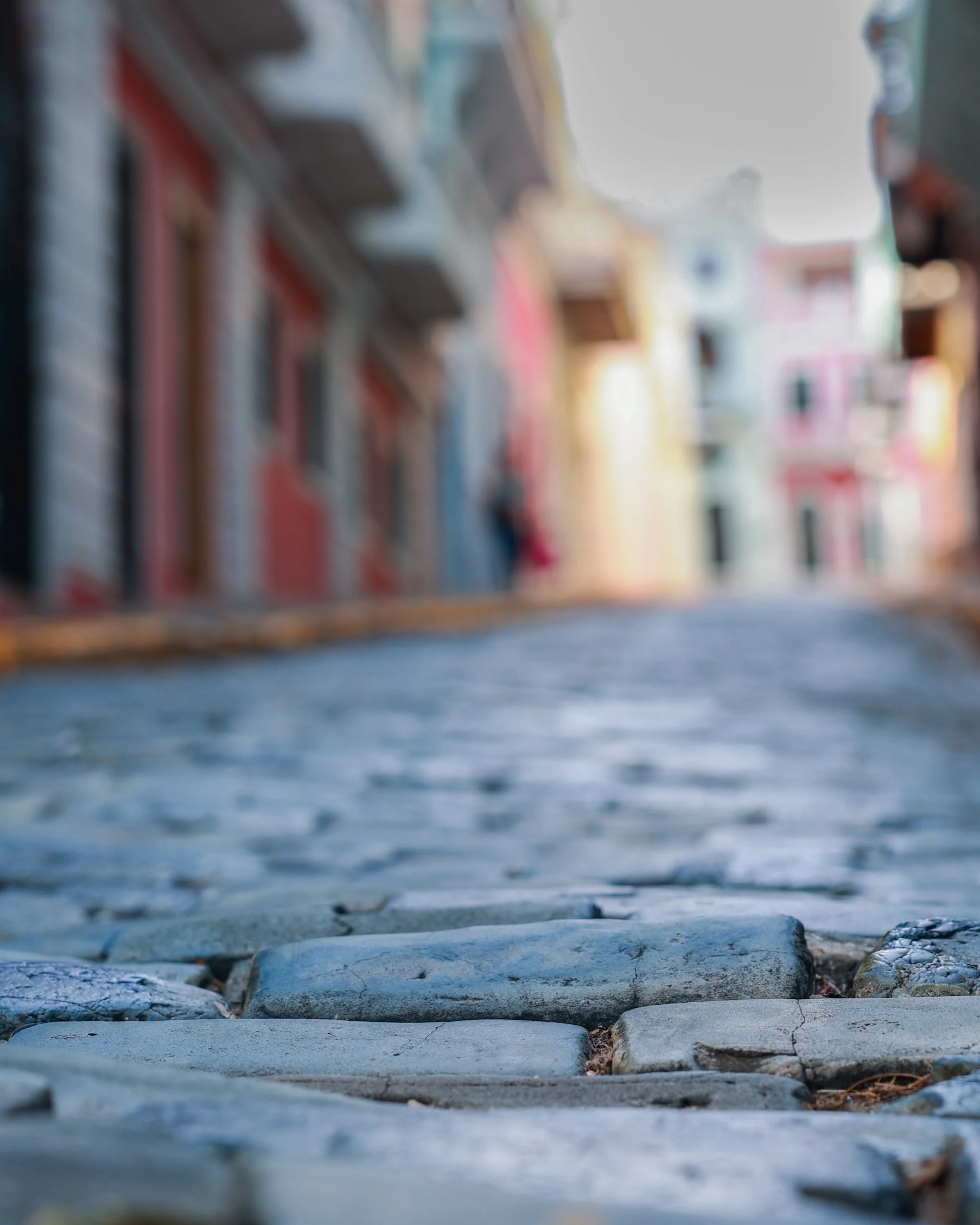
Known as “blue cobblestones,” adoquines get their blue-gray color from the stone’s composition and weathering. They line Old San Juan’s streets, their worn surfaces reflecting centuries of foot traffic, carriages, and sea weather. Walking them connects you to colonial architecture, urban resilience, and the island’s heritage—photogenic, textured, and central to the neighborhood’s character.
Thanks for reading my blog on San Juan! Drop me a note if you’re ready to go!